

Robinhood reported total net revenue of $1.31 billion for the second quarter ending June 30, a 32% year-over-year increase. However, the market was more focused on the slowdown in its crypto business and the fact that some of its profits came from one-time gains, causing its stock price to fall after the earnings release.
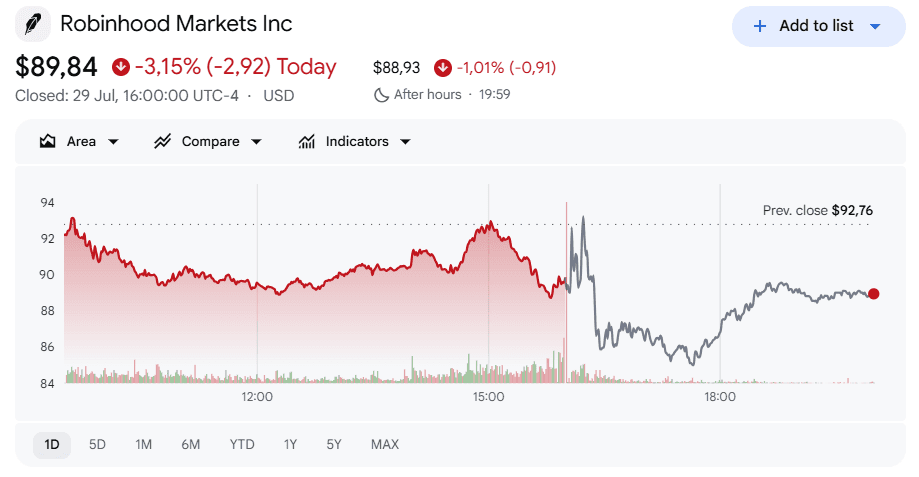
On July 29, Robinhood closed at $89.84, down 3.15% from the previous trading day. In after-hours trading, the stock price continued to fall by approximately 1.01% to around $88.93.
Net profit increased, but included one-time gains.
The company disclosed that its net profit in the second quarter increased by 48% year-on-year to $573 million, with diluted earnings per share of $0.62.
However, this result includes a $129 million gain, primarily related to the deconsolidation of Robinhood Ventures Fund I. This gain contributed approximately $0.14 per share to earnings and has kept the market cautious about core profitability.
Event contracts have become the fastest-growing business.
Trading-based revenue grew 44% year-over-year to $776 million, primarily driven by event contracts, options, and stock trading.
Event contract revenue reached $156 million, more than 10 times that of the same period last year. During the quarter, users traded over 13.6 billion event contracts. Rothera, a CFTC-licensed trading and clearing joint venture between Robinhood and Susquehanna, has processed over 3.5 billion contracts since its launch in June.
Options revenue increased 29% year-over-year to $342 million, while stock trading revenue increased 95% year-over-year to $129 million. Net interest income increased 9% to $389 million, and other income increased 54% to $143 million, primarily driven by revenue from Trump Account services and Robinhood Gold subscriptions.
Crypto revenue declines, overseas expansion continues.
Compared to other businesses, Robinhood's crypto transaction revenue declined 38% year-over-year to $100 million. The company's notional crypto transaction volume for the quarter was $40 billion, with the main app contributing $18 billion and Bitstamp contributing $22 billion.
Crypto transaction volume within Robinhood's main app declined by 35% year-over-year, while Bitstamp accounted for more than half of the company's crypto activity that quarter. This suggests that Robinhood's current crypto business growth relies more heavily on external platforms acquired through mergers and acquisitions.
Despite revenue pressures, Robinhood continues to advance its digital asset business. The company has launched the Robinhood Chain public mainnet, introduced equity tokens to eligible customers in more than 120 countries and regions, and launched Robinhood Earn, a decentralized lending product within the app.
The company also completed its acquisition of WonderFi, officially entering the Canadian market through regulated platforms such as Bitbuy and Coinsquare. Robinhood stated that it has over 1 million international depositors and plans to launch its crypto service in the UK, but has not yet announced a specific timeline.
Additional information:In Robinhood's disclosed crypto transaction volume this quarter, Bitstamp contributed more than the main app, indicating that its mergers and acquisitions have begun to directly impact the scale of its digital asset business.