



















Foreign media commentators believe that Stacks is attempting to address a long-standing problem in the crypto market: increased protocol usage does not necessarily translate into token demand. Its upcoming Bitcoin Staking product is designed to directly link BTC participation to STX demand, which is a major reason for the market's reassessment of STX.
Currently, the proportion of Bitcoin that can be "effectively utilized" in the crypto market remains very low. The article cites data from Binance Research stating that less than 1% of the total supply of BTC is used in DeFi and other scenarios, significantly lower than the staking ratios of Ethereum and Solana. Whoever can channel this dormant Bitcoin capital into yield-generating scenarios is likely to gain an advantage in the next phase of Bitcoin financial competition.
How to connect Bitcoin Staking with STX
According to the article, Stacks' Bitcoin Staking allows BTC holders to earn BTC-denominated returns without transferring custody, with a target annualized return of approximately 3%. The BTC remains on the Bitcoin main chain and in the user's own address, without needing to be packaged, cross-chained, or handed over to a third-party custodian.
The revenue does not come from the issuance of new tokens, but from the BTC paid by Stacks miners under the Proof of Transfer (PoX) mechanism. To join, participants need to bind approximately 5% of their BTC position to STX, with a lock-up period of about 6 months. The article argues that the key to this design is not the yield itself, but that every BTC participation simultaneously generates STX demand.
The first sample of institutional funds has emerged.
The article mentions that named institutions have already participated. UTXO Management, a subsidiary of Nakamoto Inc. specializing in Bitcoin asset management, has pledged to allocate funds to Bitcoin Staking. Nakamoto Inc. itself is a publicly traded Bitcoin treasury company holding 5,398 BTC.
However, Stacks isn't the only project vying for this type of funding. Babylon, Core, and Lombard have already launched similar products, with Babylon currently attracting a significantly larger amount of BTC. The article argues that Stacks' differentiator lies in the fact that the BTC doesn't leave the Bitcoin mainnet, and the source of revenue can be independently verified, making this structure more acceptable to institutions.

- If 5,000 BTC are involved, the STX value to be tied up would be close to $16 million.
- If the scale increases to over 40,000 BTC, the corresponding STX demand would be approximately $127 million.
- Compared to Stacks' market capitalization of approximately $270 million, this size already has a significant impact.
Whether the institution will continue to follow up remains to be seen.
The article argues that STX is more attractive to institutions not only because of its binding mechanism but also because of its earlier established compliance foundation. STX was the first token to be issued compliantly under the US SEC Reg A, and there are already products like Grayscale Stacks Trust in the US and 21Shares Stacks Staking ETP in Europe.
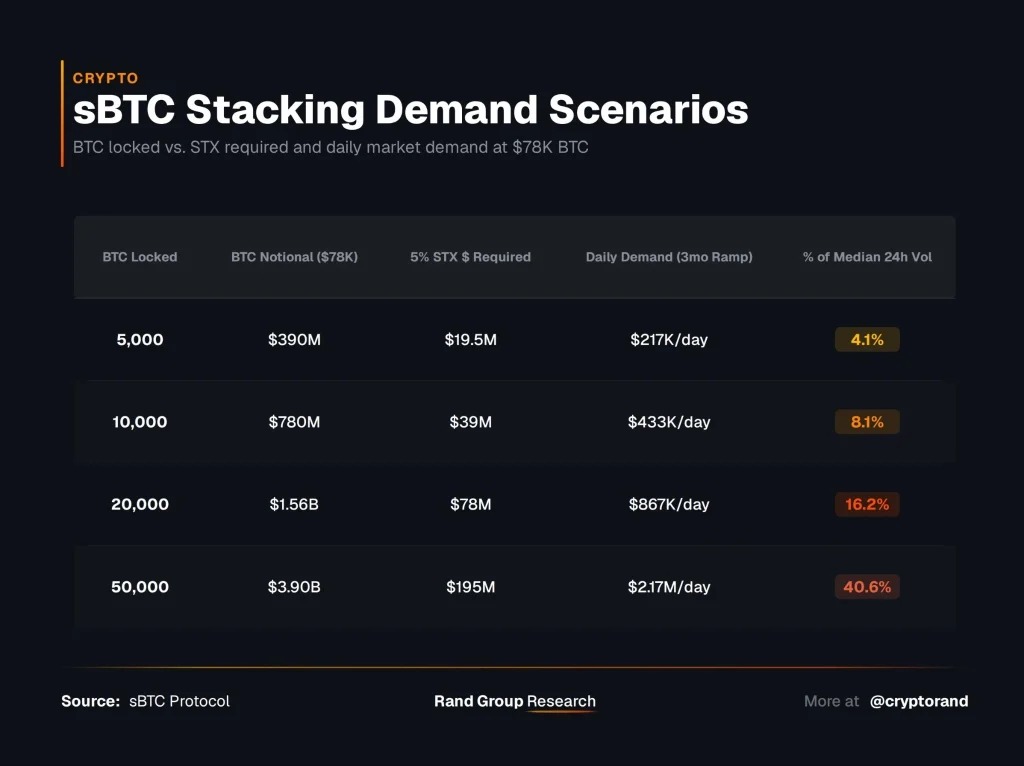
Regarding token supply, the article states that most of the STX early investor and team allocations have already been unlocked, resulting in relatively low pressure for large-scale unlocks in the future, and the inflation rate is lower than the average level of the top 50 tokens by market capitalization. Meanwhile, nearly 30% of the STX supply is locked in the existing Stacking mechanism, meaning the circulating supply is relatively thin, and price elasticity could be amplified should new binding demand emerge.
However, the article also emphasizes that this logic is still in its early stages. Currently, only UTXO Management has publicly disclosed as an institutional participant, and its calculations reflect more of a potential ceiling than a realized growth path. Whether Babylon can become a replicable model, and whether Stacks can attract a similar rate of BTC inflow after its launch, remains to be seen in actual adoption over the next few quarters.


