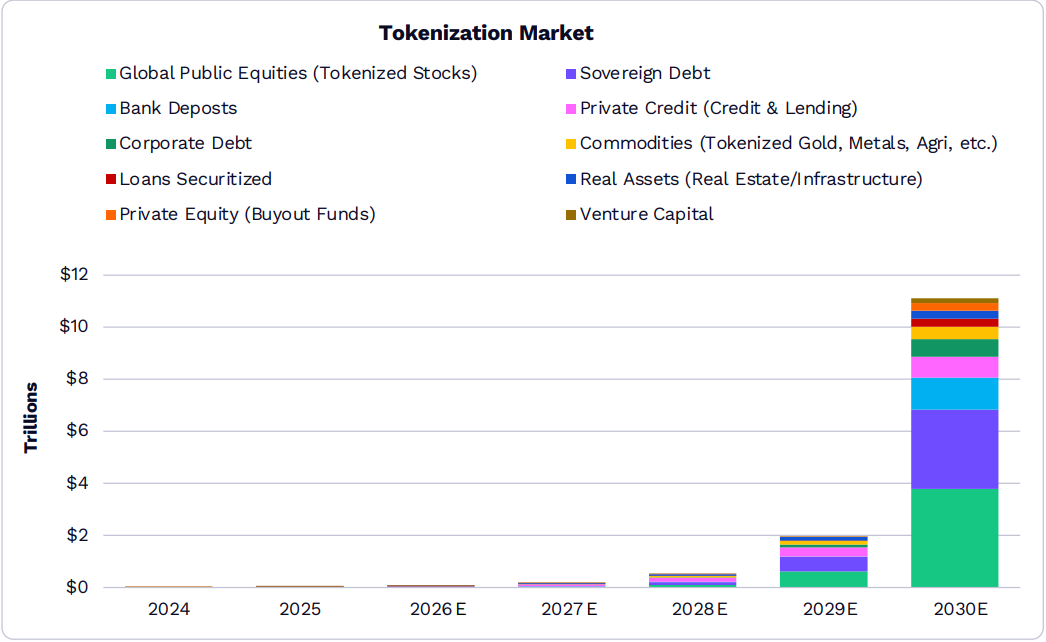


XRP Ledger is expanding its positioning from a payment network to an institutional-grade tokenization infrastructure. As the market for real-world asset tokenization heats up, XRPL is simultaneously advancing wallet distribution, stablecoin settlement, and AI trading scenarios, attempting to attract more financial institutions and developers to its ecosystem.
XRPL bets on institutional-grade tokenization
Trensik, the RWA platform surrounding the XRPL ecosystem, stated that institutions value readily usable on-chain infrastructure rather than upgrade promises that remain in the roadmap stage. According to them, XRPL already possesses several fundamental capabilities commonly found in institutional tokenization, including native asset issuance, on-chain DEX, compliance-related functions, second-level settlement, and Ripple's USD stablecoin RLUSD.
The article mentions that these capabilities can be used to support the issuance, trading, and settlement of assets such as US Treasury bonds, real estate, private credit, and corporate bonds. Related transactions can be completed using XRP or RLUSD, thereby shortening settlement times and reducing counterparty risk.
The size of tokenized US Treasury bonds rose to $418 million.
The scale of real-world asset tokenization on XRPL is also growing. The article states that in the past year, the scale of tokenized US Treasury bonds on XRPL has increased from approximately $50 million to over $418 million, an increase of about eight times.
- A year ago, the size was approximately $50 million.
- The latest size exceeds $418 million.
- The corresponding increase is approximately 8 times.
This change is seen as institutional recognition of the network's ability to support real-world financial products. For XRPL, if it can continue to attract more traditional assets to the blockchain, its role will no longer be limited to cross-border payments, but will extend to a more complete on-chain financial infrastructure.
LOBSTR integration expands wallet distribution.
Regarding ecosystem expansion, LOBSTR Wallet has added support for XRPL through its partnership with XRPL Commons. LOBSTR is one of the most widely used wallets in the Stellar ecosystem, with over 1.5 million users, according to the article, and it supports both iOS and Android.
The initial phase of functionality includes holding and transferring XRP and XRPL tokens, managing multiple XRPL wallets, viewing complete transaction records, and performing cross-chain exchanges between Stellar and XRPL. Users can also buy and sell RLUSD through integrated fiat currency deposit and withdrawal channels.
This means that XRPL has gained a ready-made wallet entry point, and further strengthens its interoperability with the Stellar ecosystem.
RippleX is optimistic about the growth of AI-assisted transactions.
In addition to wallet integration, RippleX also sees AI as a key driver of future on-chain activity. The article cites its engineering lead as saying that currently, XRPL sees approximately 1 million transactions handled by autonomous AI agents, a figure that could increase to 10 million to 100 million in the coming years.
As AI agents begin to execute payments, purchase digital services, and interact with tokenized assets more frequently, low-cost, fast-confirmation on-chain settlement networks will become increasingly important. XRPL attempts to address this demand with fast settlement, native tokenization tools, on-chain liquidity, and RLUSD support.
Overall, XRPL is simultaneously advancing RWA, stablecoins, wallet entry points, and AI-powered trading scenarios. If this expansion continues, its presence in institutional digital financial infrastructure may further increase.