

Anthropic released its new model, Opus 5, on July 24th. Unlike the typical upgrade path for larger models, this version focuses on being smaller and cheaper, and it surpasses the higher-spec Fable 5 in multiple tests, thus quickly attracting the attention of developers.
Priced below Fable 5
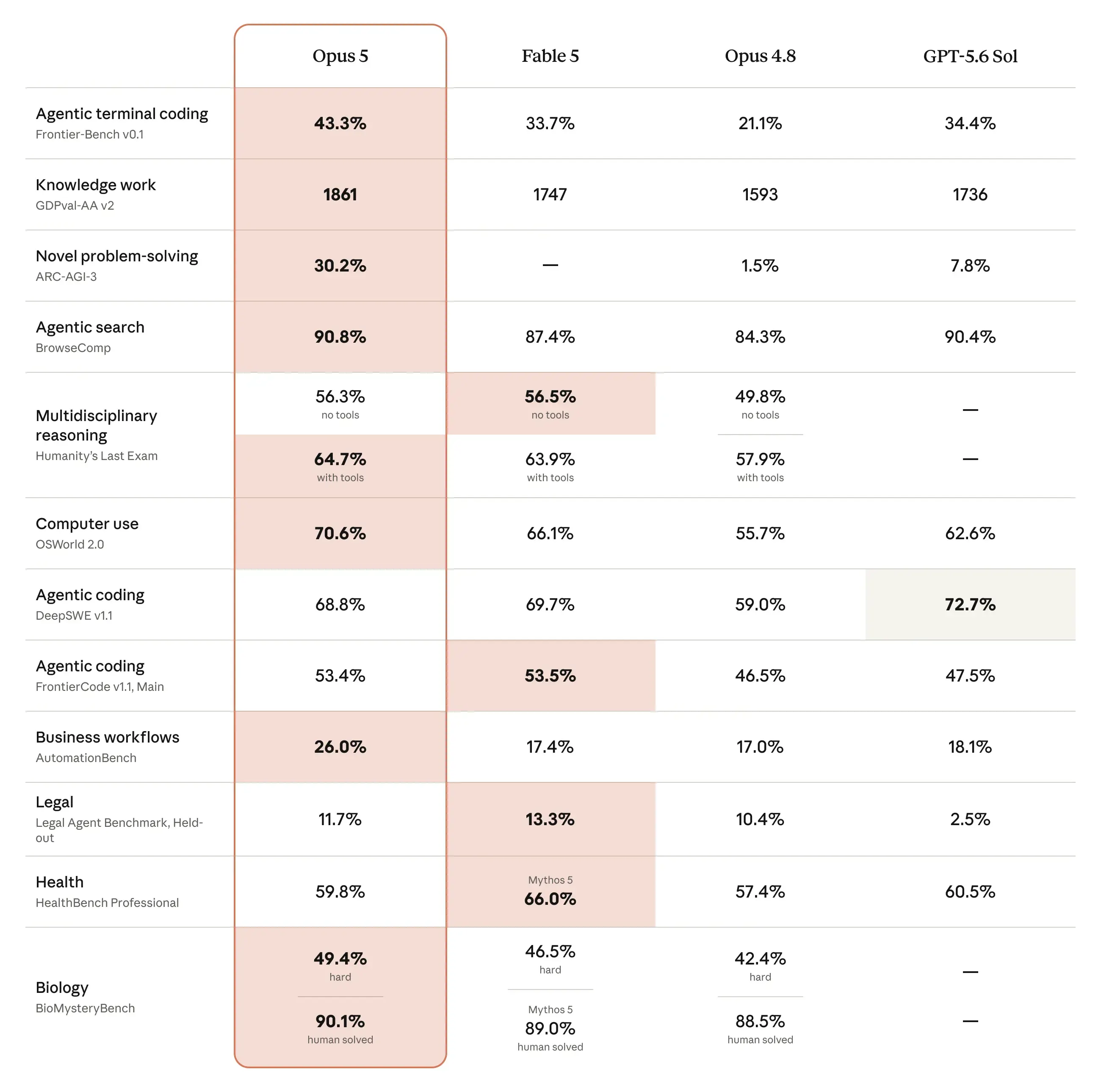
According to information released by Anthropic, Opus 5 is priced at $5 per million input tokens and $25 per million output tokens, on par with Opus 4.8 but lower than Fable 5. Ars Technica, citing benchmark tests, reports that Opus 5 is roughly equivalent to Fable 5 in programming tasks, with a slight lead in some projects.
The report also stated that Opus 5 outperformed Opus 4.8 and OpenAI's GPT-5.6-Sol in more task categories. For enterprise users, the focus of this update is not just on enhanced capabilities, but also on achieving higher availability performance at the same or lower cost.
30-day data retention does not apply
The Opus 5 comes just two months after the release of Opus 4.8. Previously, Anthropic had already launched the Mythos 5, Fable 5, and Sonnet 5 in June. With the release of the Opus 5, Anthropic's main model line has essentially completed a round of updates, with only the lightweight Haiku yet to be included in the 5 series.
Regarding data processing, Opus 5 does not use the 30-day data retention policy adopted by Fable and Mythos. This is consistent with Opus 4.8. For enterprise customers who value privacy and compliance, this reduces concerns during onboarding and may influence model selection.
Foreign media outlets point out that the reduced restrictions are related to the training method. Anthropic did not provide Opus 5 with cutting-edge training on high-risk cybersecurity tasks, therefore the model is weaker than Fable and Mythos in scenarios such as vulnerability exploitation. The lower risk ceiling also means it does not need to be configured with equally strong restrictions.
Security interception frequency decreased by 85%.
Anthropic has set clear boundaries for Opus 5. For example, the model cannot be used to scan for vulnerabilities in software binaries, but it can be used to scan source code to support defensive security efforts. The company anticipates that Opus 5's security classifier will trigger 85% less frequently than Fable 5.
For developers, this means significantly fewer API call interruptions in production environments and a more stable workflow. To further reduce call failures, Anthropic has also launched a beta feature called Automatic Fallbacks. When enabled, if a request triggers a safety classifier, the system will not directly return an error, but will automatically switch the request to a weaker model and continue to provide usable results.
Foreign media reports indicate that the Chinese open-source weighted model Kimi K3 offers similar performance, with an output price of approximately $15 per million tokens. As model prices continue to decline, the cost advantage of a single product may be difficult to maintain in the long term, and the importance of API stability and user experience is increasing.