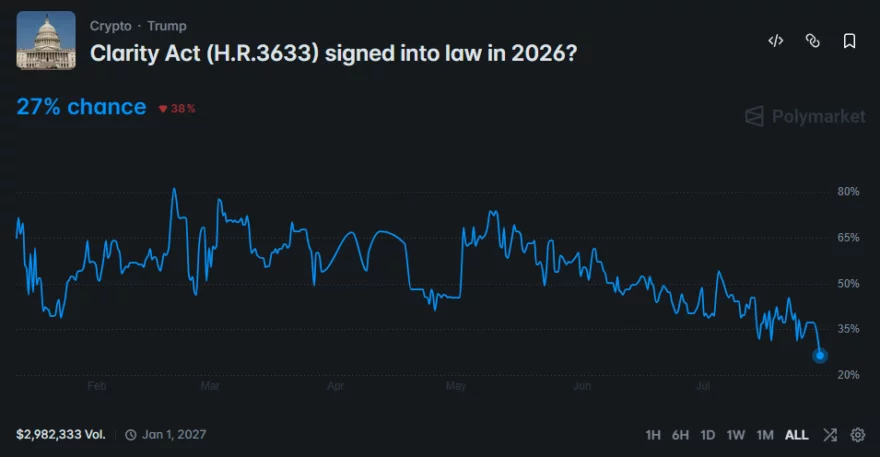
U.S. Securities and Exchange Commission (SEC) Chairman Paul Atkins stated that the SEC is prepared to introduce its own regulatory rules covering the crypto market if Congress fails to pass the Clarity Act. However, he also emphasized that what truly provides long-term stability is congressional legislation, not rule-making by the executive branch.
The bill has not yet reached a vote in the Senate.
In an interview with CNBC this week, Atkins stated that the SEC is "ready, willing, and able" to introduce alternative rules if legislation is stalled. He said that what the market needs is the certainty of written law so that the regulatory framework doesn't change with each administration.
The Clarity Act passed the House of Representatives in July of last year by a vote of 294 to 134, and was passed by the Senate Banking Committee in May of this year by a vote of 15 to 9. However, it has not yet reached the full Senate vote. The bill still needs to reach the 60-vote threshold to pass in the Senate.
Late last week, Senate Majority Leader John Thune told reporters that the bill was unlikely to pass Senate scrutiny before the August recess. The Senate subsequently shelved the bill.
The core change is the division of labor between the SEC and the CFTC.
According to the bill's design, exclusive regulatory authority over the spot market for digital commodities will be transferred to the U.S. Commodity Futures Trading Commission (CFTC). This means that most tokens may no longer fall under the direct regulatory purview of the SEC, and the digital commodity categories, including Bitcoin and Ethereum, will receive a clearer classification.
This is also one of the key points of the current legislative debate. The bill attempts to clarify the boundaries between the SEC and CFTC through congressional legislation, reducing the repeated classification of crypto assets between securities and commodities.
The SEC has prepared alternative plans.
Atkins noted that the SEC has actually prepared an alternative path in case the bill fails to pass. His "Project Crypto," launched last November, has developed into a rulemaking plan called "Regulation Crypto" and has been included in the SEC's 2026 agenda.
- Token registration exemption arrangement
- Safe Harbor Mechanism for Decentralized Projects
- Brokerage rules and trading venue requirements
Atkins previously described this plan as a transitional arrangement towards the Clarity Act. In other words, even if congressional legislation stalls, the SEC can still advance parts of the regulatory framework through executive rules.
However, Atkins also explicitly pointed out the limitations of this approach. The joint guidance issued by the SEC and CFTC in March of this year classified 16 tokens, including Bitcoin and Ethereum, as digital goods, but such arrangements are essentially still administrative measures.
Unlike congressional legislation, executive guidelines and institutional rules can be withdrawn or amended by a new administration without requiring a new vote in Congress. This is why Atkins repeatedly emphasizes that "legislation provides more certainty than rules."