


Foreign media reports that the pricing of crypto assets such as Bitcoin and Ethereum is no longer primarily determined by spot trading. CoinDesk commented that perpetual contracts now dominate in terms of trading volume and price discovery, while the spot market largely follows the fluctuations of derivatives.
Perpetual contract trading volume has significantly exceeded that of spot trading.
Perpetual contracts have no expiration date, allowing traders to hold their positions indefinitely, but they are required to pay or be charged funding fees periodically. The article states that these products currently account for approximately 93% of all cryptocurrency futures trading volume, and their daily trading volume often exceeds that of their corresponding spot markets.
In traditional futures, delivery at expiration drives the contract price back towards the spot price. Perpetual contracts lack this mechanism; their prices are primarily regulated by funding rates. When the contract price is higher than the spot price, long positions typically pay short positions to narrow the spread.
The article argues that this makes funding rates not only a tool for maintaining price anchors, but also a real-time signal of market sentiment, thus being regarded by many traders as an earlier indicator than simple prices.
Multiple studies point to the need for derivatives to come first.
CoinDesk, citing multiple market microstructure studies, states that Bitcoin prices often form first in the derivatives market before being transmitted to regulated futures and U.S. spot trading platforms.
One study published in the *Journal of Financial Markets* indicates that Bitcoin perpetual contracts on unregulated platforms play the strongest role in price discovery. Another study considers Binance's perpetual market as a major pricing source in the decentralized crypto market.
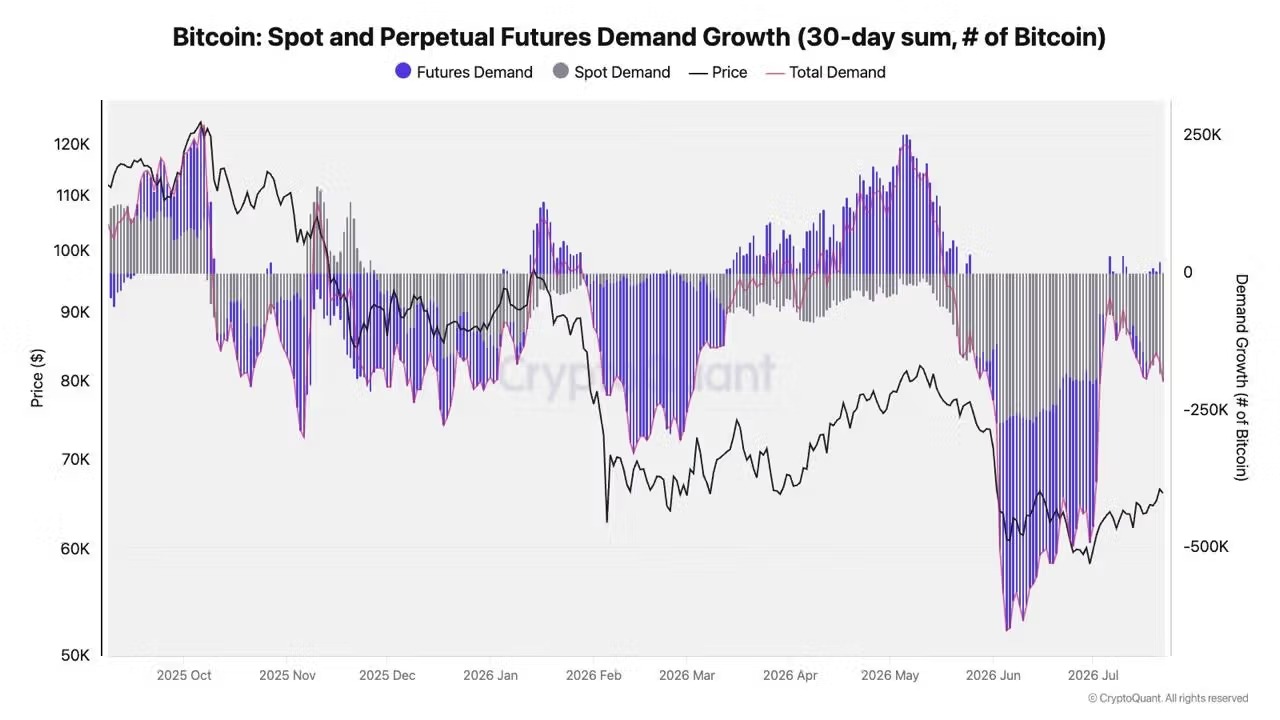
Julio Moreno, Head of Research at CryptoQuant, also stated that perpetual contracts typically lead spot prices during certain upward phases. He cited the Bitcoin rallies in January and April-May 2026 as examples, where spot demand contracted, but demand for perpetual contracts increased, and prices were still driven higher by the derivatives market.
The SpaceX contract amplified this phenomenon.
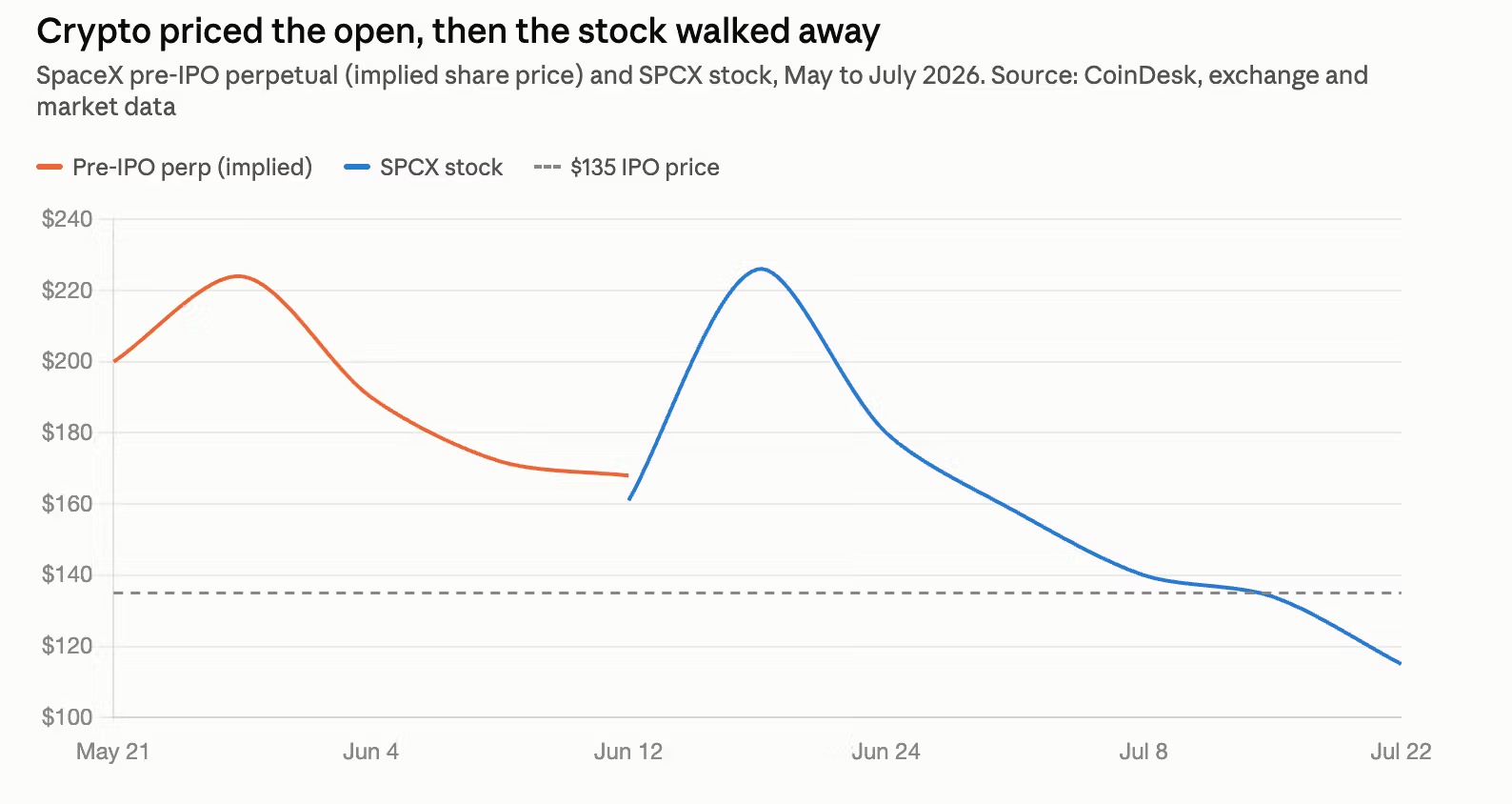
The article mentions that between May and June, several platforms launched synthetic perpetual contracts related to SpaceX, becoming an extreme example of this logic. The first to launch was the on-chain derivatives platform Hyperliquid, followed by Binance, Coinbase, BitMEX, Bitget, and OKX.
On the eve of the official trading of SpaceX-related stock products, the contract price on Hyperliquid and Binance was approximately $170 per share, significantly higher than the underwriters' offering price of $135. The following day, SPCX briefly rose above $176 during trading, closing its first day at $161, a 19% increase. The article argues that the perpetual market's assessment of first-day demand is closer to the actual trading results than traditional underwriting pricing.
However, the article also points out that while the sustainable market is better at pricing demand, it may not fully reflect changes in supply. SPCX has fallen more than 40% since its June high, and as of press time, it was trading at around $115, below its IPO price of $135.
CoinDesk argues that the SpaceX case merely amplifies this phenomenon: in the crypto market, prices are increasingly forming first in derivatives, with spot prices following suit. Whenever Bitcoin prices initiate a move or experience a rapid decline, funding rates tend to change first.