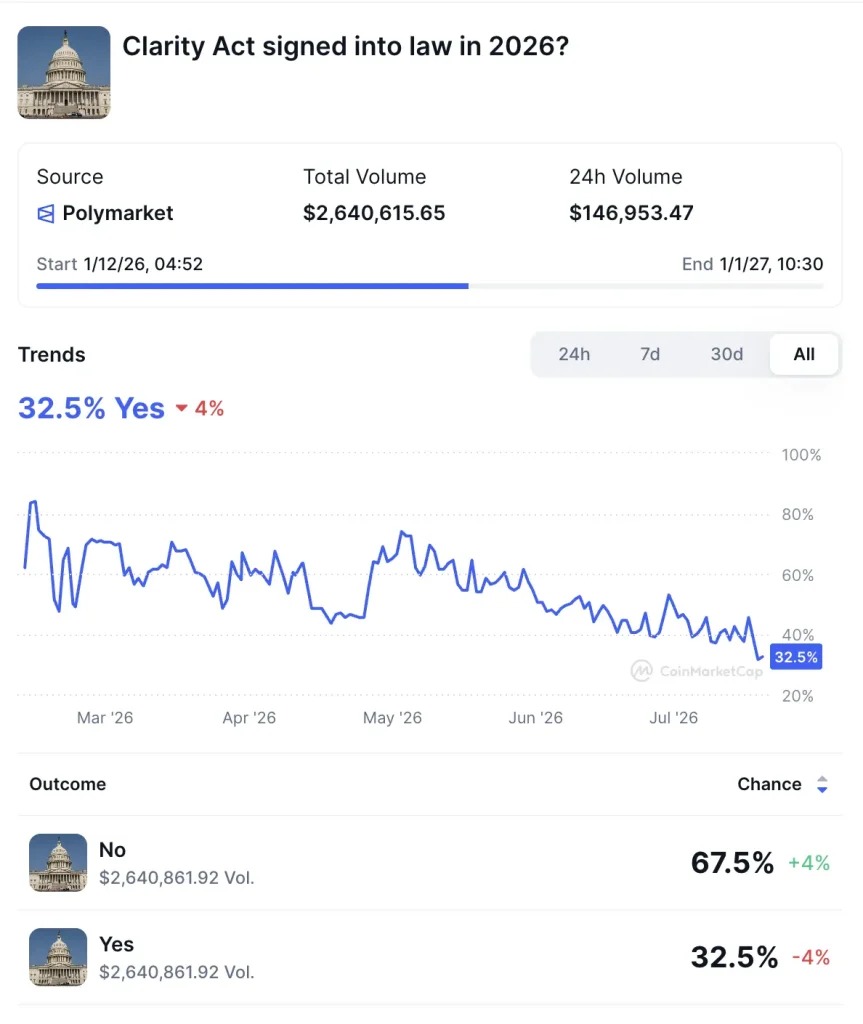


Foreign media reports indicate that negotiations in the US Congress regarding the Clarity Act on Digital Asset Markets have suffered another setback, with Senate Majority Leader John Thune stating that the bill will not pass before September. The article concludes that the bill's prospects for further progress in the current Congress are narrowing.
One of the focal points of the controversy is the "ethics" clause in the bill. This clause aims to restrict certain federal officials, including the president, from issuing cryptocurrency tokens during their term of office. Because Trump has a history of involvement in cryptocurrency issuances, this clause has put Republicans under greater political pressure in pushing the bill forward, leading to a stalemate in bipartisan negotiations.
Hopes will decline before September
If the bill fails to complete key procedures before summer, the window for further action will narrow further. The article argues that in election years, members of Congress typically focus more on campaigning in the fall. If the Democrats regain control of either house in a future election, the current version of the bill may struggle to advance to the next stage.
This means that the legislation on the US crypto market structure that the market had been anticipating may not yield a clear result in the short term. For the industry, core issues such as regulatory jurisdiction, token classification, and issuance paths are likely to remain controversial.
The design of the bill's classification system is under scrutiny.
The article further points out that even setting aside political obstacles, the Clarity Act itself has obvious problems with its institutional design. The bill attempts to establish a multi-layered, nested classification system for digital assets, including concepts such as "digital goods," "digital tokens," and "attached assets," and to distinguish which issuances or transactions are subject to securities laws.
Under this design, the primary sale of some network tokens may not be directly considered a securities transaction; however, if the token value still significantly depends on the management and operation activities of the issuer or related personnel, it may fall under stricter information disclosure and exemption requirements. The article argues that this structure is overly complex and does not fully match the actual operation of current projects.
Compliance costs for developers remain high.
The article argues that the "compliance for exemption" condition offered by the bill is not attractive. If projects want to break free from the subsidiary asset framework, they need to relinquish coordination and control, reduce management activities, and cease to be the primary source of token value. This is unrealistic for most projects still under construction.
If the project team retains strong control, it will be subject to initial and semi-annual disclosure obligations, with compliance burdens approaching those of existing securities exemption pathways. The article also points out that the bill does not address the tax incentives for offshore token issuance. Since many projects have long arranged token issuances through jurisdictions such as the Cayman Islands, the new mechanism within the United States may not be sufficient to attract them back.
In the Q&A section at the end of the article, Sapien co-founder Trevor Overko gave a relatively positive assessment of the bill. He believes that the biggest problem in the US right now is that companies often cannot determine in advance whether they should be regulated by the Securities and Exchange Commission (SEC), the Commodity Futures Trading Commission (CFTC), or both. The Clarity Act at least attempts to distinguish between financing transactions and the underlying token attributes, and adds requirements such as disclosure, restrictions on insider resales, intermediary registration, and protection of customer assets.

However, the interviewee also stated that even if the bill passes, it will most likely require subsequent revisions. Staking, DeFi, tokenized securities, governance structures, and custody models are all rapidly evolving, and how regulators will define "true decentralization" will remain a challenge in implementation.