

Coinbase recently joined forces with Glassnode to release a Q2 2026 market observation report, with the core conclusion being just one sentence: the market may be completing its bottoming process!
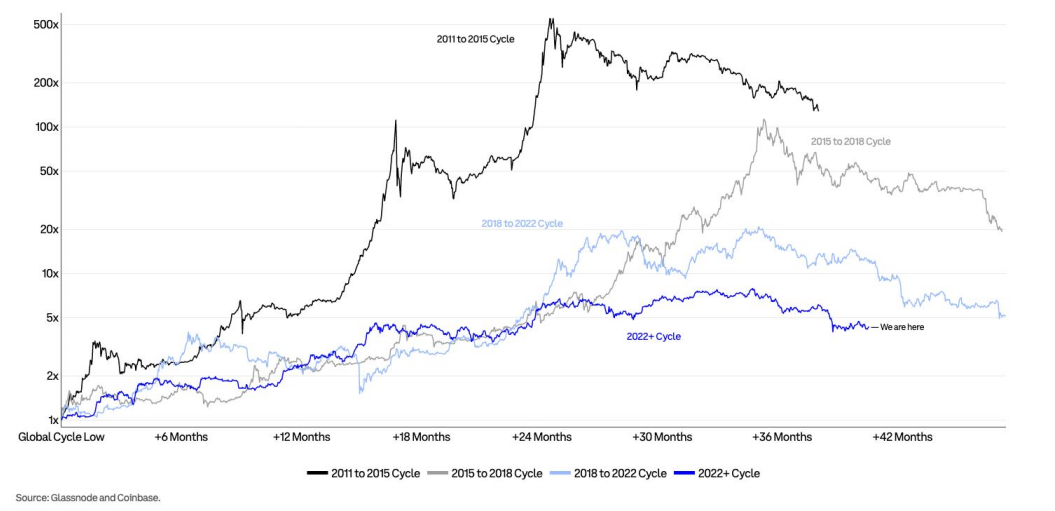
Sounds like typical brokerage report language. But what makes this report different is that it provides several independently verifiable on-chain data points, and these data points are all pointing in the same direction.
Stablecoin Supply Grew by $10 Billion Quietly
In Q1 2026, against the backdrop of an approximately 18% decline in mainstream asset prices like Bitcoin, the total stablecoin supply actually rose from $308 billion to $318 billion.
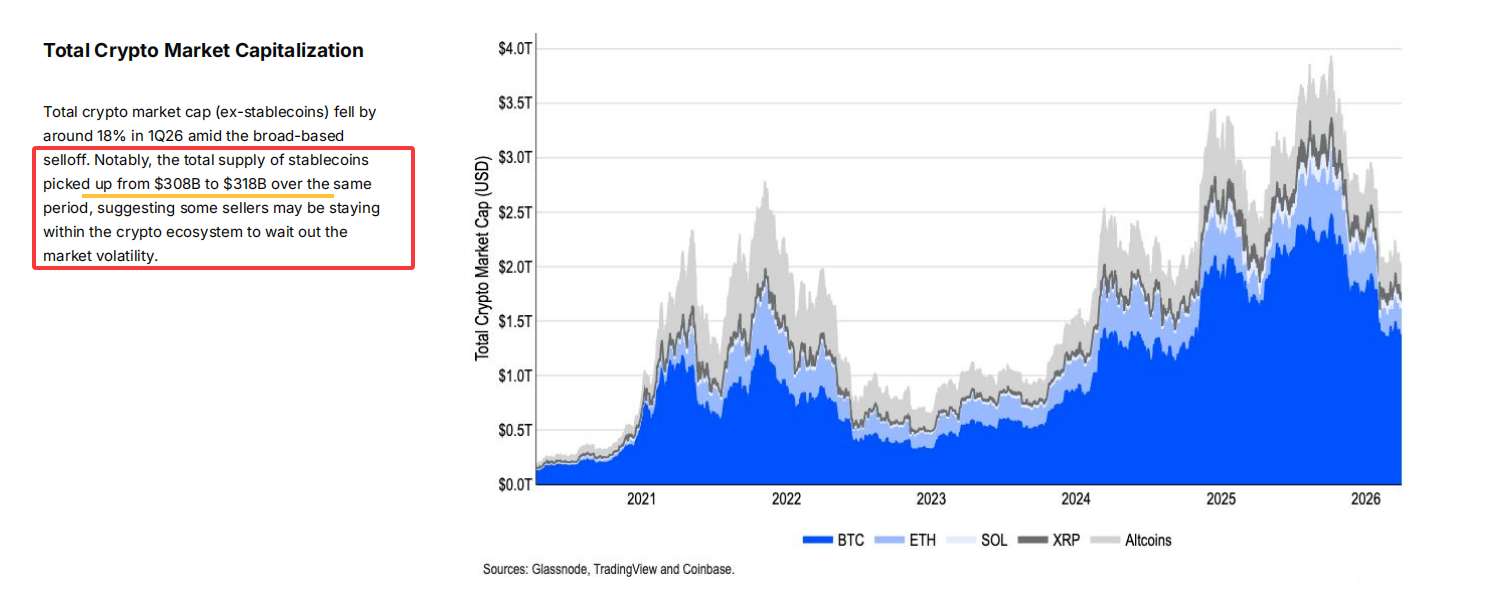
This data itself isn't complicated, but what it indicates is quite interesting. The total cryptocurrency market capitalization is falling, but stablecoins are actually rising, which may mean that money is flowing into the market, just not directly buying coins, but staying in stablecoins.
Stablecoins here play more of a "waiting room" role. Money is either waiting for a better entry point, or has already begun slowly building positions. If it were purely risk-averse behavior, capital should flow completely out of the cryptocurrency market into fiat currency, not staying on-chain in stablecoins. This distinction is key to judging "fleeing" versus "waiting."
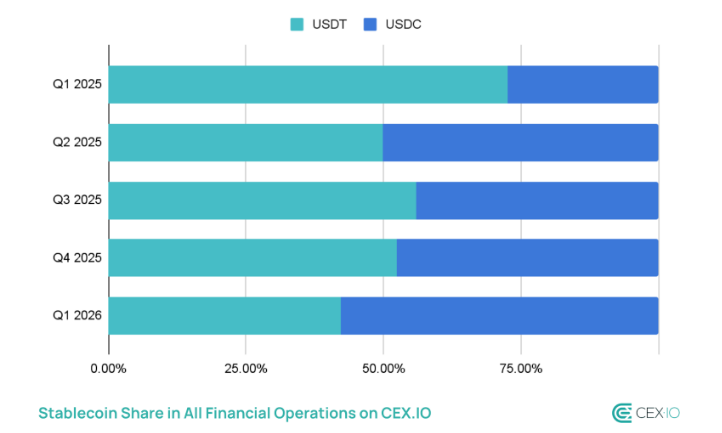
It's worth noting that stablecoins accounted for 75% of all cryptocurrency trading volume in Q1 2026, the highest percentage in history. This figure has two sides—market preference is conservative, but money hasn't left.
Bitcoin Q1 Supply Decreased by 37%
Another piece of data from the report is more direct: the Bitcoin supply that moved in the past three months dropped 37% in Q1.
To understand this: the "actively circulating" Bitcoin in the market has significantly decreased, while the Bitcoin supply held for more than a year increased by 1% during the same period. Two numbers together tell the same story—short-term speculators are decreasing, and the proportion of long-term holders is rising.
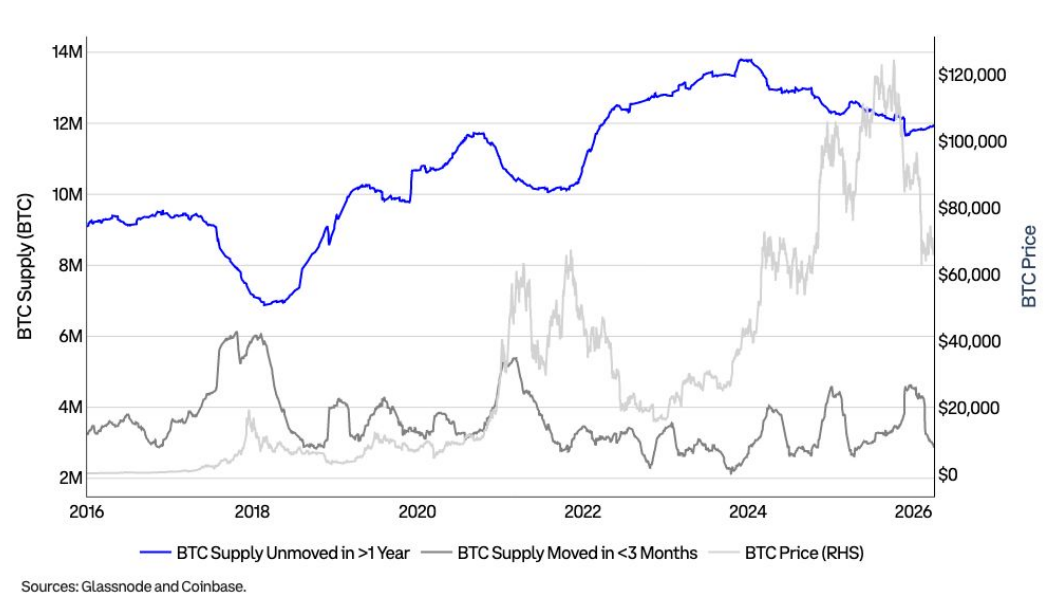
Reduced supply doesn't automatically equal higher prices—the market also needs sufficient demand to match. But with demand unchanged or even growing modestly, reduced liquidity does make prices more sensitive to buying pressure. This is basic supply and demand logic, nothing particularly complex.
The report also mentions the Puell Multiple indicator, currently reading 0.7. The Puell Multiple reflects miner revenue relative to the historical average, 0.7 means miner revenue is below the long-term average.
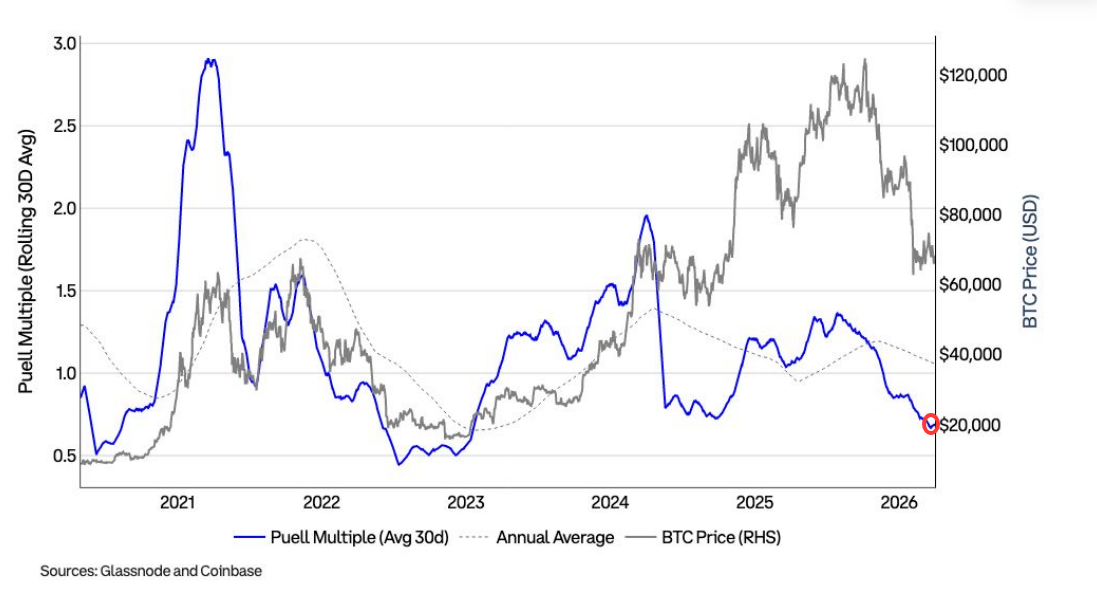
Historically, when this indicator drops to this range, it often coincides with market bottoming periods. Of course, correlation doesn't equal causation, but this data point's direction is consistent with the previous two.
75% of Institutions Consider Bitcoin Undervalued
This is the number in the report that makes people stop and think: 75% of institutional investors believe Bitcoin is currently undervalued, compared to 71% of non-institutional investors (retail). Data comes from Glassnode's research, with sample users at the institutional level.
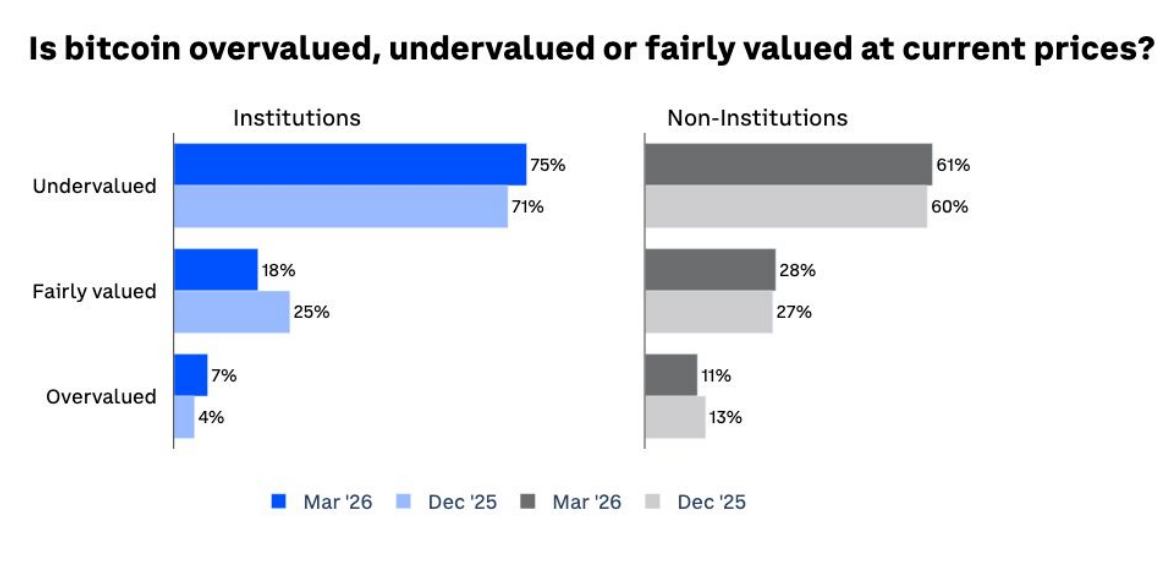
When institutions say "undervalued" versus when retail investors say "undervalued," the meanings differ greatly. Institutions have full-time research teams, compliance processes, and committee approvals—their judgment formation cycles are typically quarterly. When they say "undervalued," it usually means there has already been internal buy discussions, just waiting for the right timing and rhythm.
Three-quarters of institutional survey respondents reached the same conclusion—such a degree of consensus is uncommon. Institutions won't pile in like retail investors, but their capital scale means that once allocation begins, the market's liquidity structure will visibly change.
Three Lines Together
Any single data point alone isn't enough to conclude "bottom is in." But the logic Coinbase and Glassnode put together is: capital is flowing into stablecoins (money is waiting), tradable tokens are decreasing (selling pressure is easing), and institutions are optimistic (demand side is building up). Three directions point to the same probable range—the downside space may be much smaller than the market fears!
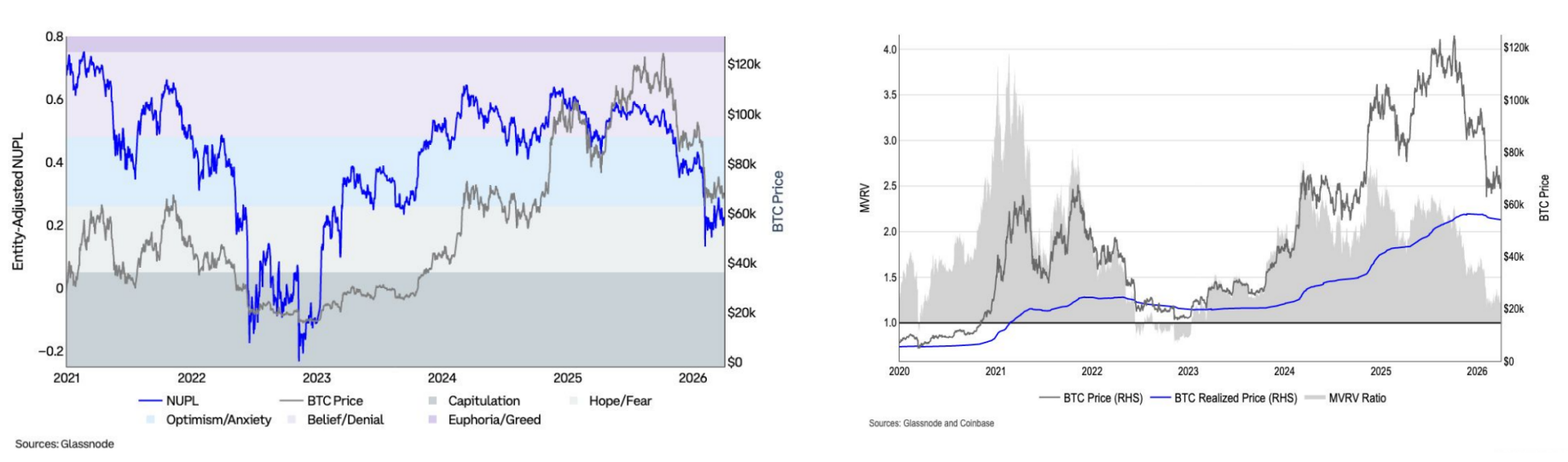
Report also cites the MVRV framework and NUPL on-chain indicators as supporting evidence. NUPL (Net Unrealized Profit/Loss) has currently moved from the "fear" zone into the "hope" zone, which has appeared during several historical market bottoming periods. These on-chain data points cover several important bottoms in 2017, 2019, and 2022, providing certain reference value, but they're not all-powerful.
Macroeconomic Risks Remain the Biggest Variable
The report does not avoid macroeconomic risks. Two numbers are worth vigilance:
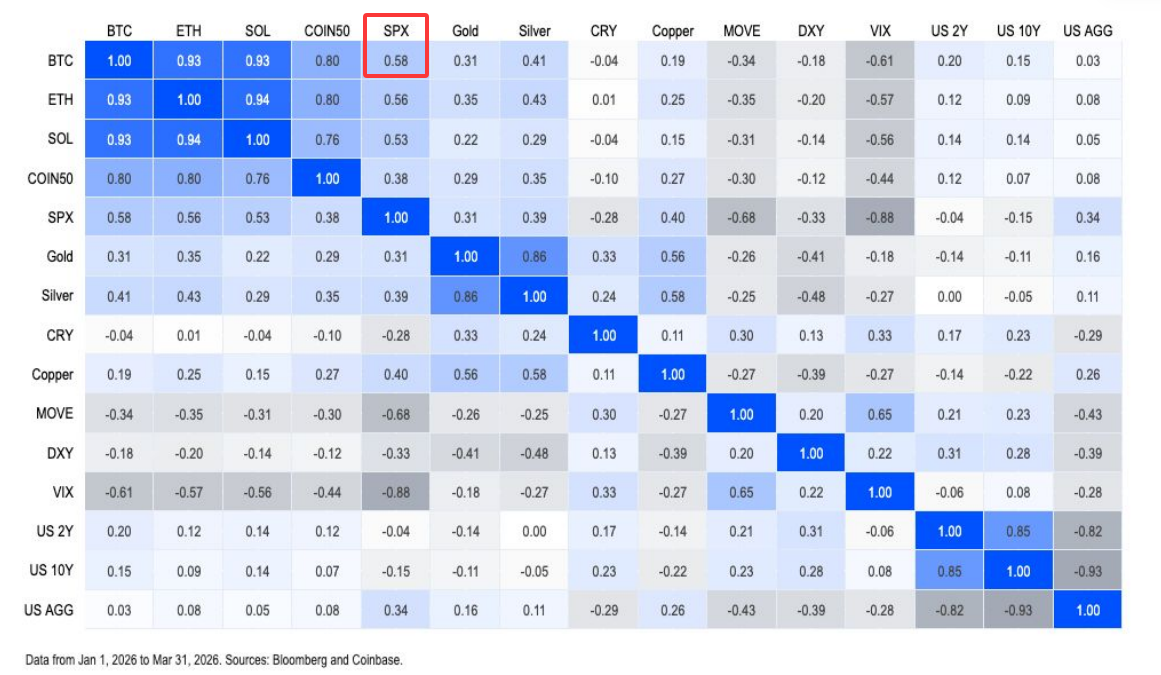
First, Bitcoin's correlation with the S&P 500 has risen to 0.58—this means in the current market structure, if U.S. stocks experience a significant pullback, Bitcoin will likely not go unscathed. No matter how good the on-chain signals are, it can't outrun the macro.
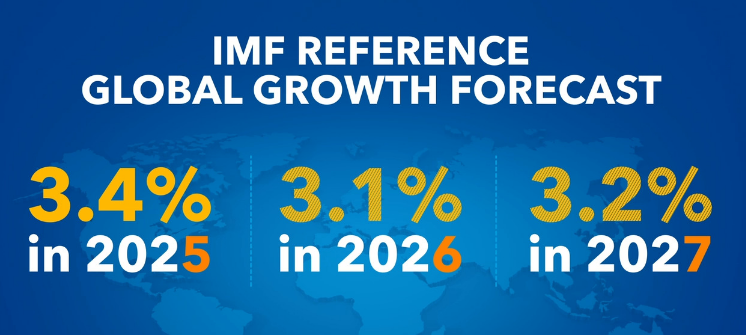
Second, the International Monetary Fund (IMF) lowered its 2026 global GDP growth forecast to 3.1% in its latest forecast, down from the previous 3.4%.
Some private sector models are even more pessimistic—if the U.S.-Iran Middle East situation further deteriorates and causes sustained high energy prices, growth could compress to around 1.4%.
Slowing economic growth is usually not friendly to risk assets, and the cryptocurrency market is no exception!
These risks cannot be offset by on-chain data. Bottom signals exist, but that doesn't mean upside signals are established—the time difference in between can be short, or it can drag on for a long time.
Conclusion
Bitcoin market bottoms are rarely precise points in time; more often they are a range, and people staying in that range either made money or waited. The value of Coinbase's report is not in telling you "buy now," but in clarifying which stage we are currently in: chips are consolidating, capital is waiting, institutions are evaluating.
For people still on the sidelines, the characteristic of this stage is—risks remain, but the risk-reward ratio is improving. How to act still depends on your own position logic and risk tolerance. The report is a reference, not an answer.
Disclaimer: Please readers strictly abide by local laws and regulations. This article is compiled based on publicly available market information for reference only and does not constitute any investment advice.