

Following Meta's earnings release, market reaction quickly weakened. Despite continued revenue growth, investors were more concerned about the ongoing high investment required for AI expansion, and the stock price fell by approximately 9% in after-hours trading.
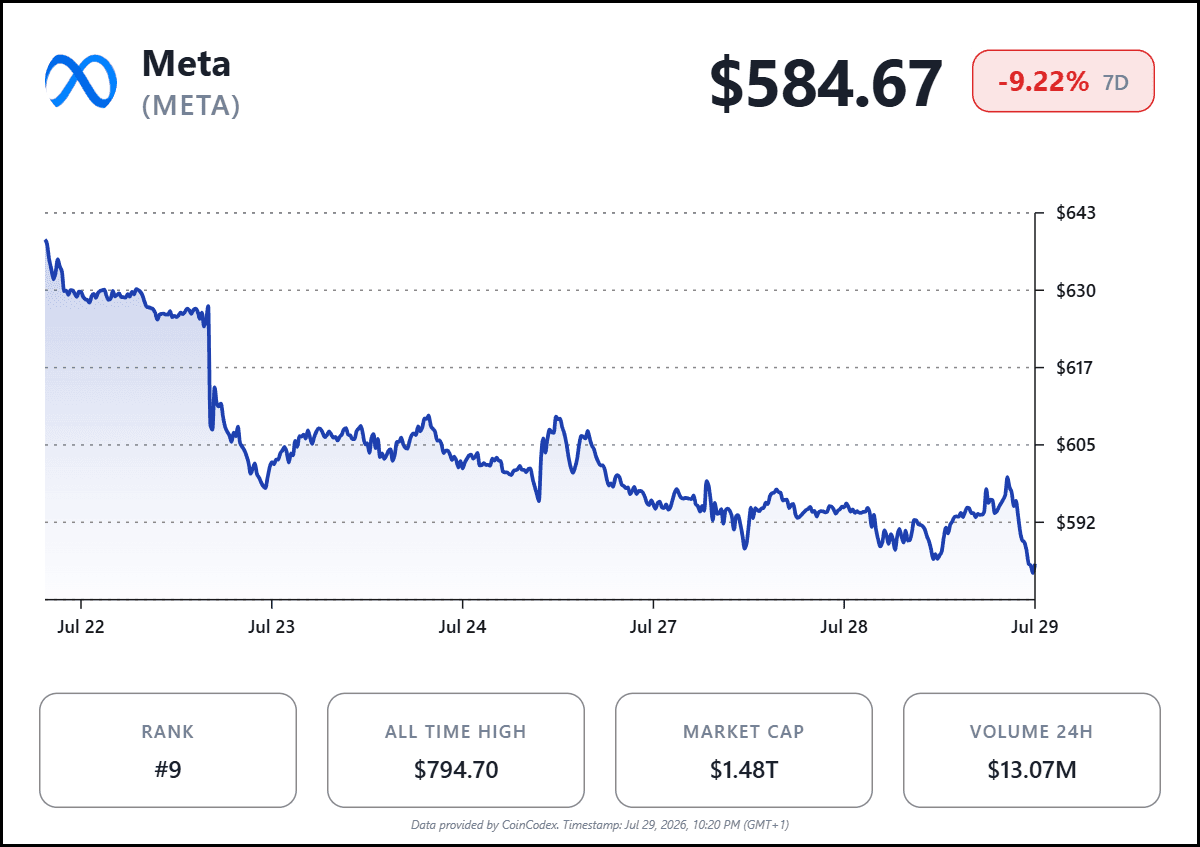
The signals released by management during the conference call further amplified concerns. The market had hoped that the growth rate of AI-related spending would gradually slow down, but the company's investment in data centers, AI chips, technical talent, and computing power may remain high for an extended period.
Capital expenditure revised upwards for 2026
Meta projects capital expenditures of $125 billion to $145 billion for 2026, up from its previous range of $115 billion to $135 billion. The company stated that the upward revision primarily reflects rising equipment prices and increased data center capacity required for future AI products.
- The new capital expenditure guidance is between $125 billion and $145 billion.
- The previous guidance was $115 billion to $135 billion.
- The reasons for the upward adjustment include rising equipment prices and increased demand for computing power.
AI monetization still needs time
Unlike Microsoft, Amazon, and Alphabet, Meta currently does not have a large-scale cloud business and cannot directly sell AI computing power to external customers. Its return on AI investment depends more on increased user engagement, improved advertising business, and the commercialization of future new products.
The report mentions that these potential products include enterprise agency tools, smart glasses, and Meta AI. The problem is that costs have risen rapidly, but the related revenue opportunities may take several years to fully materialize.
High interest rates suppress growth stock valuations
Around the time of the earnings release, the Federal Reserve kept interest rates unchanged at 3.50% to 3.75%. Meanwhile, three policymakers supported a 25-basis-point rate hike, exacerbating market concerns about high interest rates remaining in place for an extended period.
For high-valuation growth stocks, persistently high interest rates typically compress the valuation space for long-term profits. For Meta, the key going forward is to prove that this historic investment in AI will ultimately lead to stronger profitability, not just higher infrastructure costs.