

Grayscale believes that the next wave of crypto products entering the mainstream financial system will not necessarily be new stablecoins or tokenized stocks; on-chain vaults are more likely to emerge first. These products pool funds into on-chain portfolios, managed by professional managers, with the goal of improving risk-adjusted returns.
On-chain vaults are comparable to traditional CLOs.
Grayscale compares its on-chain vault to collateralized loan obligations (CLOs) in the traditional credit market. Both operate as pools, with managers allocating underlying assets and distributing related returns to investors.
The difference lies in the fact that on-chain vaults operate entirely on the blockchain network, relying on smart contracts for execution, rather than depending on traditional trustees and custodians. Grayscale claims this gives it advantages in terms of transparency, operational efficiency, and liquidity.
Currently, these products are mainly deployed on networks such as Ethereum, Base, and Solana, and transactions and settlements are completed directly on the blockchain.
The scale is still much smaller than that of traditional markets.
However, in terms of scale, on-chain vaults still lag significantly behind traditional financial systems. Grayscale data shows that as of the end of July 2026, 3,008 vaults operated by 57 managers had a total locked value of approximately $7.26 billion.
Of these, approximately 79% of the vaults are primarily allocated to stablecoins. Grayscale also noted that this figure is still lower than the approximately $12.3 billion level in September 2025, indicating that the sector is still experiencing fluctuations during its expansion.
- Number of on-chain vaults: 3008
- Number of managers: 57
- Total value locked: Approximately US$7.26 billion
In contrast, the traditional CLO market is worth over $1.5 trillion and is managed by more than 250 institutions, covering thousands of investment vehicles.
Competition for management positions intensifies
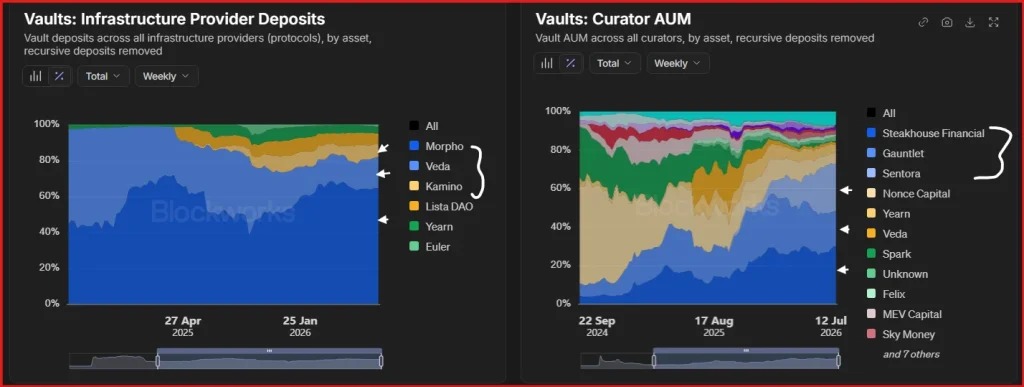
As the market evolves, the ability to screen managers and their brand influence are becoming increasingly important. According to Blockworks on-chain data, Steakhouse Financial, Gauntlet, and Sentora are currently among the leading managers.
At the infrastructure level, Morpho, Veda, and Kamino hold large deposit bases, indicating that the growth of on-chain vaults is expanding simultaneously to both the protocol and distribution layers.
Grayscale believes that regulation remains one of the major obstacles facing this market, especially in the United States. If investor returns rely significantly on the manager's active allocation, these products may raise securities regulatory issues.
Nevertheless, Grayscale believes that on-chain vaults are gradually becoming a fundamental investment tool in the digital asset lending market, and their role is expected to be similar to that of CLOs in traditional finance.