

Foreign media commentary suggests that bank stablecoins, tokenized deposits, and central bank digital currencies can all be used for digital transfers, but the entities that hold these assets as creditors are not the same for each of them. This difference further affects the methods of endorsement, payment arrangements, regulatory jurisdiction, and holding risks, therefore they cannot be simply classified as the same type of product.
Differences determined by the creditor object
The article states that bank stablecoins are typically transferable tokens pegged to fiat currencies such as the US dollar or euro, and their stability mainly depends on reserve assets, redemption rules, and arrangements by the issuing parties. Even though they are issued or supported by banks, these tokens are not equivalent to traditional bank deposits.
Tokenized deposits still fall under the liabilities of commercial banks; they are merely recorded and transferred in the form of blockchain or distributed ledgers. The creditor entity corresponding to the holders remains the bank, rather than an independent stablecoin issuing institution.
CBDC is considered a liability of the central bank.
The article points out that CBDC is a digital form of central bank currency. Unlike tokenized deposits, it is not a liability of commercial banks; rather, the central bank assumes direct responsibility for it. Based on usage scenarios, CBDC is typically divided into two categories: retail and wholesale types.
- Retail CBDC for family and business payments
- Wholesale type CBDC for inter-bank and market clearing
It is mentioned in the text that the European Central Bank defines the digital euro as an electronic form of central bank money for everyday payments. The Bank for International Settlements believes that central bank money can still serve as a source of trust, and tokenized commercial bank money can operate around it.
Three modes may coexist in the long term.
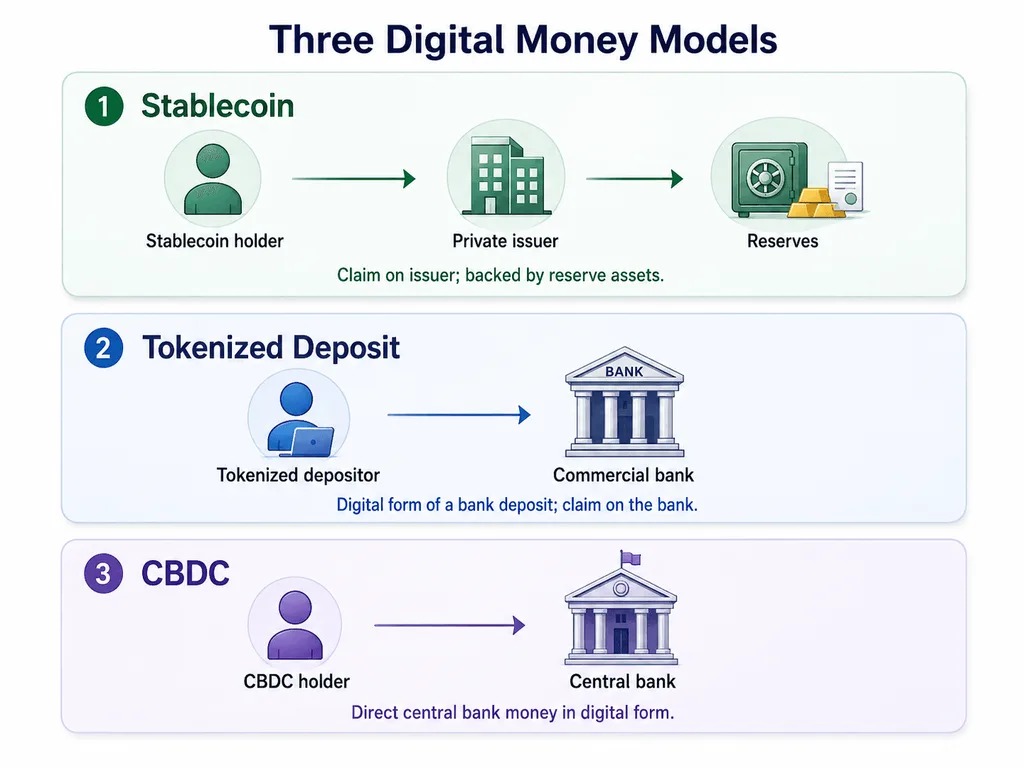
The article argues that the advantages of stablecoins lie in their on-chain portability and the ability to conduct transfers 24 hours a day; tokenized deposits maintain existing banking relationships while adding programmability; CBDC provides digital central bank money, but its adoption still depends on access, privacy, and distribution design.
Based on these differences, it is more likely that all three models will coexist rather than just one solution remaining. For businesses and investors, when evaluating a type of digital currency tool, the key is not merely whether blockchain is used, but also who the liability represents and who bears the credit risk.