

U.S. Treasury Secretary Besant responded to Washington's involvement in yen intervention, stating that the Treasury Department merely used foreign currency assets held in the Foreign Exchange Stabilization Fund to exchange for yen and did not provide loans to Japan. Therefore, there is no issue of Japan repaying or U.S. taxpayers bearing losses.
Responding to Warren's Questions
This controversy stems from a letter sent on August 13 by U.S. Senator Elizabeth Warren to the Treasury Department, in which she questioned how the Treasury Department used the Foreign Exchange Stability Fund during the coordinated actions in the foreign exchange markets between the United States and Japan last month. She believes that if such operations essentially constitute financing to Japan, U.S. taxpayers may face losses.
Bessent denied this claim. He stated that this transaction did not utilize any new congressional appropriations, and that Japan does not owe any money to the US Treasury Department, as the Treasury Department did not provide any credit. According to data disclosed by the US Treasury Department, the Foreign Exchange Stability Fund is already able to hold reserve assets such as the Japanese yen and euro.
Japanese intervention amounts to nearly $97 billion
This move by the United States is part of a larger-scale market stabilization effort by Japan. Previously, the Japanese yen fell below 163 to the US dollar, approaching a low not seen in decades, after which Japan increased its intervention in the market.
On August 28, the Japanese Ministry of Finance disclosed that from July 30 to August 26, the total amount of foreign exchange intervention in Japan reached 15.3993 trillion yen. Based on recent exchange rates, this amounts to approximately 97 billion US dollars.
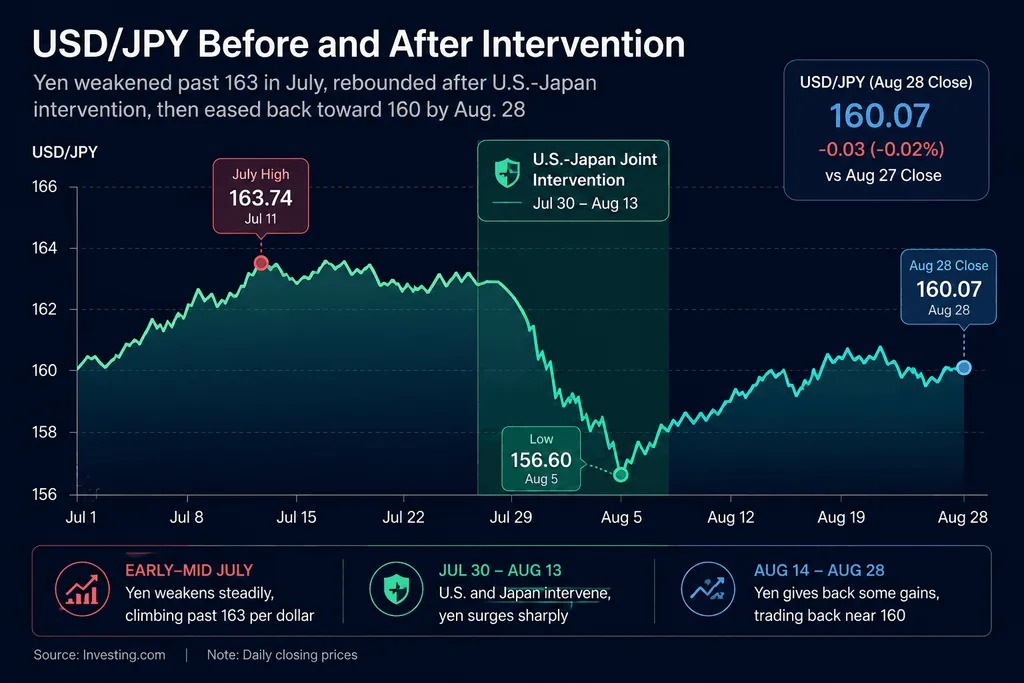
Prior to this, the market had already noticed an intervention operation of approximately 8.45 trillion yen, which is about 52.8 billion US dollars. This joint action by the United States and Japan is also seen as the first coordinated intervention in the yen by the two countries since 1998.
Why Does the US Pay Attention to Yen Fluctuations?
Bessent's main argument is that the sharp fluctuations in the yen are not just a problem for Japan itself. Japan is one of the major foreign holders of U.S. Treasury bonds, and if the exchange rate becomes severely disordered, it could force some investors to adjust their holdings, which in turn could push up the financing costs for the United States.
This risk can also be transmitted to global markets through yen carry trades. For a long time, investors have often financed in yen at low interest rates to invest in assets such as stocks and bonds. Once the yen rebounds rapidly, related positions may be forced to be liquidated en masse, exacerbating market volatility.
From the short-term performance, it can be seen that the impact of the intervention has weakened. On August 28th, the US dollar closed near 160.07 against the Japanese yen, showing a recovery from the lowest point after the intervention.
However, market attention has not faded. Intervention in the foreign exchange market can temporarily suppress disordered fluctuations, but to drive the yen to continue strengthening, it still depends on changes in interest rate spreads, inflation expectations, and subsequent policies of the Bank of Japan.