

Foreign media cited the latest estimates from blockchain analyst Willy Woo stating that the number of Bitcoin holders has exceeded 500 million, accounting for about 4.5% to 6% of the global population. The relevant calculations refer to data from Glassnode and Chainalysis. The article describes this phase as still being in a relatively early stage of adoption.
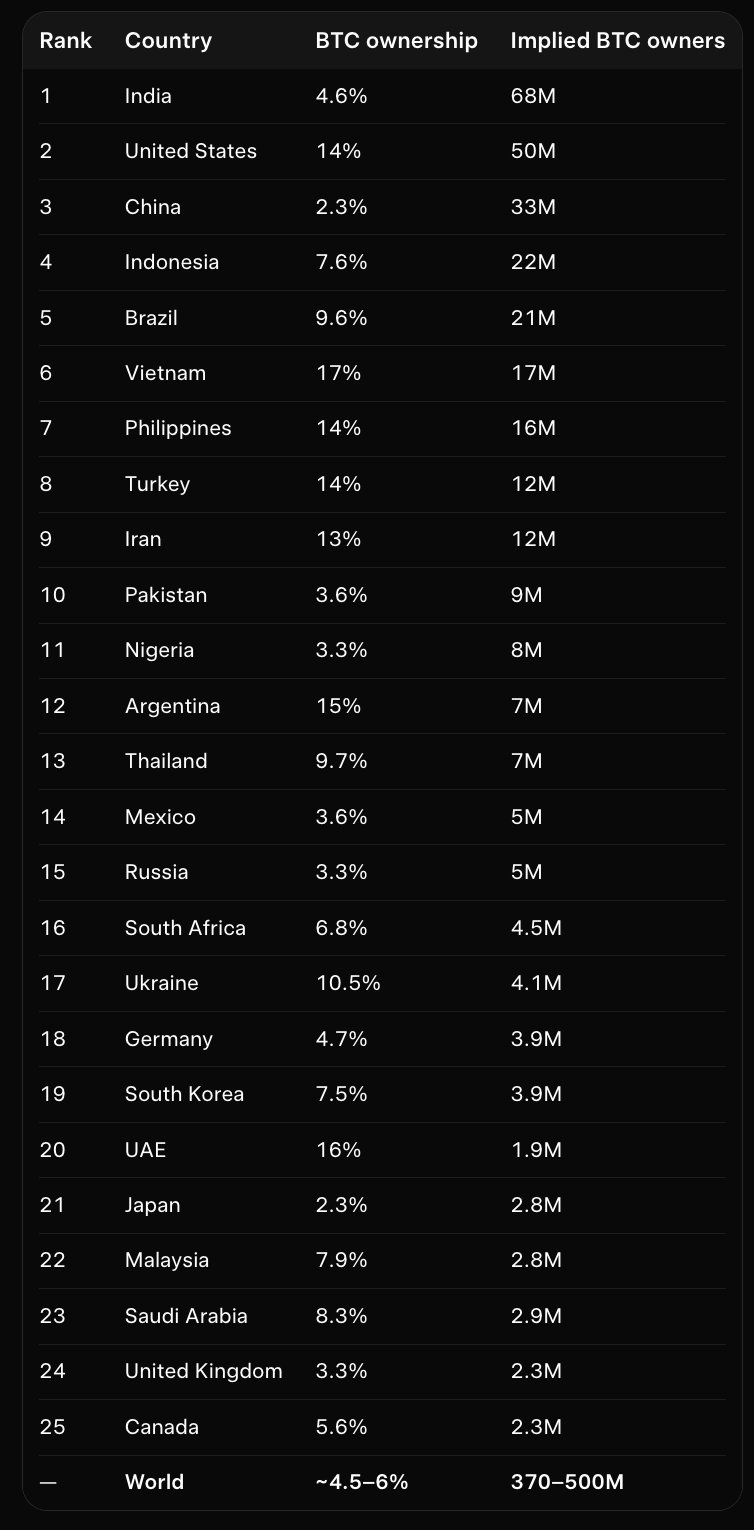
Holder base grows to between 370 million and 500 million
According to the text, the current total audience for Bitcoin is estimated to be between 370 million and 500 million people. The article states that this rate of adoption is similar to the S-shaped adoption curve seen in the early days of the Internet, but different analysts have varying opinions on whether this is sufficient to support a significant increase in price over the coming years.
- There are approximately 50 million holders in the United States, with a penetration rate of about 14%.
- There are approximately 33 million users in China, accounting for about 2.3% of the population.
- In Vietnam, it is about 17%, and in the Philippines, it is about 14%.
The article also mentions that the penetration rates of crypto assets in Argentina and Turkey are relatively high, at around 15% and 14% respectively. The explanation given is that in environments where the local currency is under pressure or inflation is high, retail users tend to use digital assets as a hedging tool or to circumvent foreign exchange restrictions.
Divergence in market expectations regarding $250,000
As holder data increases, the market once again discusses the upside potential of Bitcoin. The article states that, compared to retail investors' expectations of a target price of $250,000, the currently prevailing view is one of "decreasing returns."
According to Willy Woo, the multiple of Bitcoin's price increases during various macroeconomic cycles has been continuously declining. The article compares that in the previous two cycles, there were increases of 48 times and 16 times respectively, while in this current cycle, the upward movement is approximately 1.8 times, with the potential peak falling around $123,000.
He also believes that accurately predicting the market peak is of limited significance, as peaks are often driven by short-term sentiment and lack stable support. In contrast, during the bottom phase, it is easier to identify undervalued signals, and large funds are more likely to enter the market at this stage.
The long-term narrative still revolves around the substitution of gold.
The article also mentions that long-term supporters of Bitcoin still tend to compare it to gold. The logic behind this is that if digital assets continue to serve a part of the value storage function over a longer period, the market will continue to use gold's market value of about $32 trillion as a reference point.
However, the text also emphasizes that traditional financial institutions and regulatory authorities remain cautious about such forward-looking projections. The main controversies focus on three points: significant volatility in the crypto market, the difficulty of accurately counting the number of independent holders, and the potential for continued pressure from regulatory and central bank policies.
The article concludes that the current global holding rate of about 5% indicates that Bitcoin has entered a more mature institutionalized phase; however, to compete more directly with the fiat currency system, the global holding rate still needs to increase significantly.