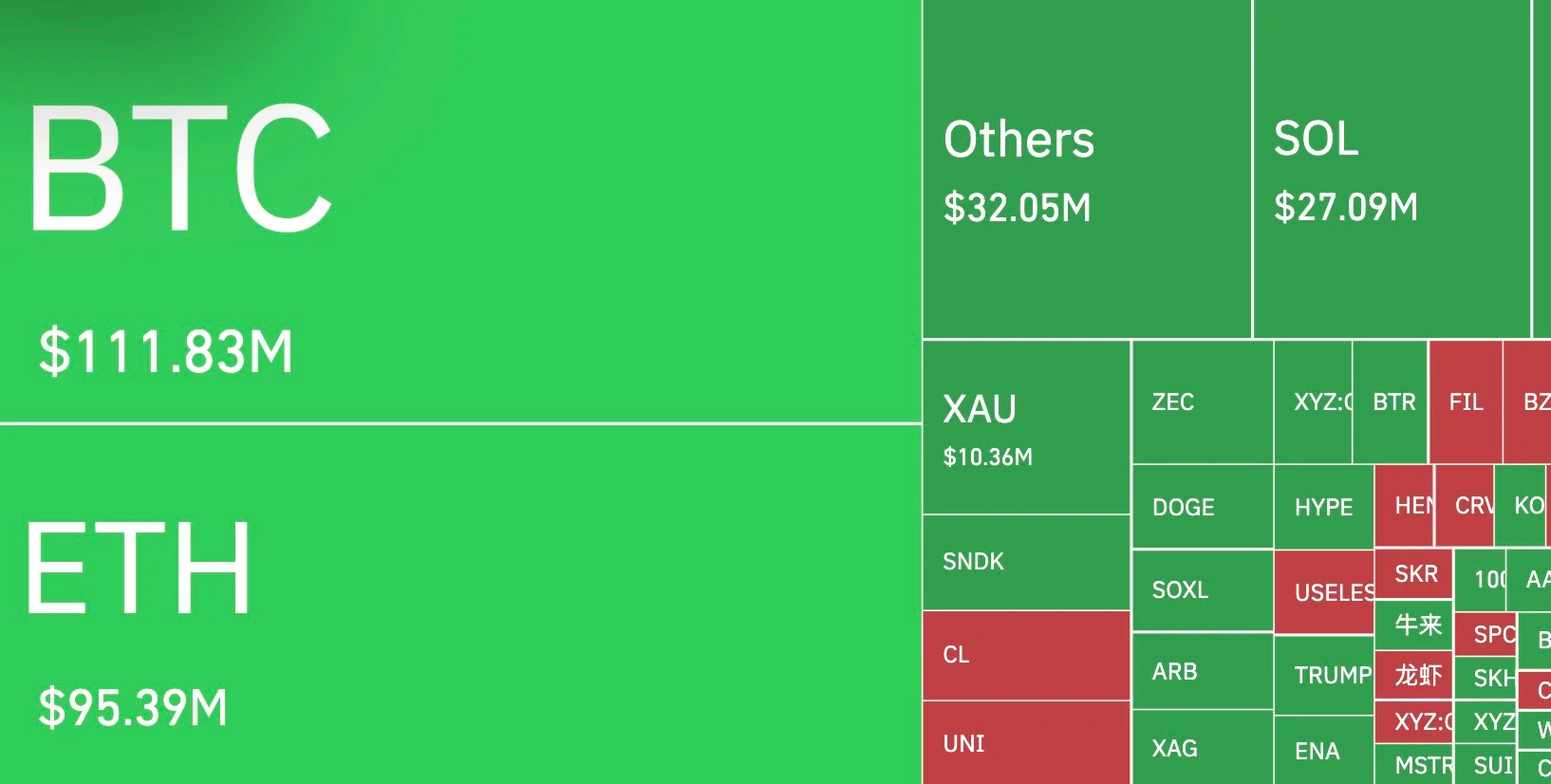


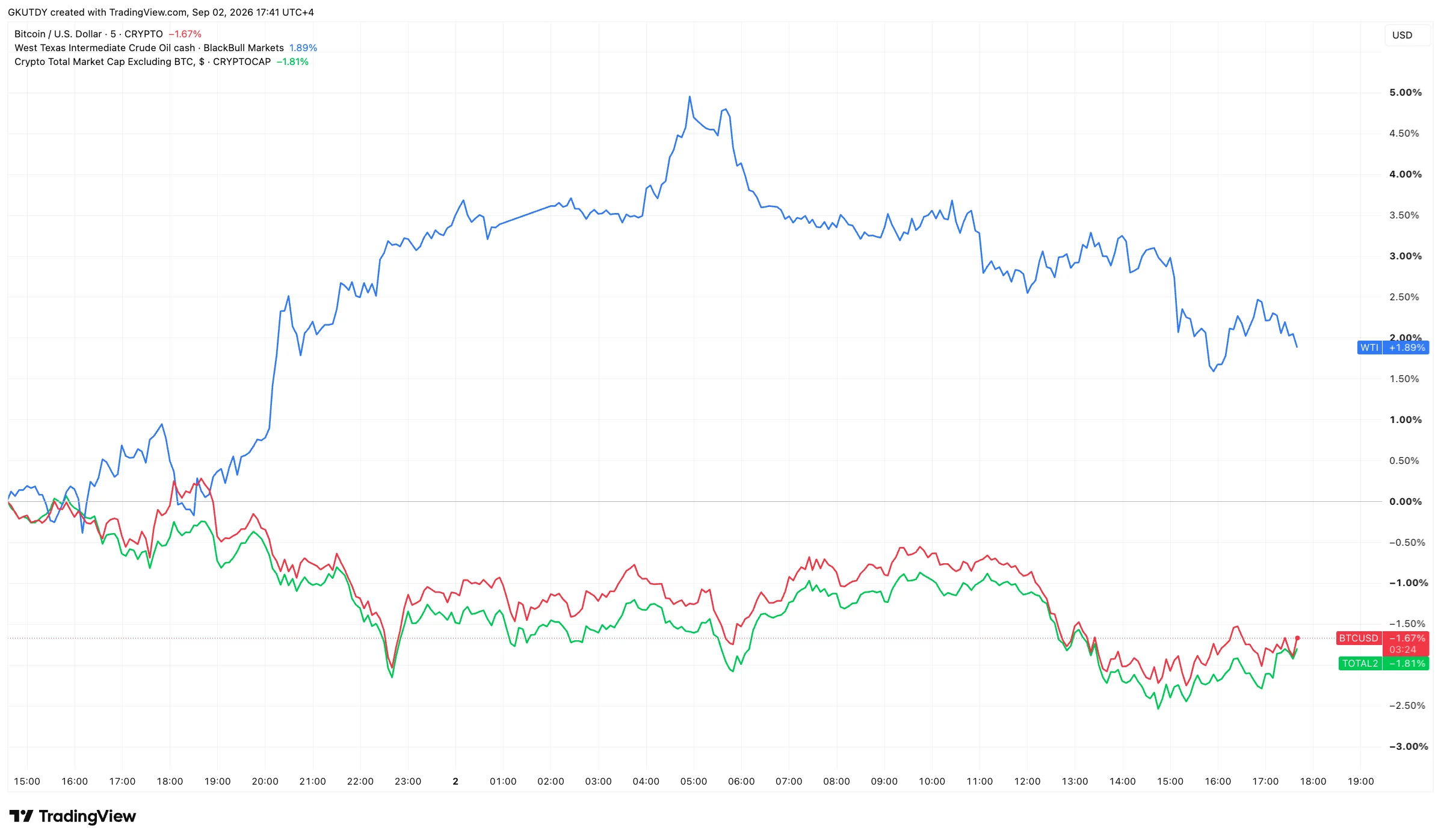
Starting in September, the crypto market weakened under macroeconomic pressure. Rising oil prices and increasing yields on U.S. Treasury bonds boosted market expectations for a Fed interest rate hike in September, leading to a concentrated liquidation of long positions with high leverage. In the past 24 hours, there were margin calls totaling approximately $370 million across the derivatives market, forcing more than 90,000 traders to liquidate their positions.
The highest proportion of margin calls occurred in the long position.
CoinGlass Data shows that in this round of margin calls, long positions suffered losses of approximately $302 million, while short positions lost about $67.83 million, with long positions comprising the vast majority. Within 12 hours, there were margin calls totaling around $141 million, and in the last 4 hours approaching dawn, another $82.1 million in positions were liquidated, indicating that selling pressure rapidly intensified in a short period of time.
Among the main assets, Bitcoin saw the highest margin call amount, which was approximately 112 million US dollars, and its price fell back to the range of 77,200 to 77,600 US dollars. Ethereum dropped by about 2% to 2,410 to 2,430 US dollars, with related margin calls amounting to about 95.39 million US dollars. Solana fell below 100 US dollars, reaching a low of 98.47 US dollars, with margin calls amounting to about 27.09 million US dollars. XRP also declined during the market downturn, and it was mentioned that this price pressure coincided with the scheduled unlocking arrangements for custody.
ETF Divergence in capital flows
While spot prices fell, the flow of funds did not weaken in a corresponding manner. Data from SoSoValue shows that Bitcoin ETF saw a net outflow of approximately $236 million on that day, but Ethereum, Solana, and XRP ETF still recorded net inflows of about $10.95 million, $10.19 million, and $14.38 million respectively.
This means that there has been a divergence in the direction of short-term trading funds and some institutional funds. The article also mentions that long-term holders have turned net buyers for the first time in a month, providing some support to the market. However, this support has not yet been able to offset the general selling pressure brought about by macroeconomic factors.
Macroeconomic factors become the main triggering points.
The report attributes the main cause of this round of decline to changes in external markets. With rising oil prices, increasing inflationary pressures, and higher yields on U.S. Treasury bonds, the market has raised the probability of a Federal Reserve interest rate hike on September 16 to 66%. Under this expectation, risk assets are under overall pressure, and the crypto market has also declined accordingly.
The article also mentions that September has traditionally been regarded as a month when digital assets tend to be weaker. In Bitcoin's history, out of the 13 Septembers since 2013, there have been 8 instances where the monthly price closed lower. Coupled with the new round of employment data that the United States is about to release, short-term market fluctuations may continue to intensify.
SEC Promotes Adjustment of Blockchain Infrastructure Rules
In addition to market fluctuations, the U.S. Securities and Exchange Commission (SEC) is also advancing rule adjustments related to blockchain. Reports mention that SEC has proposed changes to the transfer agent rules to adapt them to public blockchains, tokenized stocks, and artificial intelligence-related scenarios, and plans to hold a roundtable meeting on September 17 to discuss the possibility of 24/7 trading arrangements for traditional stock markets.
The participating institutions are said to include BlackRock, Nasdaq, the New York Stock Exchange, Robinhood, etc. The discussion topics covered overnight regulation, real-time settlement, and investor protection during non-trading hours. If these arrangements are implemented, traditional stock markets will further align with digital asset markets in terms of trading hours and settlement methods.