






Foreign media commentary suggests that asset tokenization is moving stocks, bonds, and funds onto the blockchain, but this only completes half of the transaction process. The settlement phase, where the buyer pays the funds and the seller delivers the assets, still determines whether a transaction can truly be completed.
Having assets on the blockchain does not equate to a closed-loop transaction.
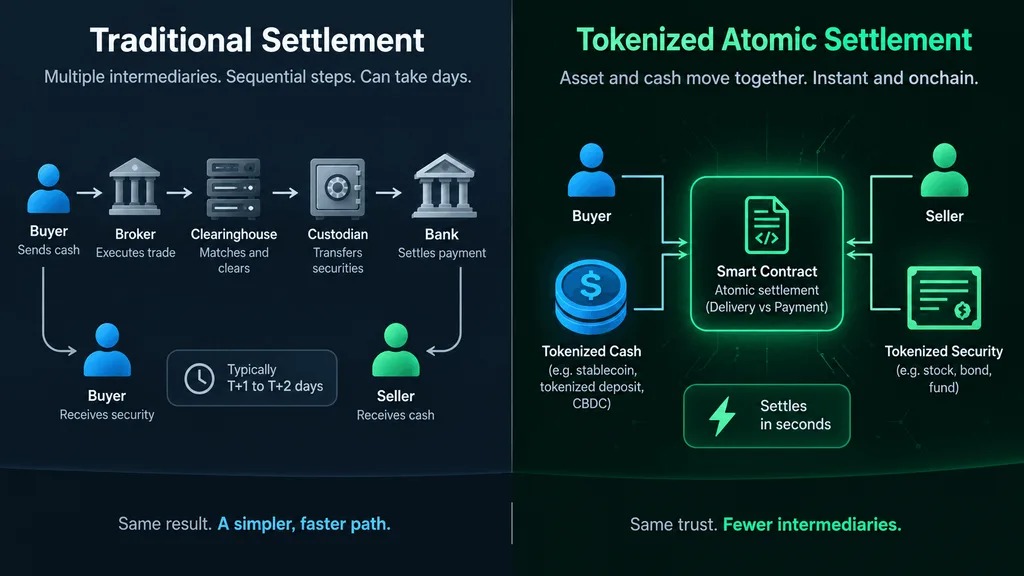
The article points out that traditional markets have long relied on the 'cash against goods' method for settlement, which means that funds and securities are exchanged simultaneously to prevent one party from delivering the goods without receiving payment in advance. Blockchain aims to further streamline this process, enabling the transfer of assets and funds on the same digital infrastructure at the same time.
This type of arrangement is commonly referred to as atomic settlement. Only when both the buyer and the seller can deliver on time will the system complete the transfers on both sides simultaneously; if either party fails to fulfill their obligations, the transaction will not proceed. This approach reduces counterparty risk and also shortens the time during which funds are held hostage.
However, the article emphasizes that for atomic settlement to be possible, it is prerequisite that "money" can also flow reliably within the same network. If assets are already on the blockchain, but payments still have to go through the traditional banking system, then the entire transaction does not truly complete a closed loop on the blockchain.
Three types of financial instruments enter competition
The article divides the settlement funds in the tokenization market into three categories: stablecoins, tokenized bank deposits, and tokenized central bank currencies.
- Stablecoins are widely present on public blockchains and are suitable for 24-hour continuous trading.
- The tokenization of bank deposits allows existing deposits to be transferred and circulated within programmable systems.
- The tokenization of central bank currency is closer to the highest credit tier of traditional clearing systems.
Among them, the advantage of stablecoins is their convenience in circulation; assets such as tokenized U.S. Treasury bonds can be paid for directly with stablecoins pegged to the US dollar, without the need to leave the blockchain environment. However, stablecoins are essentially liabilities of private issuers, and their credibility depends on the quality of their reserve assets and their ability to fulfill redemptions.
In contrast, the tokenization of bank deposits does not create new stablecoins; rather, it converts existing commercial bank deposits into token form. The article argues that this model is more attractive to banks because it allows for the introduction of programmable settlement capabilities without the need to completely rebuild the existing banking system.
The tokenization of central bank money is regarded as a higher-level option, especially suitable for large financial institutions. The reason is that central bank reserves are already at the core of the traditional settlement system and do not rely on the solvency of private institutions.
Wall Street is more concerned about whether funds can be connected to the blockchain.
The article argues that as tokenization moves from experimentation to larger-scale applications, funding-related issues will become more prominent. Blockchain can quickly transfer a tokenized stock, but if payments still have to go through traditional banking channels, transaction efficiency and risk control will remain limited.
Recently, many institutional projects have adopted this hybrid structure: assets are transferred on-chain, while some settlements still rely on existing banking infrastructure. The article argues that this is not necessarily a disadvantage, as the traditional clearing system is unlikely to be completely replaced in a short period of time, and it is very likely that both systems will coexist for many years.
In the coming period, different transactions may use various funding tools: some may utilize deposits from commercial banks, while others may employ stablecoins. For transactions involving large institutions, the tokenization of central bank reserves could be introduced. The truly critical question is not which tool will emerge victorious first, but whether these tools can interact securely with each other.
The article concludes that if each type of tokenized asset corresponds to a different payment network or cannot be connected to the banking system, the improvement in market efficiency will be very limited. The next step in tokenized finance is not just to get more assets onto the blockchain, but to enable the smooth settlement of assets and funds within the same system.