





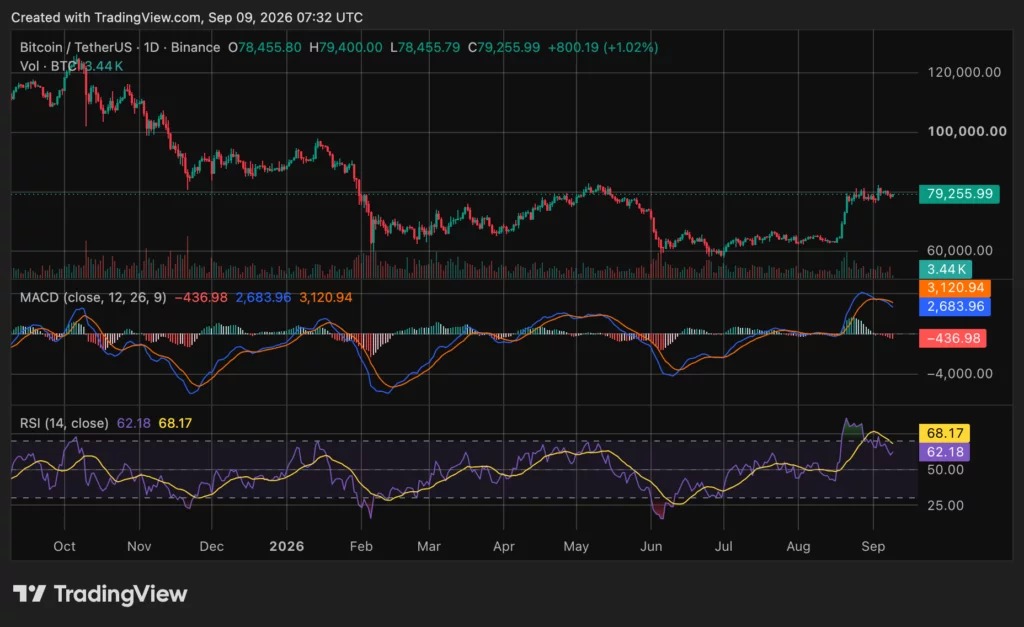
On September 9, Bitcoin remained around $79,200, still about 37% below its historical high set in October 2025. Market maker Wintermute believes that the maximum pullback during this cycle is significantly smaller than those seen during the bear markets of 2018 and 2022, a view that has once again drawn market attention recently.
It is important to distinguish that the “about 50% pullback” mentioned by Wintermute does not refer to the current price on September 9th, but rather the deepest decline that occurred at an earlier stage of this cycle. Based on a historical high of approximately $125,700, Bitcoin fell by about 52.6% at its low point in June 2026, and then rebounded in August. The current pullback has significantly narrowed.
The current drawdown has dropped to approximately 37%.
Independent price data generally supports the overall trend of 'a relatively mild decline in this round.' Historical analysis of Hashrate Index shows that when Bitcoin fell from its high point in October 2025 to its low point in June 2026, the maximum decline was approximately 52.6%.
Thereafter, Bitcoin closed at $63,577 in July, representing a decline of about 48.9% from its peak; in August, it continued to rebound and once again topped $78,000 by the end of the month. As of September 9th, at around $79,200, it is currently down by about 36.97% from its historical high, which can be approximated as 37%.
ETF Financial support for a rebound
Wintermute attributes the relatively mild pullback to institutional funds entering the market earlier, especially in US spot Bitcoin. ETF has provided new channels for demand. Data shows that as of the week ending September 4th, there was a net inflow of approximately $987 million in US spot Bitcoin. This is the third consecutive week of net inflows, with a total of about $3.8 billion accumulated over the three weeks.
On September 3, there was a net inflow of approximately $731 million in a single day, and on September 4, the net inflow was about $175 million. However, at the beginning of the new week, there was again a net outflow from the product, indicating that the flow of funds is not stable.
Employment data followed, but prices remained stable.
In August, the United States added 162,000 non-farm jobs, with the unemployment rate remaining at 4.1%. Wages increased by 0.3% month-on-month and 3.1% year-on-year. The stronger-than-expected employment data weakened market expectations for a short-term interest rate cut by the Federal Reserve, also putting pressure on risk assets.
After the data was released, Bitcoin fell from around $82,400 to below $80,000, but still managed to retain some of its weekly gains thereafter. Wintermute views this performance as a sign that demand is still supported.
However, a single market reaction is not sufficient to indicate that Bitcoin has broken free from macroeconomic constraints. Interest rates, the US dollar, bond yields, and liquidity expectations remain the main factors affecting subsequent trends. Moving forward, the market will continue to pay attention to US inflation data as well as the Federal Reserve's meeting on September 15th to 16th.