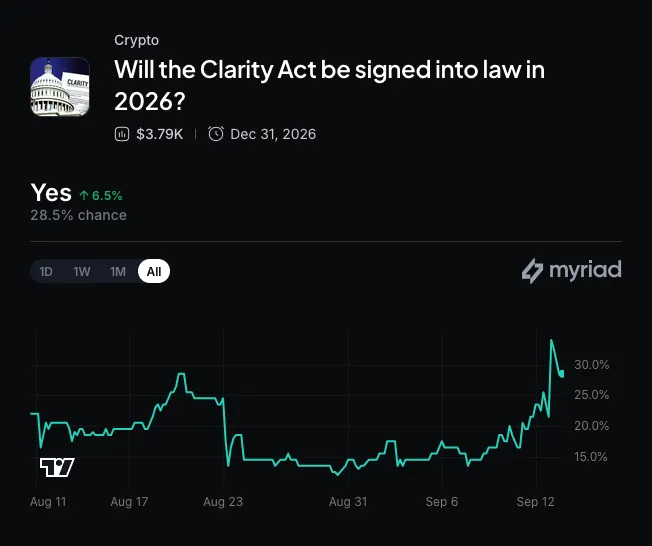






Republican senators in the U.S. Senate released a new version of the Clarity Act on Sunday evening, attempting to gain more support from Democrats before the procedural vote on Tuesday. For the bill to move on to the next stage of consideration, it requires 60 votes to pass; therefore, cross-party voting will be key in this vote.
Ethical restrictions have been significantly tightened.
The most notable change in the new version is that Trump has accepted stricter ethical constraints regarding crypto assets. Previously, Democrats had consistently viewed the crypto business interests of the Trump family as one of the main obstacles. After the revision, officials who are subject to these constraints and hold significant financial interests in related areas are required to divest themselves of those holdings or entrust them to qualified blind trusts for management.
The new version also expands the scope of applicability to include not only currently serving officials but also those who have been elected but have not yet taken their oath, as well as their spouses. The text also allows state attorneys general to enforce relevant prohibitions, restricting these officials from issuing, promoting digital assets, or continuing to hold significant related interests.
DeFi Developer protection has seen both increases and decreases
The bill also makes modifications to the "Blockchain Regulation Clarity Act" section. Originally, this section was intended to clarify that software developers who do not handle customer funds are not required to register with financial institutions and do not have to comply with the relevant requirements of the "Bank Secrecy Act."
However, the new version of the text removes the explicit protection for criminal prosecutions. This is seen by some in the crypto industry as a concession, as it does not overturn the legal path previously used to prosecute the developers of Tornado Cash and Roman Storm. At the same time, the bill still strengthens the civil provisions, further stating that developers and service providers who do not control customer funds should not be regarded as institutions for fund transfers.
The new version also includes miners and verifiers in this protection scope for the first time, continuing to use whether they control user funds as an important criterion for dividing responsibilities.
Stablecoins to include circuit breaker clauses
In the area of stablecoins, Republicans did not accept the more extensive restrictions demanded by the banking industry, but they did incorporate what is known as a "circuit breaker" mechanism. According to this design, if there are signs of a large-scale flow of community bank deposits into stablecoins, the U.S. Treasury Secretary can intervene.
In addition, the bill also makes adjustments to the relevant sections under the jurisdiction of the Senate Agriculture Committee, addressing issues such as conflicts of interest among digital commodity exchanges, brokers, and traders, related-party transactions, and exemption authorities. The new version of the text also clarifies that state consumer protection laws remain in effect, and that developer protection provisions will not exempt them from derivative legal responsibilities, nor will they affect the regulation of predictive markets.
Based on industry feedback, the initial evaluations were relatively positive. Galaxy Digital Research Supervisor Alex Thorn has raised his estimate of the likelihood of the bill passing in 2026 from 10% to 25%. However, whether the bill can overcome this week's procedural hurdles still depends on whether the Democratic Party accepts these final revisions.