

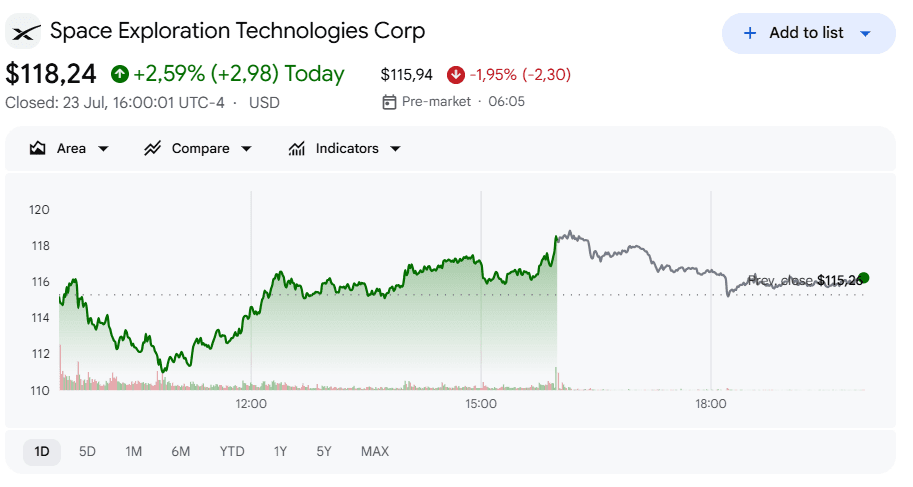
SpaceX shares rebounded on Thursday but remained significantly below their post-IPO highs. Market concerns about the company's valuation, the scale of its investment, and potential shareholder sell-offs continued to weigh on the stock price. Meanwhile, the further delay of the Starship launch mission also weighed on investor sentiment.
The post-listing volatility has not yet ended.
SpaceX completed its initial public offering in June, with an offering price of $135 per share. The stock price subsequently rose to $225.64, but has recently fallen significantly. The report points out that three main factors are behind the volatility: whether the valuation is too high, the cost pressure from the continued expansion of the space business, and expectations of future shareholder sales.
From a market perspective, even with the rebound on Thursday, the stock price is still far below its previous high, indicating that investors are still repricing the company's medium- to long-term growth prospects.
Alphabet holdings information revealed.
Alphabet's latest disclosures have provided a clearer picture of its investment relationship with SpaceX. The connection dates back to 2015 when Alphabet, along with Fidelity, participated in an investment in SpaceX.
However, with SpaceX's stock price falling, the current market value of these holdings has also decreased compared to before. The report did not provide details of the new holding adjustments, but this disclosure has once again drawn market attention to the capital ties between large technology companies and SpaceX.
The Starship mission has been postponed again.
The next round of Starship test flights was already underway, but the mission has been delayed again. During a previous launch attempt, several engines on the Super Heavy booster failed to ignite as planned, disrupting the mission. SpaceX subsequently replaced several Raptor engines and completed further ground tests.
According to current plans, the next flight will carry 20 Starlink satellites, while also testing Starship's satellite deployment and reentry capabilities. For the market, the progress of the Starship project not only relates to SpaceX's technological roadmap but also influences the company's future commercialization expectations.
The Falcon 9's launch rhythm is relatively stable.
In contrast, the Falcon 9 project proceeded more smoothly. On July 21, SpaceX successfully launched 24 Starlink satellites from California. Just the day before this mission, a launch was unusually aborted at the last minute, but this did not affect the subsequent completion of the mission.
This also shows that, despite the ongoing testing and schedule pressures facing Starship, SpaceX's existing Falcon 9 launch system is maintaining a relatively stable operating pace.