

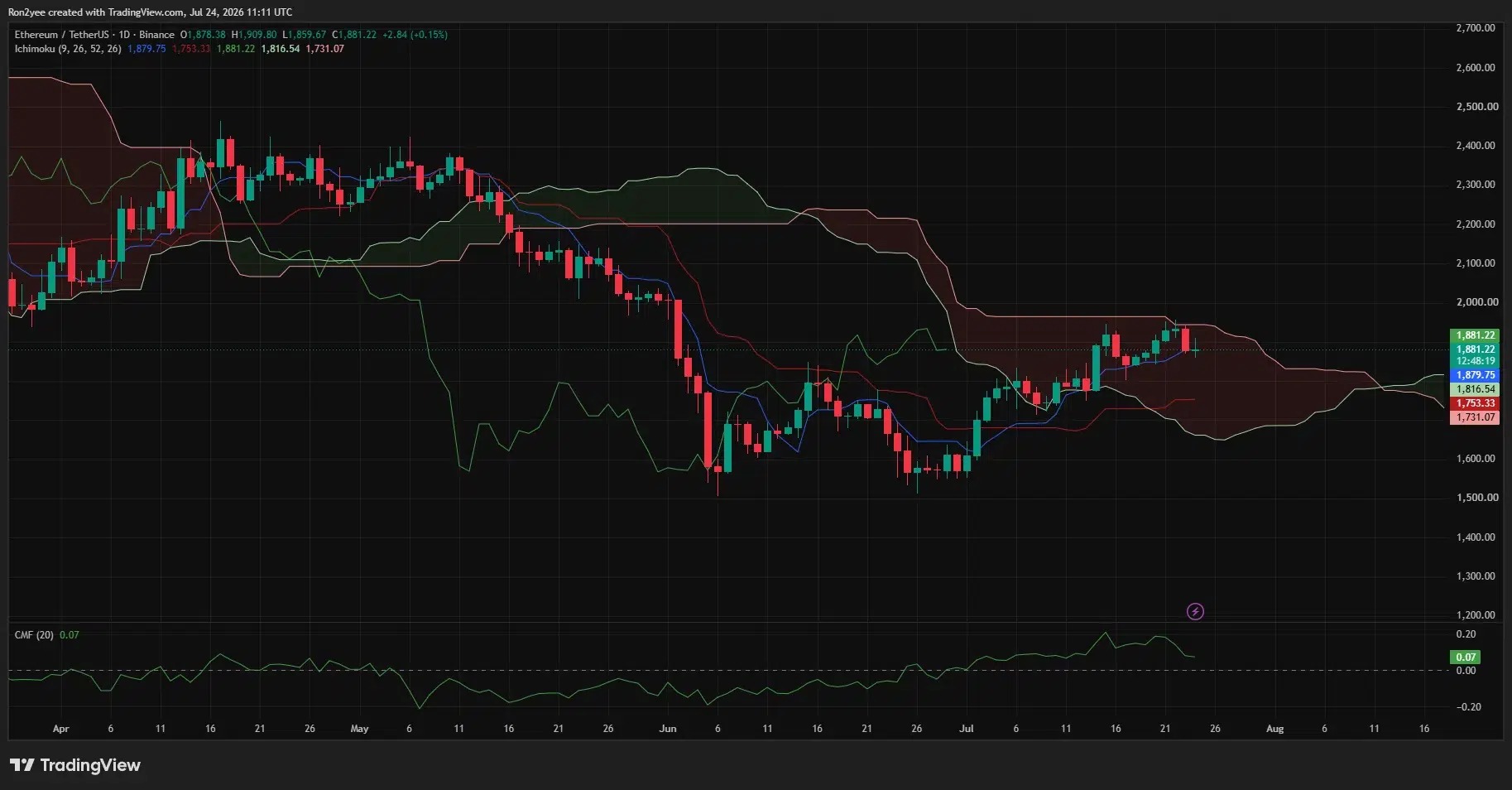
Ethereum reversed course after approaching $2,000, falling approximately 3% in the last 24 hours, with the price briefly dropping to around $1,880. Market sentiment was also dragged down by a sharp decline in the US tech sector, putting pressure on risk assets overall, and ETH's pullback was significantly larger than Bitcoin's.
Earlier this week, ETH rose to the $1935-$1950 range, but encountered resistance below the $2000 level. Selling pressure also appeared near the 100-day exponential moving average, temporarily slowing the rebound that started from around $1560 at the end of June.
The decline in technology stocks dragged down risk appetite.
Major U.S. tech stocks generally declined on Thursday, with Magnificent Seven falling 4.8%, wiping out approximately $797 billion in market capitalization, marking its worst single-day performance since the tariffs are set to hit in April 2025. During the same period, the S&P 500 fell 1.2%, and the Nasdaq 100 fell 1.9%.
The market attributed this decline in part to Alphabet's upward revision of its 2026 capital expenditure forecast and Tesla's weaker-than-expected earnings. Investors began to reassess whether the high investment in AI could deliver sufficient returns, putting greater pressure on highly volatile assets.
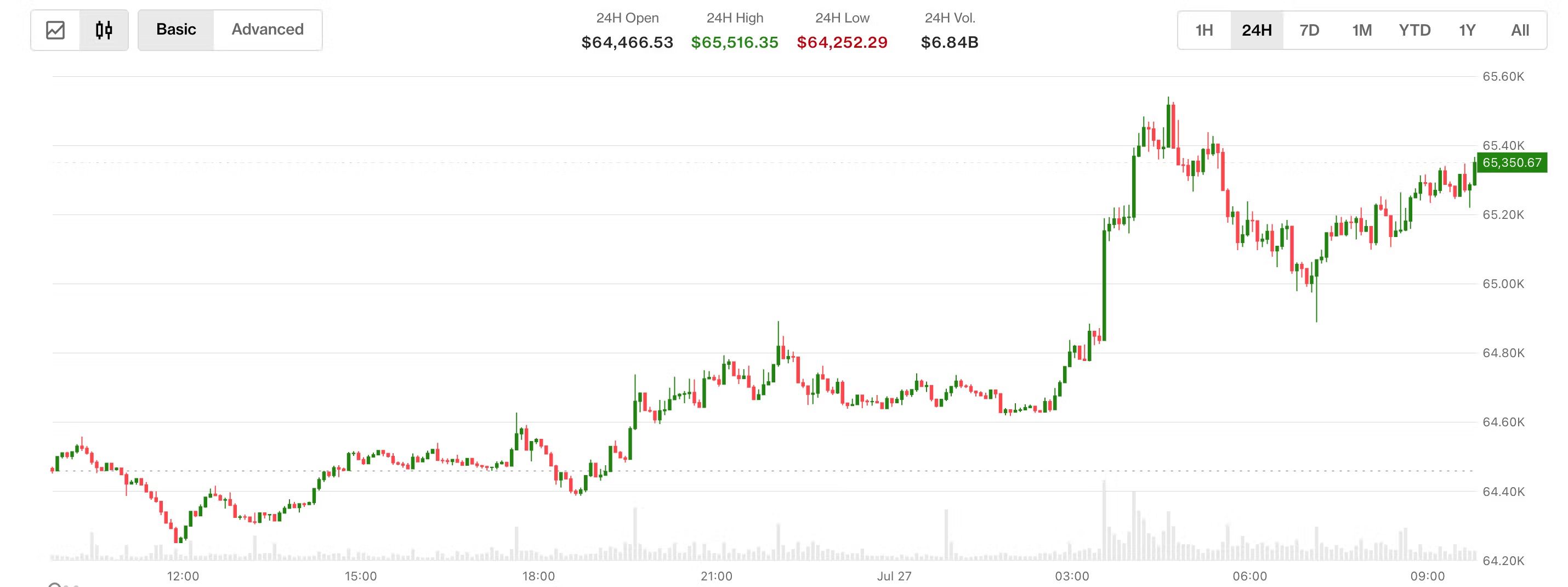
Compared to ETH, Bitcoin only saw a slight decline during the same period, still fluctuating around $65,400. This indicates that even with weakening risk appetite, investors remain more cautious about altcoins.
ETFs continued to see inflows, with leverage increasing in tandem.
Despite the price pullback, the US spot ETH ETF continued to see net inflows. On July 23, the product saw a total net inflow of $26.3 million, marking the fifth consecutive trading day of net inflows.
- BlackRock's ETHA saw a net inflow of $8.5 million.
- Fidelity FETH saw a net inflow of $14.9 million.
- Grayscale Mini Ethereum Fund sees net inflows of $2.9 million.
Institutional channels are also expanding. BancaStato in Switzerland has integrated with Sygnum's digital asset infrastructure, allowing its clients to trade Bitcoin, Ethereum, Solana, and USD Coin through their existing online and mobile banking services, adding a new compliant distribution channel for ETH.
However, leverage in the derivatives market is rising. CoinGlass data shows that as ETH approaches resistance, open interest increased by 600,000 ETH in two days, reaching 14.6 million ETH, the highest level since June 7.
After remaining positive for most of July, funding rates briefly turned negative on Thursday for the first time since June 29. In the past 24 hours, total leveraged positions liquidated reached $41.55 million, with approximately $34.4 million of that liquidation occurring in long positions. The rise in open interest coupled with negative funding rates suggests that both long and short positions are more susceptible to forced liquidation.
The area around $1850 has become a key short-term support level.
Looking at the 4-hour chart, ETH has returned to the lower edge of the upward channel that began in early July, with $1850 to $1880 forming the current support zone. If the price rises back above $1950, the upper channel target is roughly $2060.
The price difference between on-chain and exchange rates also indicates that US spot buying has not yet fully caught up with the recovery pace of ETFs. CryptoQuant's Coinbase Premium Index has been negative for nearly three consecutive months, indicating that ETH's trading price on Coinbase remains lower than that on offshore exchanges.
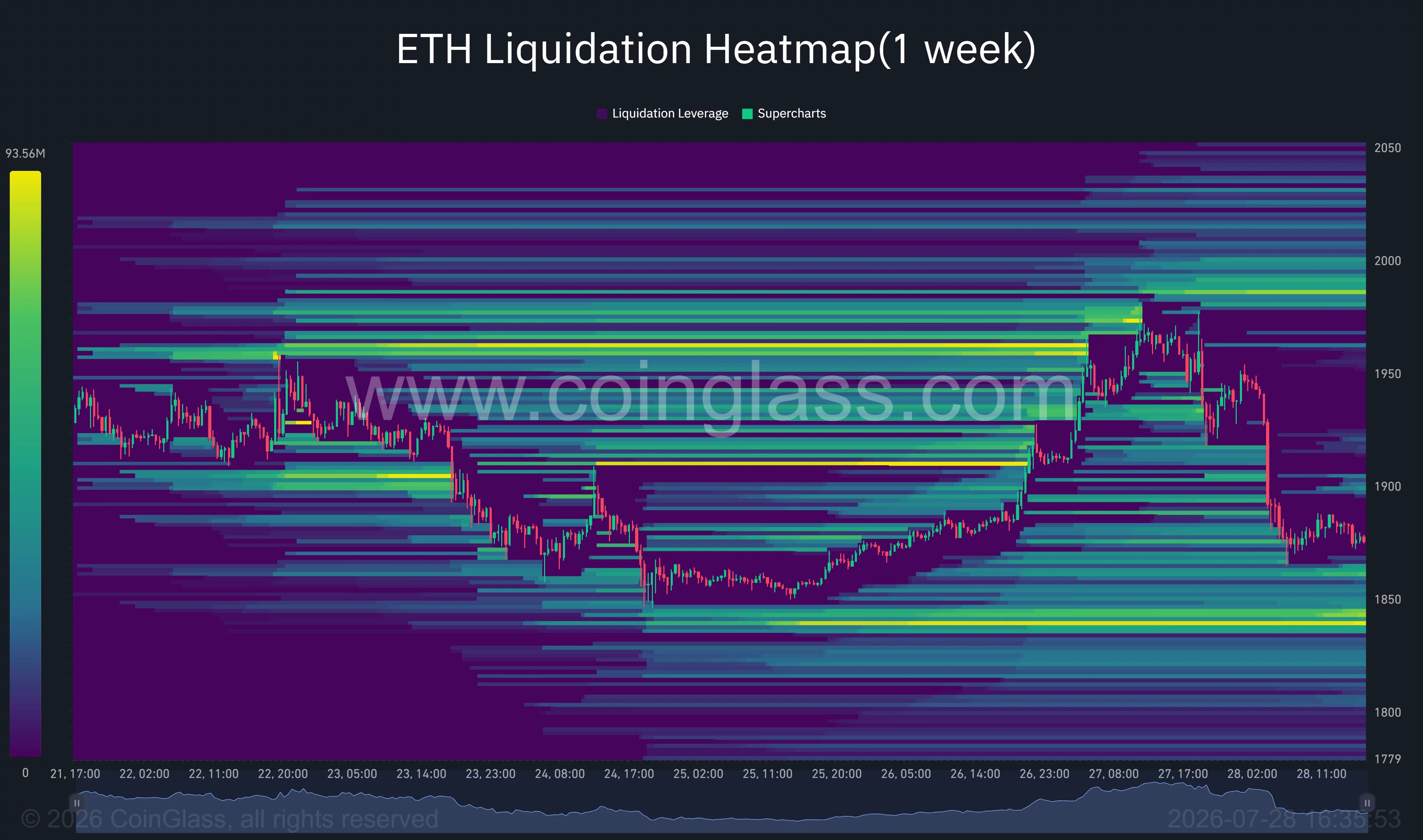
Regarding liquidation distribution, CoinGlass's weekly heatmap shows a cluster of closely spaced leveraged positions around $1900 to $1910, while a larger liquidation zone exists above $1955 to $1965. If the price rises to this area, it could trigger short covering and reopen the possibility of testing $2000.
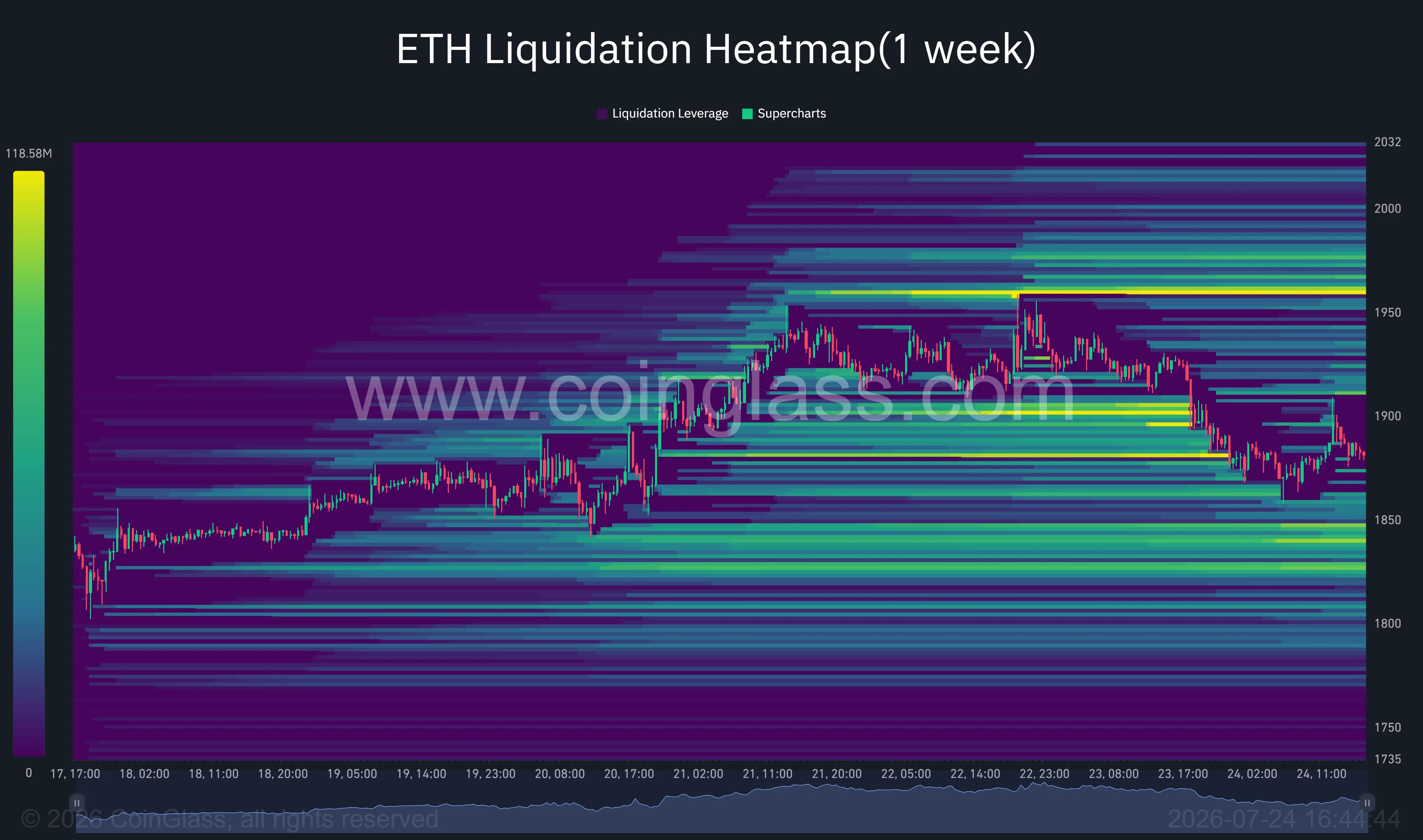
Liquidity is mainly concentrated between $1840 and $1850, followed by the area around $1820. If the price breaks below the lower channel line on the 4-hour chart and falls below $1850, the short-term rebound structure will be weakened, and the market will further focus on the $1816 and $1750-$1730 area.