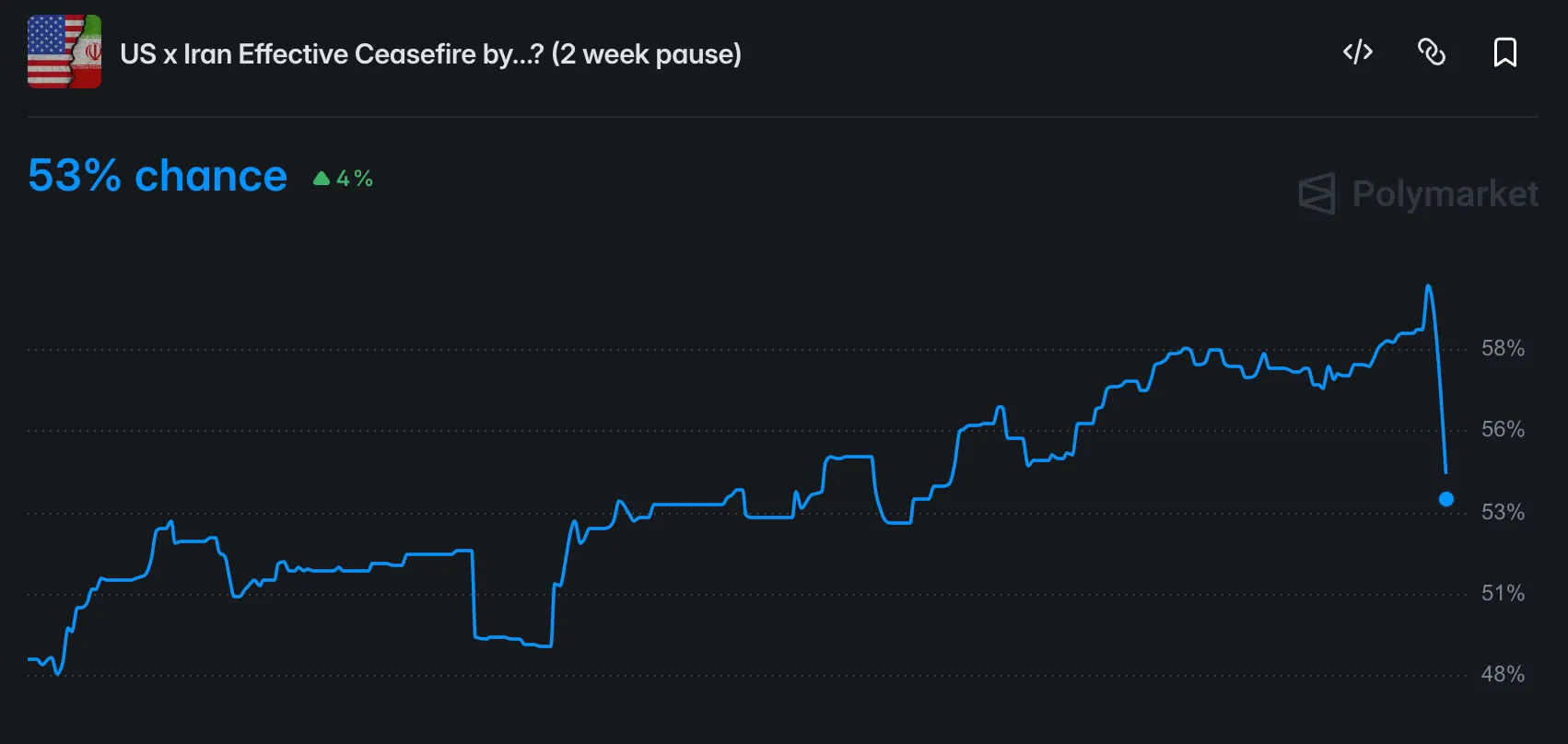
Following the US announcement of a ceasefire with Iran, the market forecasts have not shown a significant shift towards optimism. A Polymarket contract directly related to the situation indicates that traders remain cautious about whether the ceasefire can last for two weeks, reflecting market concerns about the ongoing turmoil in the Middle East.
The probability of a 14-day ceasefire has decreased.
The contract stipulates that the United States refrain from directly striking Iranian territory with airstrikes or surface-to-surface missiles for 14 consecutive days. Latest data shows that the probability of this agreement being signed has fallen from over 60% to approximately 53%, a drop of about 10 percentage points in a single day.
Based on this price, the market currently views the "ceasefire lasting two weeks" as a 50/50 chance. In other words, although the United States has announced a ceasefire, traders do not believe the situation has stabilized.
- Contractual Target: No direct US military strikes against Iran for 14 consecutive days
- Probability change: from over 60% to approximately 53%
- Observation period: 14 days. Ceasefire windows must be established consecutively.
Trump says military operations may resume
As of Monday, no new clashes had occurred between the US and Iran for the third consecutive day. However, US President Trump told Axios that the US was prepared to resume "very strong military action" if diplomatic efforts failed. This statement undermined market confidence in the long-term sustainability of the ceasefire.
Meanwhile, Iran denied that direct negotiations were taking place, stating that information was currently being relayed through mediators. For the market, this means the formal de-escalation mechanism remains fragile, and the ceasefire remains largely in a precarious state.
Betting on the progress of negotiations leans towards delay.
Besides the ceasefire agreement, the market is also watching whether the US and Iran will soon begin formal high-level talks. Another contract tracked by Myriad, a prediction market developed by Dastan, the parent company of Decrypt, shows that most funds are betting that the next round of formal high-level peace talks will not begin before July 31.
The contract rules explicitly state that technical meetings, telephone communications, and messages relayed through intermediaries are not considered formal high-level talks unless such contacts are incorporated into a formal high-level negotiation arrangement.
The market has reacted similarly before. A ceasefire announcement in April boosted Bitcoin and oil prices, but analysts subsequently described it as a brief respite. A few days later, the market remained skeptical about whether shipping in the Strait of Hormuz could return to normal, as some vessels were still turning back to avoid danger.