

Foreign media commentators believe that while the tokenization of real-world assets has been widely accepted by large financial institutions, on-chain RWA perpetual contracts are expanding at a faster pace. These products are attracting more funds and trading demand due to their 24/7 trading availability, low barrier to entry, and faster pace of new product launches.
Trading volume and open interest increased rapidly.
The article cites data showing that RWA perpetual contracts traded $347 billion in May, a significant increase from $230 million at the beginning of 2025. By July, the average daily open interest on decentralized exchanges alone had risen to a new high of $4.5 billion.
The author also stated that as of the end of May, the cumulative trading volume of such products on relevant exchanges had reached $1.32 trillion. At the beginning of the year, RWA perpetual contracts accounted for only 1.3% of the on-chain perpetual market, but this has now risen to 31%.
- Trading volume in May was $347 billion.
- Daily open interest on DEXs rose to $4.5 billion in July.
- The proportion of on-chain perpetual blockchains increased from 1.3% to 31%.
24/7 transactions are seen as a selling point.
The article argues that part of the reason for the growth of RWA perpetual contracts is that crypto traders want exposure to assets such as commodities and AI stocks. Compared to futures and options in traditional markets, perpetual contracts are more straightforward in terms of trading time and product structure.
The article cites the example of how, during conflicts related to Iran, perpetual crude oil contracts on Hyperliquid reflected price changes before trading resumed on the CME Group. The author argues that on-chain perpetual markets can continue price discovery even when traditional markets are closed.
The pre-IPO market was specifically named.
The article argues that another reason for the faster expansion of RWA perpetual contracts is their ability to launch new markets more quickly than tokenized assets. Tokenized products often involve longer issuance processes and more complex legal arrangements, while perpetual contract markets offer greater flexibility in launching new products and make it easier to test new themes.
The author cites the pre-IPO market as a prime example. The article states that when Cerebras listed on Nasdaq in May, the pre-IPO perpetual contracts on Hyperliquid were priced at approximately $354, close to the opening price of $350, but significantly higher than the $185 IPO price set the previous night.
- The perpetual trading volume of stocks is approximately 13 to 20 times that of spot trading.
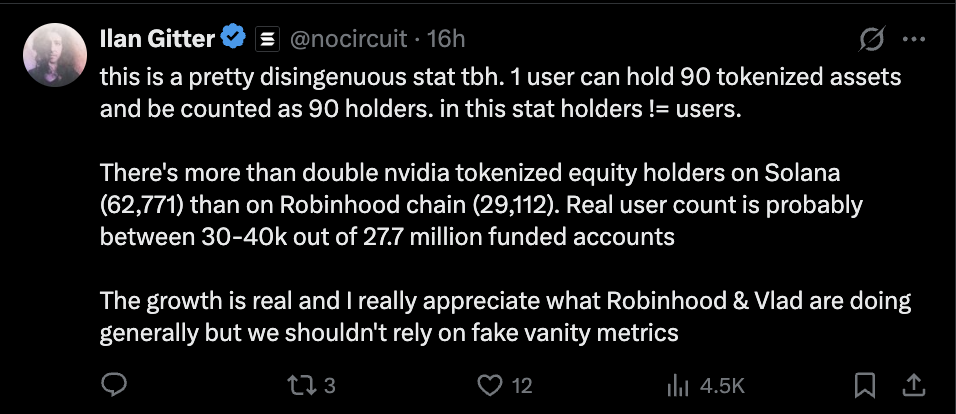
- The number of tokenized stock wallets is 180,845.
- The number of perpetual shareholders is 24,378.
The article concludes by suggesting that with Robinhood already offering RWA perpetual contracts to its European clients, more retail brokerages are likely to follow suit. The author argues that perpetual contracts may not only be used for crypto assets in the future, but could also become a trading gateway for a wider range of asset classes.

Additional information:Martin Lee, the author of this article, is the Head of Market Insights at DWF Labs. The original article was published on CoinDesk's Opinion section, and the opinions expressed in the article primarily represent the author's personal views.