Tokenized ETF holders hits an all-time high
Finbold
05-21 01:29

The number of unique holders of tokenized exchange-traded funds (ETFs) surged 11,803% year over year (YoY) to an all-time high (ATH) on May 20.

As of press time, the number of tokenized ETF holders was about 44,400, up from 373 a year ago, according to metrics from Token Terminal analyzed by Finbold. Consequently, the unique addresses holding tokenized ETF surged by approximately 119-fold YoY.
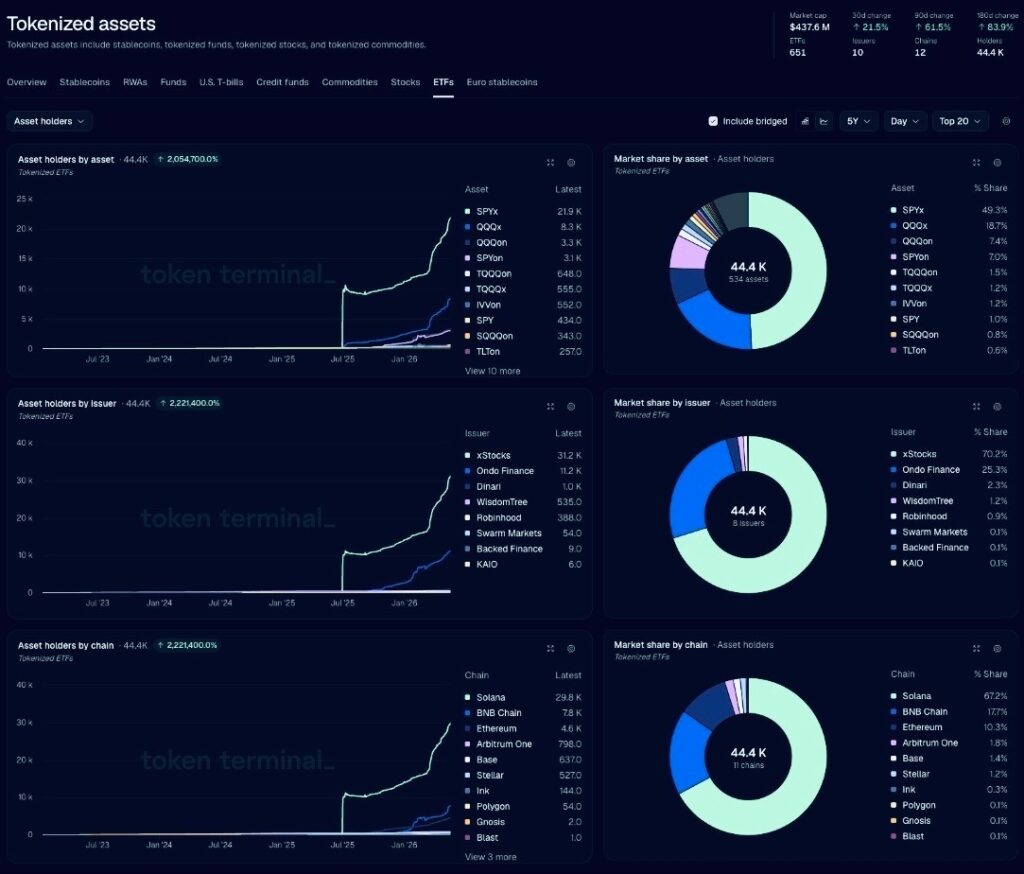
Tokenized assets analysis. Source: Token Terminal

With the growing number of investors in tokenized ETFs, the sector has grown in tandem, reaching a market capitalization of roughly $437.6 million at the time of publication. The most demanded tokenized ETFs among these users over the past year have been SPYx (SPDR S&P 500 ETF Trust) and QQQx (Invesco QQQ Trust), with market shares of 49.3% and 18.7%, respectively.

Notably, the Solana (SOL) network accounts for the sector’s lion’s share, currently estimated at around 67.2%. Meanwhile, the BNB chain and the Ethereum (ETH) network account for roughly 17.7% and 10.3%, respectively, of the total tokenized ETFs.

Why is the tokenized ETF space ballooning?

The tokenized ETFs space has ballooned over the past year, driven by 24/7 global trading, ultra-low costs in Decentralized Finance (DeFi), regulatory clarity, and self-custody. With tokenized traditional ETFs on DeFi, more users can seamlessly trade and earn yields unavailable on traditional platforms.

Worth noting, this sector offers crypto users more options to diversify their portfolios with less-volatile assets, without trading restrictions. Moreover, unlike DeFi protocols, which operate continuously and are open to anyone, traditional stock markets close at night and on weekends and often restrict retail access due to geographical limits.

The growth of this space has been heavily influenced by the regulatory clarity in the United States. Under the chair of Paul Atkins, the U.S. Securities and Exchange Commission (SEC) has approved the listing of tokenized assets.

Tip
$0
Like
0
Save
0
Views 187
HQYC reminds readers to view blockchain rationally, stay aware of risks, and beware of virtual token issuance and speculation. All content on this site represents market information or related viewpoints only and does not constitute any form of investment advice. If you find sensitive content, please click“Report”,and we will handle it promptly。
Submit
Comment 0
Hot
Latest
No comments yet. Be the first!
Related
web3: Foreign media: SOL falls below $110, with $133 still being the upper target
SOL fell back after encountering resistance around $110. Foreign media reports that the range of $102 to $95 is a key support level for the short term; if this level can be held, the subsequent target remains at $133.
CoinPedia
·2026-08-30 12:11:26
22
Ethereum: Foreign media: The CLARITY bill may reshape the regulation of BTC, ETH, and XRP
Foreign media reports that the US CLARITY Act aims to clarify the boundaries between securities and commodities of crypto tokens, and it will affect the regulation of BTC, ETH, XRP as well as trading platforms.
CoinPedia
·2026-08-30 12:11:23
27
South Korea Tightens Leverage Requirements; ETF Trading Volumes Drop Significantly After Access
South Korea reduces leverage on individual stocks ETF by raising thresholds and mandating simulated transactions, resulting in a decline in both the trading volume of related products and the asset size.
Wall Street CN
·2026-08-30 10:03:52
25
LuLu uses USDC for cross-regional settlement: 24-hour remittance processes still need to comply with regulations and ensure local currency settlement
Circle released a case in August stating that LuLu Financial Holdings uses USDC to support cross-regional remittance settlements in the Gulf, Middle East, and Asia-Pacific regions. The case study describes a specific institution using stablecoin infrastructure in a particular business process and should not be extrapolated to imply that the entire regional remittance system has been fully digitized on-chain. Cross-border remittances involve licensing for both the sender and recipient, bank cooperation, foreign exchange conversion, customer identity verification, anti-money laundering checks, and local cash or account payment networks; on-chain settlement can improve one of these processes, but it does not necessarily replace all of them.
币界网
·2026-08-30 10:02:46
75
Circle Mint Expands support for 8 local currencies for deposits and withdrawals: The addition of channels does not mean individual users can use them directly
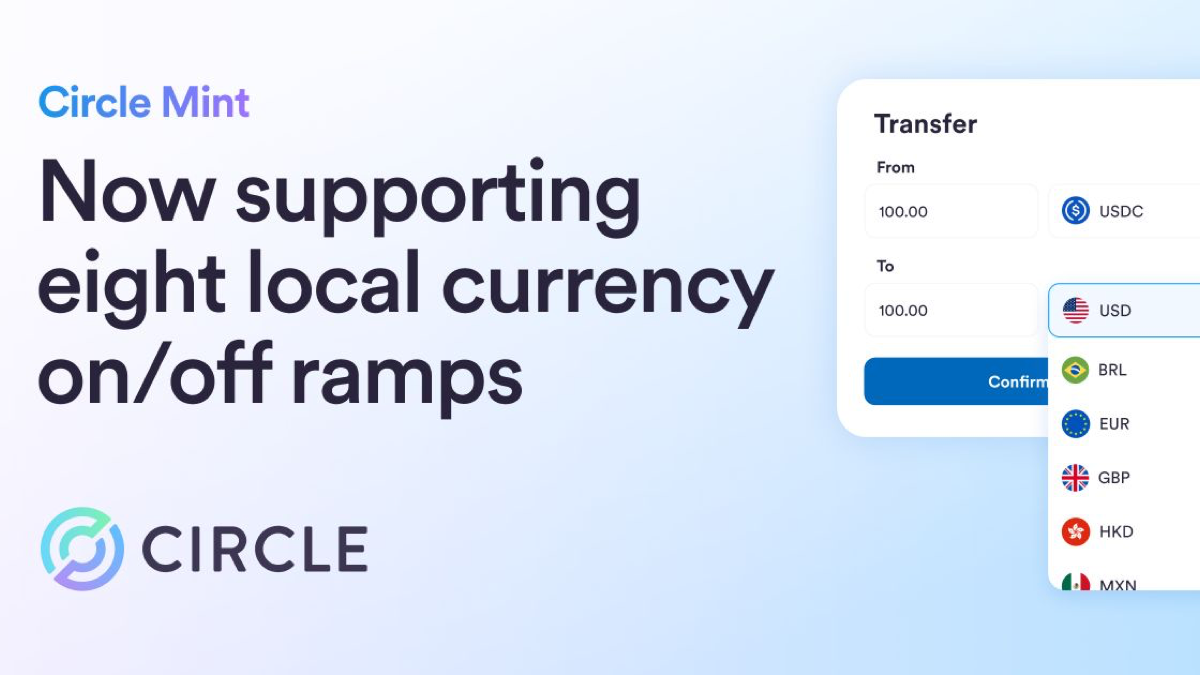
Circle announced in August the expansion of the local currency deposit and withdrawal capabilities of Circle Mint, adding 8 new local currency channels. The core of such updates is how institutions can convert fiat funds into on-chain stablecoins, followed by redemption and settlement; this is not a retail wallet feature available to all individual users. Circle also emphasizes in its public statement that Mint is mainly targeted at institutions, and specific services are subject to restrictions based on location, account qualifications, banking partnerships, and compliance requirements. Describing "new channels" as "free withdrawals for everyone" is not only inaccurate but also overlooks the most important access limitations in the use of stablecoins.
币界网
·2026-08-30 10:01:42
73
View More