

The US Senate recently shifted its agenda to sanctions bills against Russia and Iran, as well as federal nominations, while the CLARITY bill, which was previously of great interest to the crypto industry, has not yet made it onto the priority voting list. This further tightens the timeline for the bill's progress before the August recess, and the market has quickly cooled its expectations for legislation this year.
Through probability fallback
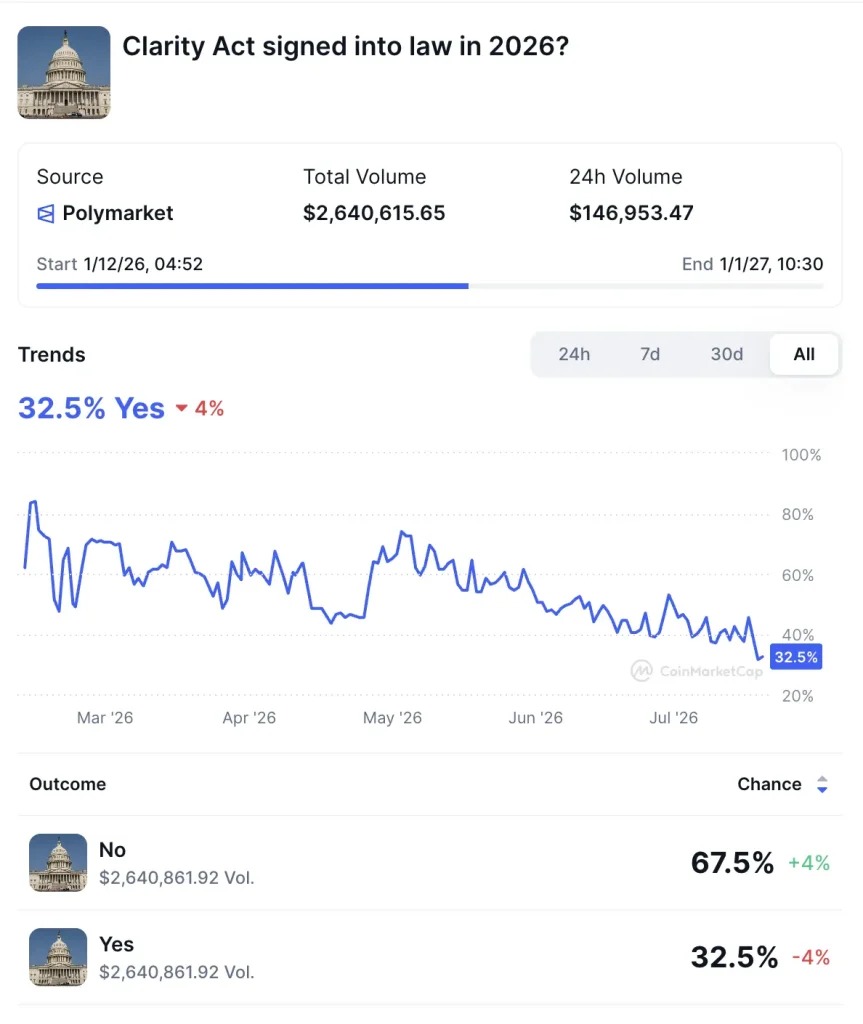
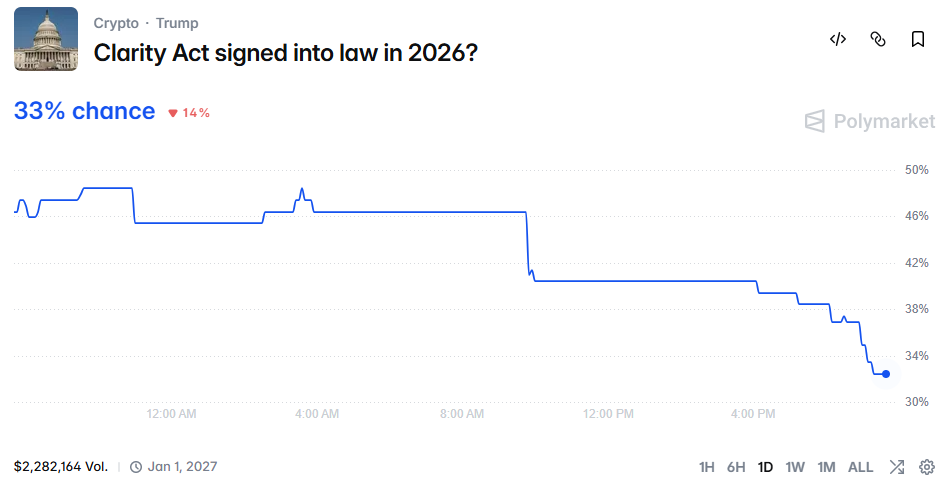
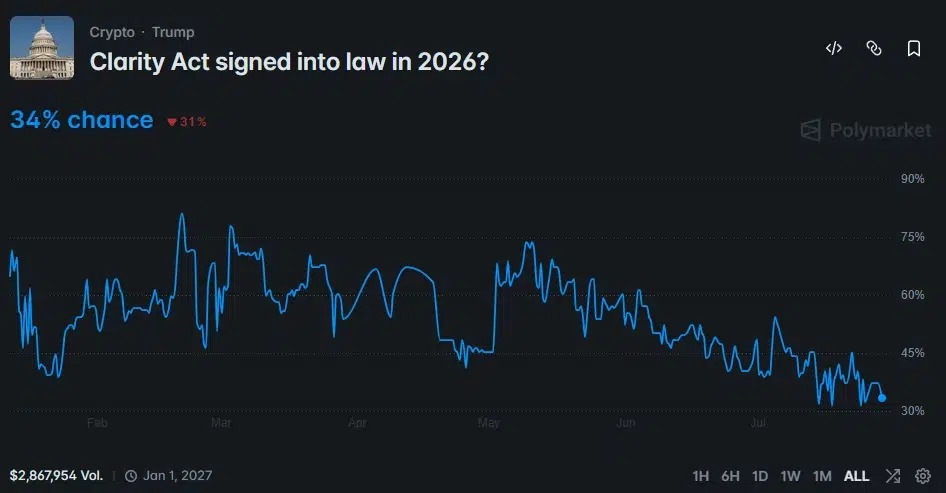
According to Polymarket, a market research firm, the probability of this bill becoming law by 2026 is about 34%, a significant drop from 53% on July 21. Alex Thorn, head of research at Galaxy Digital, gave an even lower estimate of about 30%.
He believes the biggest problem is not the bill itself, but the Senate's lack of available time. If the Senate session cannot be initiated soon, the time for subsequent procedural votes and debates will be compressed.
Senate vote space is limited
A bill in the U.S. Senate requires 60 votes to overcome the obstruction threshold. Republicans currently hold 53 seats, but not all Republican senators have explicitly endorsed the bill.
According to Thorn's assessment, the actual number of Republican votes that can be reliably secured is likely closer to 50. If this assessment is correct, the bill would still need the support of about 10 Democratic members of Congress to have any chance of moving forward.
The Senate Banking Committee passed its version of the bill by a vote of 15 to 9 in May, with two Democratic senators voting in favor. However, both senators stated at the time that committee-level support did not guarantee continued support in the full Senate vote, particularly regarding ethical provisions concerning public officials' interests in cryptocurrencies, and they hoped to see further amendments.
Party divisions continue to widen
After Trump accepted the inclusion of ethical restrictions in the bill, the market initially raised its expectations for its passage. However, with the Senate deadline being postponed, this optimism has clearly been eroded.
Anthony Scaramucci, founder of SkyBridge Capital, said that resistance within the Democratic Party is likely to persist, partly because Trump has included the bill in his own political agenda. Charles Hoskinson, founder of Cardano, echoed this view, arguing that the political narrative surrounding Trump is making the issue of crypto regulation more visibly partisan.
Democrats, on the other hand, continue to demand stronger consumer protections, greater law enforcement authority, and restrictions covering the indirect financial interests of public officials. Even with some concessions made by Republicans, the number of publicly endorsed voters is still insufficient to guarantee crossing the 60-vote threshold.
If the Senate ultimately passes a text that differs materially from the House version, the bill will have to return to the House for further processing, meaning there will be additional procedures before it is sent to the president for signature.
Bitcoin and ETF funds are both under pressure.
Bitcoin briefly traded at around $63,800 as progress on the bill slowed, a single-day drop of about 1.6%, with intraday trading ranging between $62,772 and $64,953.
However, the market pullback may not be solely driven by the postponement of the bill. Macroeconomic conditions, derivatives positioning, and weakening demand will also affect the short-term performance of crypto assets.
On July 27, US spot Bitcoin ETFs saw a net outflow of $11.64 million, with BlackRock IBIT experiencing a net outflow of $8.82 million. In contrast, Ethereum funds saw a net inflow of $9.23 million, and XRP ETFs saw a net inflow of approximately $592,000.
If the Senate does not initiate the relevant procedures before the August recess, the US crypto market will likely continue to maintain a regulatory landscape of parallel regulation by the SEC, CFTC, court precedents, and state-level rules in the short term, rather than forming a unified federal market structure framework.