

Foreign media reports that Ripple's USD stablecoin RLUSD has been listed for spot trading in Korean won on two major South Korean cryptocurrency exchanges, Upbit and Bithumb. However, judging from its actual performance since its launch, the liquidity of this new trading pair remains weak, and the price has not been able to stabilize around $1.
The Korean exchange has completed its launch.
Bithumb launched RLUSD/KRW spot trading, just one day after Upbit. With this, RLUSD is now available on two major South Korean cryptocurrency exchanges.
The article states that, in terms of market infrastructure, local support in South Korea is largely in place. Custodian BDACS has previously provided compliant institutional custody services for XRP and RLUSD, meaning that trading and custody processes are already integrated.
High ranking but weak transaction volume
According to CoinMarketCap data, the Korean won trading pair for RLUSD quickly rose to a high position in the market rankings of this stablecoin after its launch. However, the article argues that this ranking reflects more the limited number of global trading pairs for RLUSD than the substantial trading activity already occurring in the Korean market.
The article mentions that the combined share of South Korea's two major exchanges in global RLUSD trading volume is still less than 1%. Under these circumstances, the South Korean market has a very limited influence on the global pricing of RLUSD, and local trading is relatively independent.
Price below $1
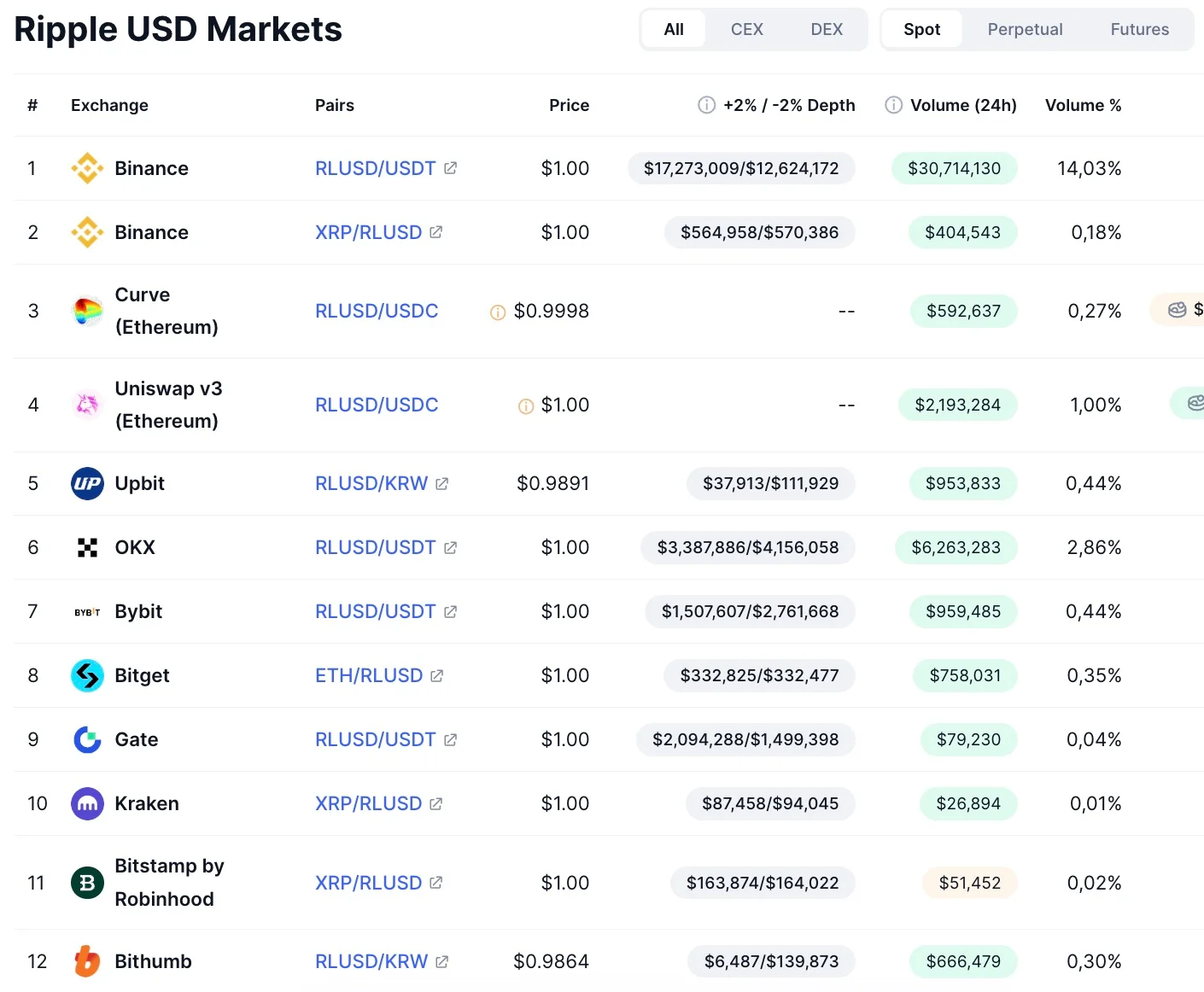
The article points out that there is a significant imbalance in the buy and sell order depth for RLUSD on Upbit. Within a 2% price range, the buy order size is significantly lower than the sell order size, indicating insufficient buying power.
- The purchase price was approximately $37,900.
- The sell orders totaled approximately $111,900.
- The discount range is approximately 1% to 1.5%.
As a result, RLUSD traded at around $0.986 to $0.989 in the South Korean market, below the $1 level that stablecoins should typically maintain.
Market making and arbitrage have not yet caught up.
The article argues that a direct reason for the current discount is the lack of an effective local market-making and arbitrage mechanism. Exchange prices have failed to converge with global markets in a timely manner, leading to the undervaluation of RLUSD in the Korean won market.
In this scenario, if users buy, sell, and exchange in the local market, the actual transaction price may be lower than expected. Based on this, the article concludes that although RLUSD has been listed on major South Korean platforms, the trading pair is still in an early stage characterized by insufficient liquidity and price instability.
We'll see how liquidity is replenished going forward.
The article states that whether the South Korean market can form a more stable RLUSD trading system depends on whether more corporate funds and market makers enter the order book, increasing bilateral depth and narrowing price deviations.
If liquidity remains insufficient, even if the Korean won trading pair has been launched, it will be difficult for it to assume the pricing and exchange functions commonly found in stablecoins in the short term.