

The U.S. Senate has stalled the CLARITY Act, a bill that establishes the crypto market, further cooling the progress of this digital asset legislation. With lawmakers recently focusing on sanctions against Russia and federal appointments, the time available for Congress to process the bill before its August 8 recess has been further reduced.
Senate time window narrows
Despite the postponement of the vote, negotiations between the two parties have not stopped. The latest revised version has been finalized after multiple rounds of consultations between Republican and Democratic lawmakers and has reportedly garnered initial support from some Democrats. Senator Catherine Cortez Masto stated that the latest version sent to the White House makes all parties "feel good" about resolving the issue.
After Senate Majority Leader John Thune suspended the bill's passage, industry groups began urging him to initiate procedural steps to end the debate, at least before senators leave Washington. Even if the Senate cannot reach a final vote in the near future, a procedural vote can still indicate whether the bill has sufficient bipartisan support.
The bill focuses on the division of regulatory responsibilities.
The core objective of the CLARITY Act is to establish a more comprehensive regulatory framework for the U.S. digital asset market and clarify the boundaries of responsibility between the Securities and Exchange Commission (SEC) and the Commodity Futures Trading Commission (CFTC). Specifically, the CFTC will gain regulatory authority over the spot market for digital commodities.
Supporters argue that clear legislation will help crypto companies expand their operations and increase investment in the United States, while reducing the risk of regulatory shifts due to changes in government. Previously, during the enforcement cycle led by Gary Gensler, many crypto companies moved their operations overseas. Although the current SEC has withdrawn some lawsuits and adopted a more moderate stance, the industry still believes that regulatory policies alone are insufficient to provide long-term stable expectations.
The banking industry and the SEC are putting pressure on each other simultaneously.
American Bankers Association CEO Rob Nichols told CNBC that the banking industry supports establishing a regulatory framework for digital assets and acknowledges the opportunity for the U.S. to become a "global crypto hub." However, the industry hopes for minor, targeted amendments to the bill, focusing on limiting the excessive diversion of bank and credit union deposits by interest-bearing stablecoins, which could impact lending capacity.
Meanwhile, SEC Chairman Paul Atkins stated that if Congress ultimately fails to pass legislation, the SEC is prepared to develop rules for the crypto market based on its existing authority. Atkins said the SEC could issue rules on issues such as digital tokens, trading platforms, and tokenized securities, but he also emphasized that legislation remains the better option because institutional rules could still be adjusted by a new administration in the future.
Market expectations have cooled significantly.
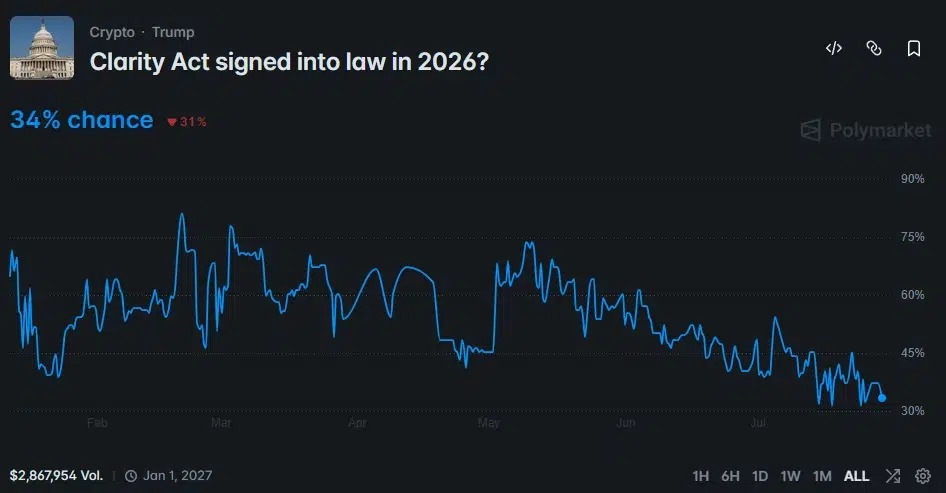
Following the Senate's delay in enacting the bill, market forecasts quickly weakened. Polymarket's data on July 29 showed only a 27% chance that the CLARITY Act would become law in 2026, a new low for forecasts related to the bill.
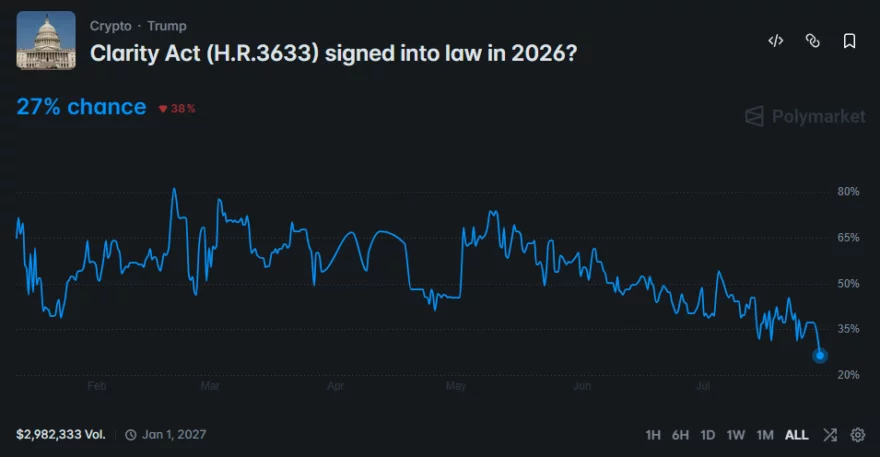
However, Coinbase Chief Policy Officer Faryar Shirzad remains optimistic. He points out that the House of Representatives had previously passed relevant legislation with bipartisan support, and the latest Senate amendments have incorporated more Democratic concerns, including enforcement and consumer protection clauses. He believes the Senate may still schedule a vote as early as August 3 and complete the process before the August recess.