

Japan's grain self-sufficiency rate, calculated based on calorie content, dropped to 37% in the fiscal year 2025, hitting a historic low. The rounded figure released by Japan's Ministry of Agriculture, Forestry and Fisheries indicates a decrease of 1 percentage point from the previous year and is also lower than the previous low level recorded in the fiscal year 2020, once again drawing attention to the issue of food security.
Rice shortage drives up imports
Rice was originally one of Japan's most representative native staple foods, but this time it has become a hindering factor. Due to insufficient supply and a noticeable increase in retail prices, consumers and businesses have begun to turn to imported rice, with some large Japanese supermarkets already stocking rice from California, USA.
In 2025, Japan's civilian rice imports rose to 96,834 tons, which is approximately 95 times that of the previous year. In particular, imports from the United States amounted to 75,638 tons, accounting for about 78% of the total imports. Even though a tariff of 341 yen per kilogram is still required for civilian rice imports, the scale of imports has significantly increased.
The government releases emergency reserve rice
During periods of tight supply, the Japanese government also released hundreds of thousands of tons of emergency reserve rice to ease market pressure. At that time, retail rice prices temporarily rose to about twice the level of the same period last year, indicating that the imbalance between domestic supply and demand had clearly been transmitted to the end-market.
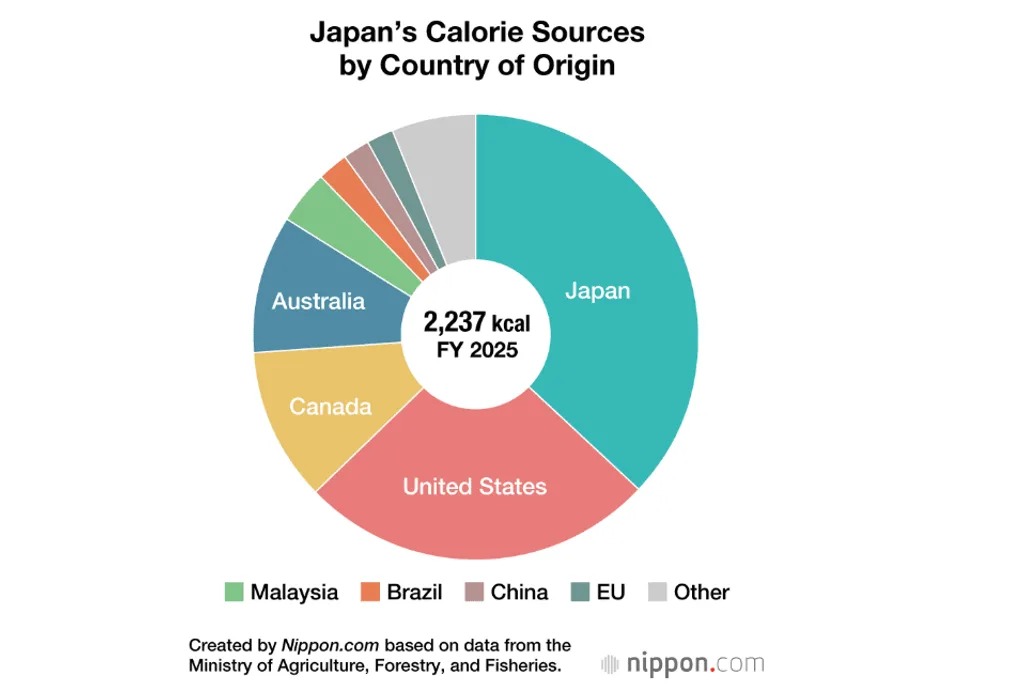
This also indicates that the decline in food self-sufficiency rates is not merely a change in statistical methodology, but rather a concurrent change in staple food supply, prices, and import structures. For an economy that has long relied on the global supply chain, fluctuations in rice, a core commodity, are of more representative significance.
There is still a distance to reach the 2030 goals.
The Japanese government hopes to increase the self-sufficiency rate of food calculated in terms of calorific value to 45% by the fiscal year 2030, and to raise the self-sufficiency rate calculated based on output value to 75%. However, this calorific value-based indicator has been below 40% for over a decade, and there is still a significant gap from the target.
In contrast, the grain self-sufficiency rate calculated based on output value increased by 2 percentage points to 66% in the fiscal year 2025. This is mainly due to rising domestic food prices, which have increased the nominal value of Japan's agricultural output, but it does not mean that the actual supply capacity has improved accordingly.
Japanese agriculture also faces the problem of a continuous decline in the labor force. By 2026, it is estimated that there will be about 987,000 core agricultural workers in Japan, with an average age of 67.7 years. In addition to addressing the current rice shortage, Japan also needs to deal with long-term pressures such as an aging agricultural population, limited domestic production capacity, and a high dependence on imports.