

U.S. spot Bitcoin ETF saw net inflows for 9 consecutive trading days, but on August 28th, it turned into a net outflow of $201.9 million. Bitcoin subsequently fell, but as of press time, it still remains above $77,000 per coin. The market is also paying attention to the latest statements from the Federal Reserve regarding their impact on risk assets.
ETF turned into outflows in a single day
Farside Investors Data shows that on August 28, US spot Bitcoin ETF had a total net outflow of $201.9 million, ending the previous nine consecutive trading days of net capital inflow.
Among them, Morgan Stanley's MSBT recorded a net inflow of $9.3 million, which partially offset the redemption pressure, while the remaining listed funds did not show any significant net changes on that day.
Compared to the net inflow of $242.3 million on August 27th, there was a reversal of $444.2 million in the direction of funds on a single day. However, looking at the entire week from August 24th to 28th, this ETF still attracted a cumulative inflow of $924.5 million in funds.
BTC fell below $80,000 before pulling back
Bitcoin previously attempted to stabilize above $80,000 and reached around $81,200 earlier this week, but then faced selling pressure. On August 29th, BTC experienced a 2.9% 24-hour decline, falling to around $77,078 at one point before returning to the vicinity of $77,500.
From a short-term perspective, the middle band of the Bollinger Bands is at $78,815, while the lower band has risen to $76,992, approaching the support range of $76,500 to $77,000. If this area is lost, the market may continue to test lower levels; if it can be held, there is still a chance to revisit $78,000.
The Fed indicates a desire to suppress risk appetite
The report mentioned that the market decline is related to the policy statements made at the Jackson Hole Conference. Federal Reserve Chairman Kevin Warsh stated that current inflation is still above the Fed's target, and the overall financial environment cannot be considered sufficiently tight.
In his speech on August 28, he stated that the inflation target favored by the Federal Reserve was 3.7% calculated over 12 months and 4.1% calculated over 6 months, both of which are higher than the 2% target. This statement weakened market expectations for short-term easing policies.
For the Bitcoin market, maintaining high interest rates usually increases the attractiveness of cash and government bonds, and may also reduce the amount of capital flowing towards high-volatility assets.
Short-term liquidity is concentrated between $78,500 and $80,500.
The 24-hour clearing heat map of CoinGlass shows that the liquidity above Bitcoin is mainly concentrated in the range of $78,500 to $79,000 and around $80,300 to $80,500; below, there is a more noticeable accumulation of liquidity in the range of $76,700 to $77,000.
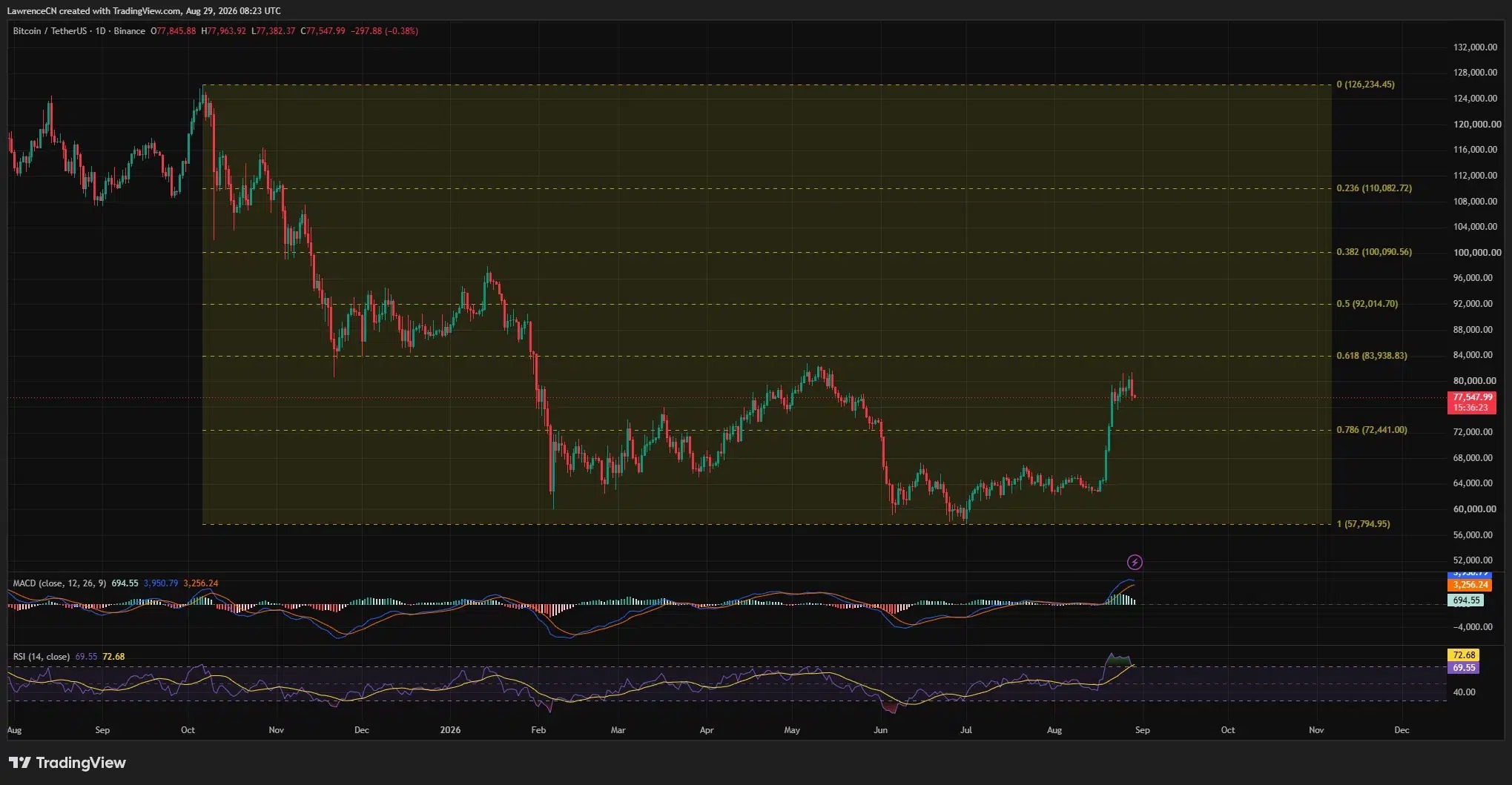
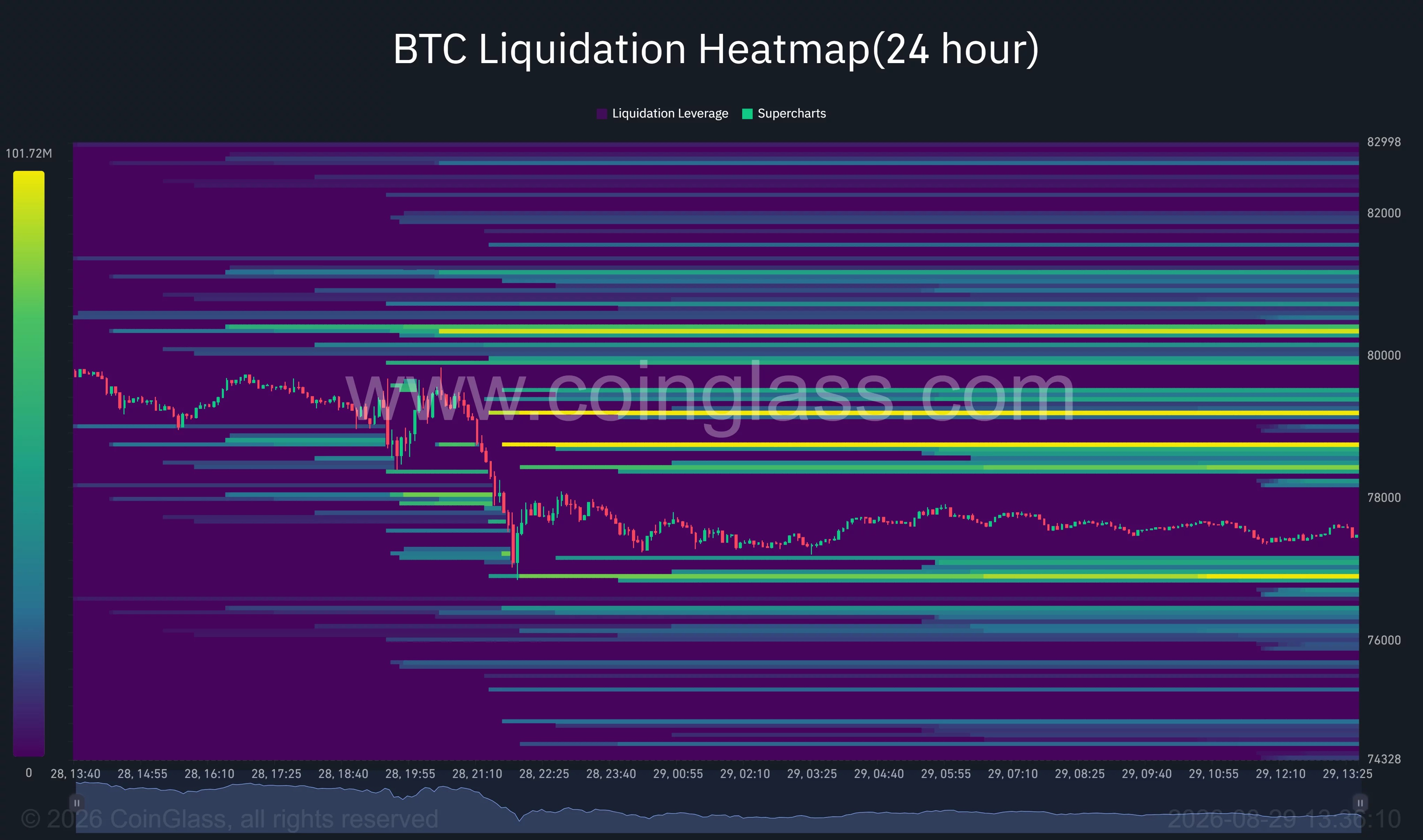
If the price reclaims the range of $77,800 to $78,000, the downward pressure in the short term is expected to ease. Subsequently, the resistance levels will be around $78,800, as well as the range of $79,200 to $80,000. If it falls below $76,500, the market may move further towards the range of $75,700 to $76,000, or even to the area of $72,000 to $74,500.