


On August 30th, SpaceX carried out a launch mission at the Kennedy Space Center in Florida, using a Falcon Heavy rocket to send the Nancy Grace Roman Space Telescope of NASA to the second Lagrangian point of the Sun-Earth system ( L2 ). This mission, with a total cost of about 4 billion US dollars, is one of the most important new-generation space observation projects in NASA in recent years.
Reuters confirms that this launch has been successfully completed. According to the plan, the Roman telescope will complete its flight, system deployment, instrument calibration, and in-orbit testing within about three months, after which it will enter the formal scientific observation phase.
Executed nine months ahead of schedule
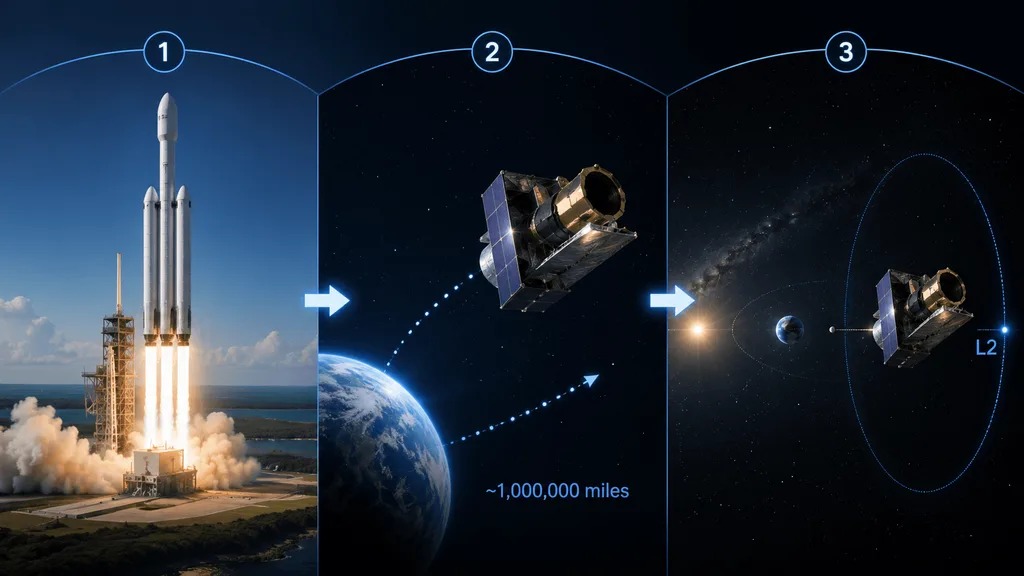
NASA advanced the launch time of this flagship scientific mission by about nine months, which is not common among projects of the same level. The target orbit for the Roman Telescope on this mission is located at a point approximately 1 million miles from Earth, known as L2, a location suitable for long-term deep space astronomical observations.
NASA It is expected that this telescope will be used to map the distribution of billions of galaxies, study dark energy and dark matter, and expand the search for planets outside our solar system. According to official statements, its survey mission is expected to discover about 100,000 new exoplanets.
The field of view is much larger than that of Hubble.
The core advantage of the Roman telescope does not lie in making deeper observations at a single time, but in its ability to observe the sky over a larger area simultaneously. NASA indicates that its field of view is at least 100 times that of the Hubble Space Telescope, while maintaining similar sensitivity and resolution in many observation tasks.
This means it is more suitable for performing large-scale sky survey tasks. The international media generally regard it as a complement to the Hubble and James Webb Space Telescopes: the former is adept at detailed observations, while the latter focuses on infrared deep space research; however, the Roman telescope places greater emphasis on wide-area imaging and three-dimensional cosmic mapping capabilities.
Falcon Heavy still undertakes critical missions
This task also occurred during the SpaceX rocket business adjustment period. Just a few days before the launch, Musk stated that once the Starship is able to achieve multiple launches per week stably, SpaceX will eventually phase out the Falcon 9 and Falcon Heavy, shifting more engineering and manufacturing resources towards the Starship.
However, Roman reiterates that it will still be difficult for the Falcon series to be phased out in the short term. For high-value government payloads that require extremely high reliability, the Falcon Heavy remains a proven and mature option. NASA According to the introduction, the Falcon Heavy's three-stage booster configuration is equipped with 27 Merlin engines, providing a thrust of about 5 million pounds.
This is also the sixth major mission carried out by NASA at the Kennedy Space Center using the SpaceX Falcon rocket, with previous missions including Psyche, Europa Clipper, and IMAP among others.
From a corporate perspective, this launch reinforces the current dual narrative of SpaceX. On one hand, the Falcon rocket remains an important platform for government space missions; on the other hand, market attention to the company's future growth is increasingly shifting towards Starship, Starlink, and its expanding AI business.