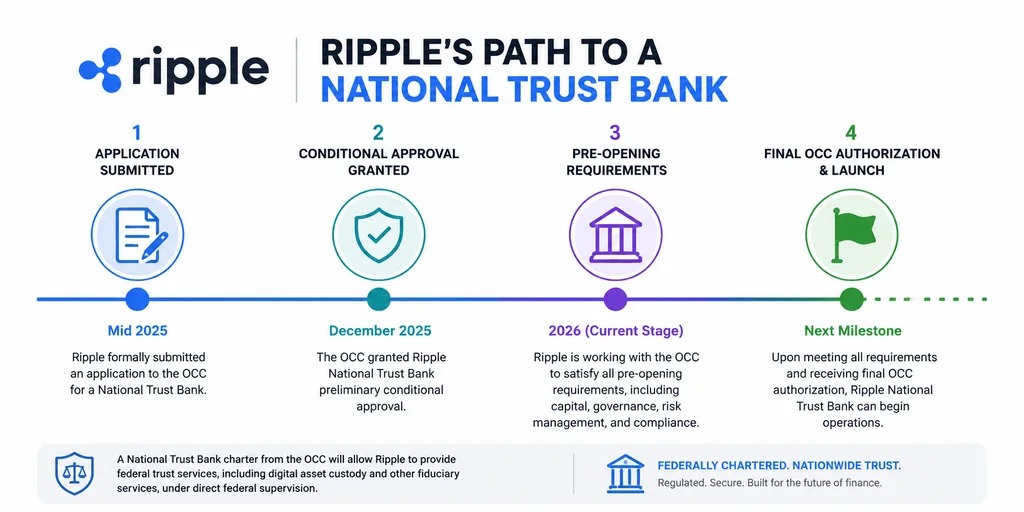


World Liberty Financial takes another step towards entering the US federal regulatory banking system. Its subsidiary, World Liberty Trust Company, received conditional preliminary approval from the US Federal Reserve (OCC) on August 14 to establish a national trust bank. If all subsequent requirements are met, the issuance, reserve custody, and management of USD1 stablecoins will be able to be carried out under the same federal regulatory entity.
Still not the final bank license
This approval does not equate to officially obtaining a banking license. According to reports, World Liberty Trust Company still needs to meet several conditions before it can open for business, including maintaining a capital of at least 20 million US dollars, establishing management and auditing functions, and complying with federal regulatory requirements.
If ultimately approved, the focus of this institution's business will not be on traditional retail banking services, such as accepting ordinary deposits and issuing mortgage loans. Instead, it will concentrate on custody, settlement, and asset management services. Currently, some of the related functions of USD1 are still carried out through external partners, including BitGo.
USD1 or incorporated into the same regulatory entity
This progress means that USD1 is one step closer to being incorporated into a more comprehensive federal regulatory framework. In mid-August, Reuters cited data stating that the market value of USD1 was approximately $4 billion, making it the fourth largest stablecoin in the world at that time.
As stablecoins have evolved from trading tools to being used for payments and on-chain settlements, the responsibilities of issuers regarding reserves, redemptions, and compliance have also increased. Reports mention that World Liberty has previously drawn attention due to its centralized issuance authority. HTX was taken off the market after a dispute involving the freezing of addresses associated with exchanges. USD1
The investment background of the UAE sparks scrutiny
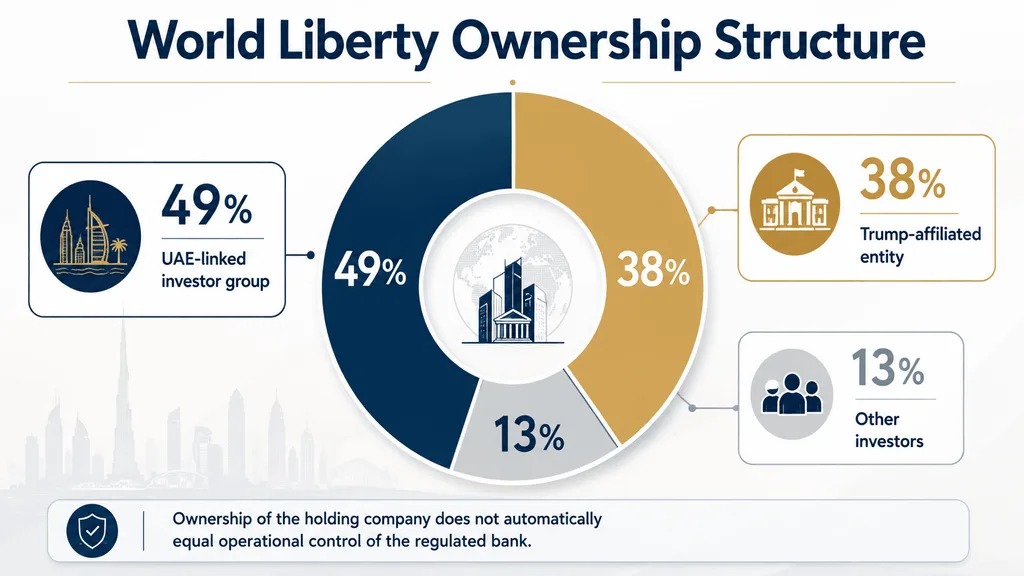
In addition to regulatory progress, another focus of attention from the outside world is the shareholding structure. Reports indicate that investment vehicles related to the Trump family hold 38% of the shares in this holding company; another 49% of the shares are held by investors supported by Sheikh Tahnoon bin Zayed Al Nahyan, the UAE's National Security Advisor and brother of the President.
This investment related to the UAE originated from a $500 million deal completed shortly before Trump returned to the White House in January 2025. Some Democratic lawmakers have questioned whether this investment requires more stringent national security scrutiny, especially after the United States subsequently made policy decisions regarding the export of AI chips to the UAE.
At present, these doubts remain at the level of potential conflicts of interest, and there is no evidence to suggest that there is any exchange relationship between the U.S. policy decisions and this investment. The World Liberty party denies that the transaction is related to government policy, while the White House states that Trump does not participate in the daily management of their business assets.
The crypto earnings of the Trump family have drawn attention.
As the scale of USD1 expands, the related commercial interests have also been further amplified. Reuters reports that Trump's financial disclosure for 2025 shows that his family's revenue from cryptocurrency business exceeded $1.4 billion, of which nearly $800 million is related to World Liberty Financial.
Therefore, this bank licensing application is no longer just a single corporate expansion event; it involves three main issues: stablecoin regulation, the entry of foreign capital, and the business interests of the U.S. presidential family. If OCC is ultimately approved, World Liberty's connection with the U.S. regulated banking system will further deepen.