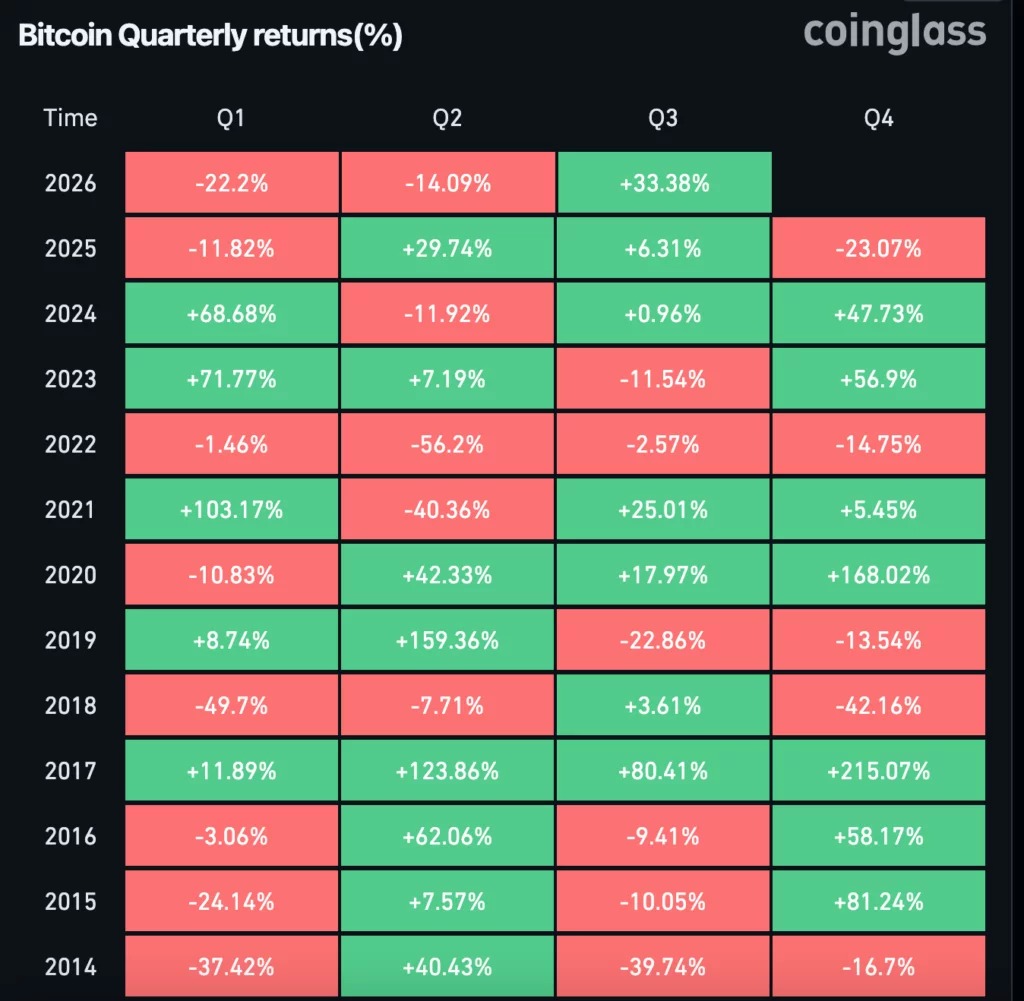


After a significant rise in August, Bitcoin remained above $78,000 at the end of the month. Although it has fallen slightly from its high levels in recent days, on a monthly basis, Bitcoin's cumulative gain in August still exceeded 24% according to BTC. The market has also begun to re-evaluate whether there will be a temporary pullback in September.
The upward trend in August broke the weak performance of previous years.
At the beginning of August, Bitcoin was still hovering just above $60,000, and then it rose all the way to a high of $81,455. According to data cited by Coinpedia, this upward trend broke the usual pattern of weak performance for Bitcoin in August.
One of the factors driving the market is that the U.S. Treasury Department has increased the scale of long-term government bond repurchases from $2 billion per time to at least $4 billion. At the same time, institutional funds continue to flow into spot Bitcoin ETF. The report mentions that U.S. spot Bitcoin ETF attracted over $3 billion in net inflows in August, with approximately $924 million in the last week alone.
Historical data shows that September tends to be weaker.
Despite a strong performance in August, historically, September has often been one of the weakest months for Bitcoin throughout the year. The article cites data from CoinGlass which indicates that the average return rate for Bitcoin in September is approximately -3.08%.
What is more noteworthy is that a similar pattern has occurred in previous years: after consecutive increases in July and August, there has been a pullback in September.
- In 2013: it rose by 9.60% in July, 30.42% in August, and fell by 1.76% in September.
- In 2017: it rose by 17.92% in July, 65.32% in August, and fell by 7.44% in September.
- In 2020: it increased by 24.03% in July, 2.83% in August, and decreased by 7.51% in September.
A similar situation occurred in 2021 as well; in July and August of that year, there were increases of 18.19% and 13.80% respectively, followed by a decline of 7.03% in September. In 2026, Bitcoin saw an increase of 7.36% in July and another rise of 24.19% in August, showing a trend that has some similarity to the aforementioned years.
The market is focusing on the support level of $75,500.
The article shows that historical patterns do not necessarily imply a decline in September, but after two consecutive months of significant strength, the market's vigilance against temporary pullbacks is increasing.
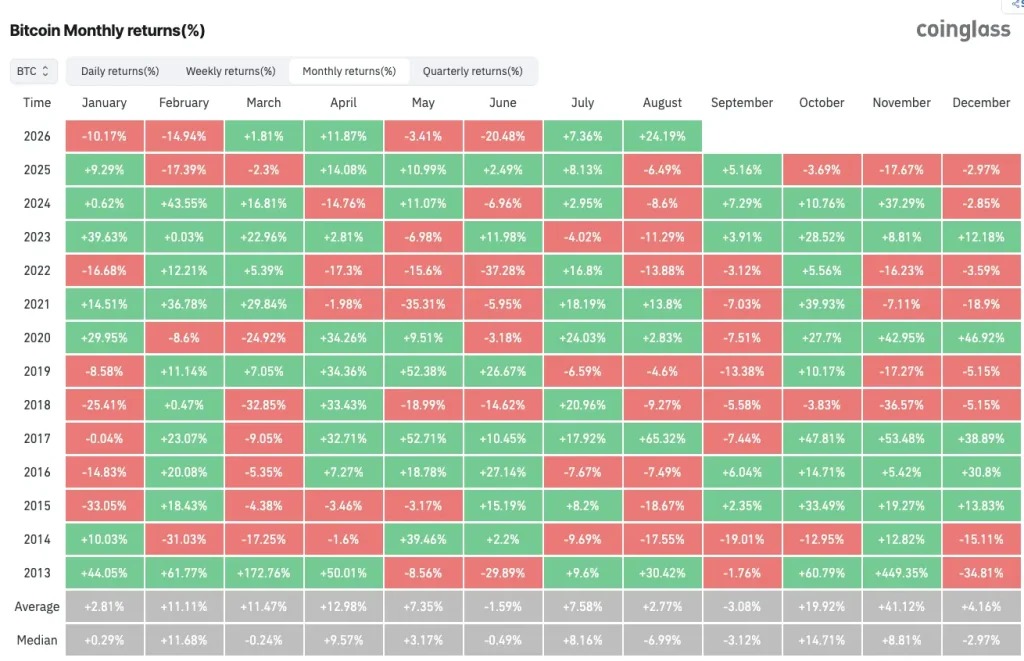
The report also mentioned that October and November have traditionally been months when Bitcoin performs well, with average returns of around 19.92% and 41.12% respectively. This means that even if there is a decline in September, it may not necessarily change the overall upward trend.
From a technical perspective, analyst Crypto Rover indicates that Bitcoin's 50-day moving average and 100-day moving average have formed a bullish crossover. A similar signal appeared in January 2023, but at that time, before the subsequent sharp rise, the price first experienced a decline of about 17%.
Another trader, Ted Pillows, believes that if Bitcoin manages to regain the 50-week moving average, there is a chance for the price to rise to the range of $88,000 to $90,000. However, around $75,568 remains an important support level at present; if it falls below the 50-week moving average, EMA, the price could drop back to the $74,000 area.