

In financial markets, the common belief that "the probability of the Federal Reserve raising interest rates is 60%" usually does not come from economist surveys, but rather from the prices of federal funds futures. Tools like FedWatch convert these prices into the probability of interest rate movements at future FOMC meetings, which are used to observe how the market currently prices the path of monetary policy.
The core basis is federal funds futures.
The basis for the calculation of FedWatch is the 30-day Federal Funds Futures traded on the CME. The final settlement of these contracts refers to the average effective Federal Funds rate for a given calendar month, which is the EFFR published by the Federal Reserve Bank of New York.
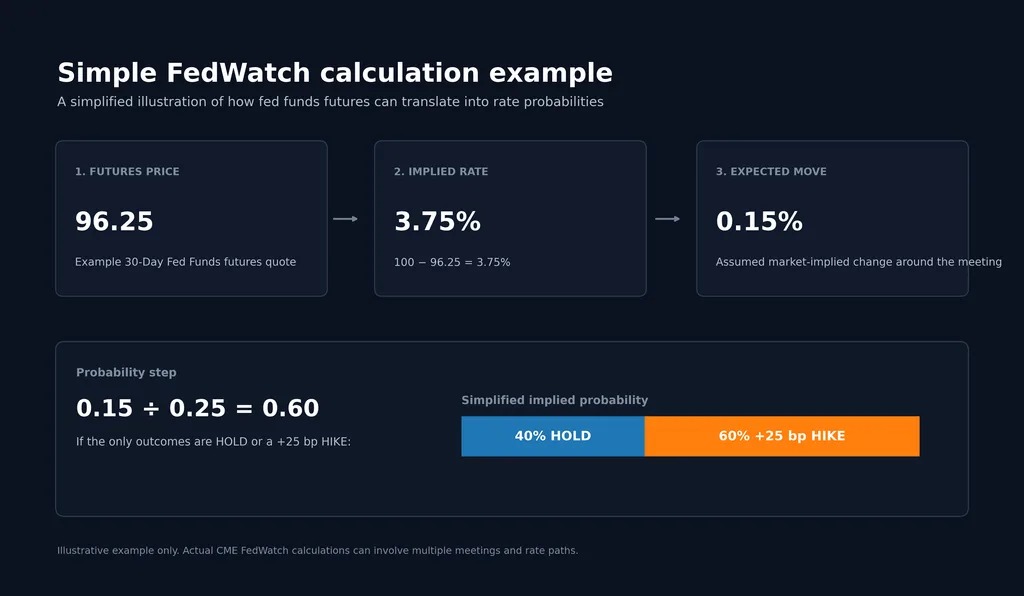
The conversion method for futures prices is relatively straightforward: Implied interest rate = 100 − Futures price. For example, if the contract price is 96.25, the corresponding implied market interest rate is approximately 3.75%.
Probabilities are usually calculated based on 25 basis points.
The really complex part is that FOMC meetings often occur in the middle of the month. The futures prices for the same month include both the interest rates before and after the meeting. CME takes into account contracts from adjacent months to estimate how much policy change the market has incorporated before and after that meeting.
FedWatch It is generally assumed that the Federal Reserve adjusts interest rates in increments of 25 basis points, which is 0.25 percentage points. If market prices imply an average increase of 0.15 percentage points before and after a certain meeting, then in a simplified scenario, this would correspond to a probability of about 60% for a 25 basis point rate hike.
Currently viewing the pricing for the target range.
FedWatch The most commonly used part is the probability table of target interest rate ranges corresponding to a future FOMC meeting. The Federal Reserve usually announces the target range for the federal funds rate, rather than a single interest rate level.
As of August 31, 2026, following the meeting on July 29, the Federal Reserve maintained its interest rates unchanged, with the target range remaining at 3.50% to 3.75%. The next decision on interest rates is scheduled to be announced on September 16. The article cites that on August 31, the market was giving a probability of about 60.4% for a rate hike in September, which just a few days prior was around 35%.
Inflation and the Fed's stance are most likely to trigger repricing.
Information that can change inflation, employment, growth, and policy judgments will affect the prices of federal funds futures, thereby driving adjustments to the probability of FedWatch. Common triggering factors include inflation data, non-farm payrolls and unemployment rates, speeches by Federal Reserve officials, meeting minutes, as well as changes in U.S. Treasury yields, oil prices, and the trend of the dollar.
The article mentions that changes in interest rate expectations can also affect risk assets such as Bitcoin, as they influence liquidity, bond yields, and investors' risk appetite. FedWatch Therefore, it is more suitable to be seen as a real-time thermometer of market expectations, rather than an official forecast of the Federal Reserve's final decision.