

The United States District Court for the Southern District of New York recently ruled on a class action regarding Pump.fun, dismissing all charges against Solana Labs, Solana Foundation and related executives. The case has not concluded as a whole, and future proceedings will primarily focus on Pump.fun's operator, Baton Corporation Ltd, and its three founders.
The scope of the case has clearly narrowed down.
Presiding Judge Colleen McMahon issued a 79-page ruling on August 31, partially supporting and partially rejecting the defendant's motion to withdraw the lawsuit. The plaintiff filed the lawsuit as early as January 2025, alleging that Pump.fun's token issuance and trading mechanism allowed insiders to hold positions first, then promoted them to retail investors for sale.
The plaintiff previously stated that retail investors incurred cumulative losses of approximately $4 billion to $5.5 billion in the trading of Pump.fun platform tokens. Following this ruling, the entities and executives related to Solana are no longer the core subjects of the case, and the focus of the litigation has shifted to the Pump.fun platform itself and its management.
Two token securities claims were denied.
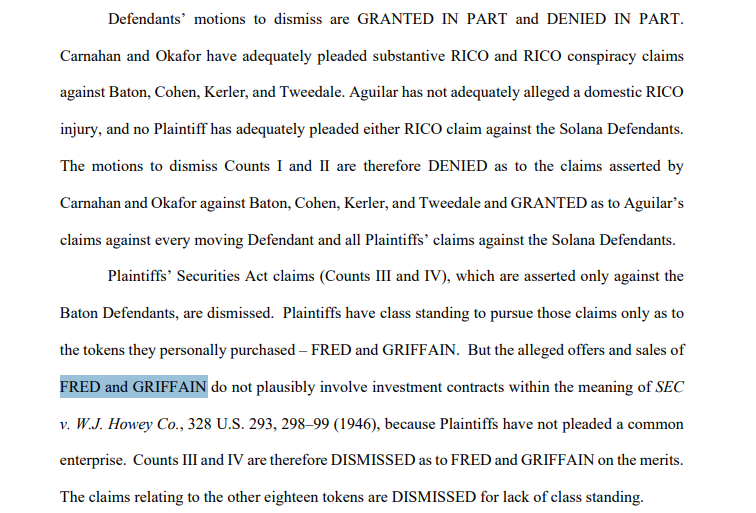
The court also dismissed the plaintiff's claims under the Securities Law regarding $ FRED and $ GRIFFAIN. These two tokens are the subjects that the plaintiff actually purchased.
The judge did not determine that all Meme tokens were not securities, but rather believed that the plaintiff's complaint failed to prove the 'common enterprise' requirement in the Howey test. The plaintiff claimed that the SOL deposited in each token curve constituted a common fund pool, however, the court held that such a design did not bind investors to any underlying business project, nor was it sufficient to prove that investors' profits were jointly dependent on the success or failure of the same undertaking.
The court pointed out that early buyers may have profited by selling to subsequent buyers, while subsequent buyers could suffer losses when demand declined. This transaction relationship alone is not sufficient to support the plaintiff's arguments under securities law.
The allegations regarding the issuance of R tokens will continue to be pursued.
In addition, the claims regarding another 18 types of tokens were not supported as the named plaintiffs did not actually purchase these tokens, and therefore did not possess the corresponding qualifications for a class action.
Despite setbacks in the securities law approach, the more critical charges regarding the issuance of R-tokens in this case were not completely dismissed. The court allowed the plaintiff to continue to pursue allegations of conspiracy in the issuance of R-tokens against Baton Corporation Ltd as well as the three founders Alon Cohen, Dylan Kerler, and Noah Tweedale.
The court held that the plaintiff had provided sufficient statements regarding the direct connection between the allegations of telecommunications fraud and related activities, as well as the loss of transaction fees, to proceed to the next stage of the case. However, the plaintiff's theory of "gambling" was not supported by the court. The judge deemed that although trading Meme coins carries high risks, it does not constitute a gambling activity under New York state law.
Explain the situation of the defendant KOL by September 10th.

The case will now proceed to procedures such as evidence exchange. The plaintiff has previously obtained nearly 5,000 internal chat records and has revised the complaint accordingly.
The court also requested the plaintiff to explain why the 25 defendants with unidentified identities, identified as “Lead KOL”, should not have their cases withdrawn. The plaintiff is required to provide details on the defendants who have been identified, the attempts to serve legal documents on them, and what additional evidence collection measures are needed to confirm their identities by September 10th. If no response is given, the relevant claims may be dismissed.
At the time of this ruling's release, Pump.fun continues to expand its products. The platform recently announced the addition of a limit order feature to its Solana mobile app, which also supports stop-loss and take-profit settings.