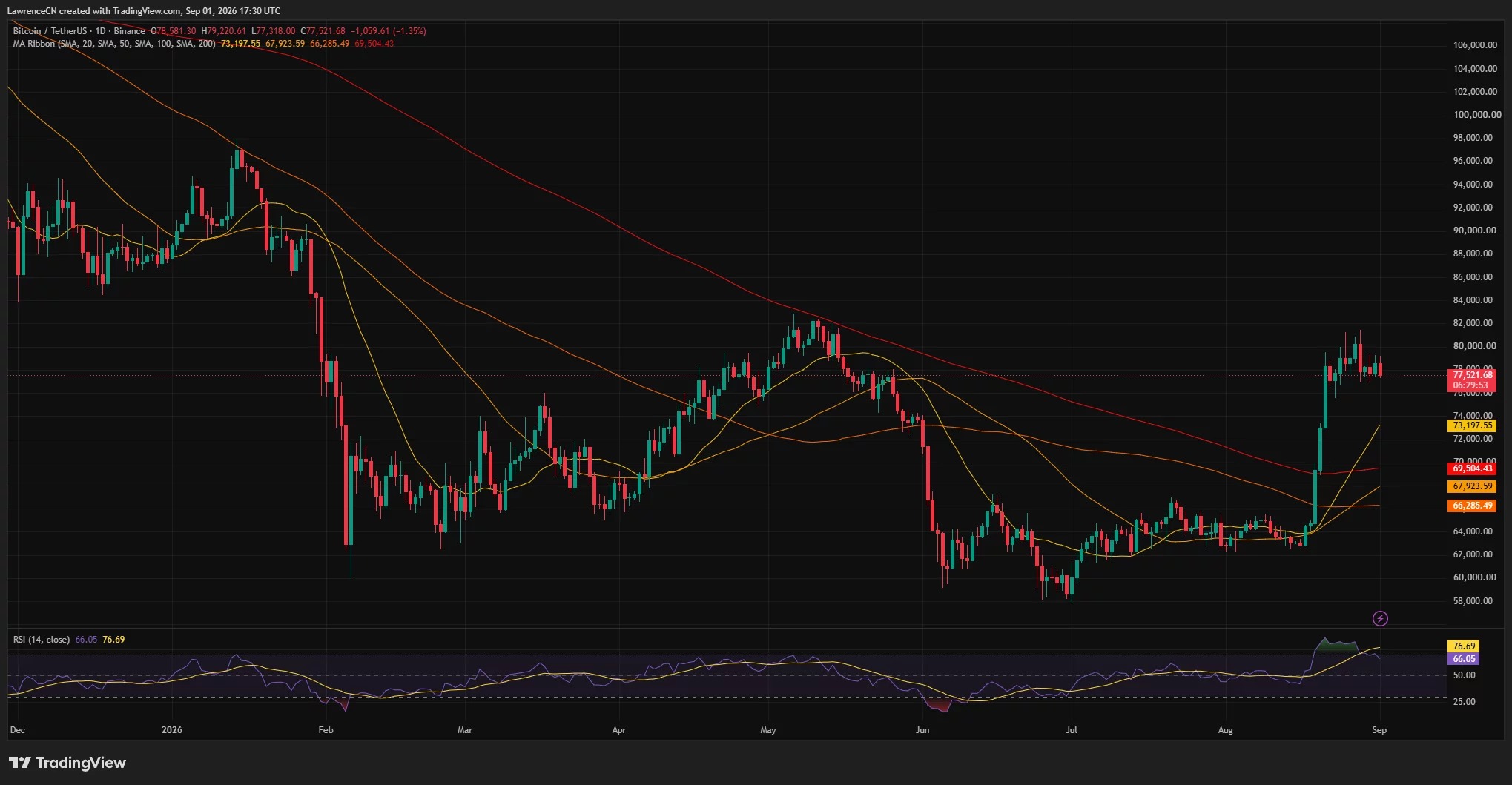


After the United States launched a new round of strikes against Iranian targets, tensions around the Strait of Hormuz have escalated once again. Oil prices have risen rapidly, putting global risky assets under pressure. Bitcoin fell below $77,000, and Ethereum also lost its support above $2,400.
Bitcoin falls below $77,000
After market news emerged, Bitcoin fell below the $78,000 and $77,000 levels, and at one point during the session it dropped to $76,762, a significant decline from the intraday high of nearly $79,166.
Ethereum fell below $2,400 in sync. CoinGlass data shows that there was a margin call of approximately $115 million in the crypto market within an hour, indicating that leveraged positions that had been betting on an increase were liquidated en masse during the sharp decline, further intensifying the selling pressure.
In August, Bitcoin saw a cumulative increase of about 23%, but as September began, geopolitical tensions and interest rate expectations once again suppressed risk appetite, leading to a clear weakening of market sentiment.
Tensions in the Strait of Hormuz have risen again
U.S. Central Command stated that U.S. forces began targeting targets associated with Iran's Islamic Revolutionary Guard on Tuesday noon, citing recent threats to merchant vessels near the Strait of Hormuz and U.S. personnel stationed in the Middle East.
Iranian media reported that explosions occurred in several areas of the southern part of the country, including the island of Qeshm, Bandar Abbas, and Chabahar. Multiple foreign media sources cited reports that Jasak, Konarak, Minab, and Sirik were also within the scope of the attacks.
The Strait of Hormuz is a vital global energy transportation route; before the conflict, about one-fifth of the world's oil and liquefied natural gas supply was transported through this waterway. Iranian semi-official media subsequently reported that Tehran had launched missiles and drones in response. Trump described this action as a “large-scale and powerful” strike and warned Iran not to retaliate further.
Oil prices break through $90
As military operations around the strait intensified, crude oil prices soared rapidly. Reports indicate that Brent crude closed at $94.65 per barrel, up 4.6%; US WTI crude closed at $90.22 per barrel, up 5.2%.
The market is also paying attention to the news of oil tankers being attacked, as well as the risk that Gulf crude oil exports may be further disrupted. Rising energy prices mean that U.S. inflation data may come under pressure again, which will also affect the market's judgment of the Federal Reserve's policy decisions in September.
On that day, U.S. Treasury yields rose, and the S&P 500 index fell to a level not seen since August 4th, indicating that the selling pressure was not limited to crypto assets but had spread to a broader range of risk markets.
Long-leverage reduction exacerbates volatility
Bitcoin's intraday low approached 76,483 US dollars, making the area around 76,500 US dollars a short-term focus. If this level is further lost, the market may test even lower ranges; to ease the downward trend, it is necessary to regain above 77,000 US dollars first and then recover the previous range of 78,000 to 79,000 US dollars.
From the market perspective, this round of decline is driven by both geopolitical conflicts and the concentrated liquidation of leveraged positions. As Iran's subsequent responses continue, the linkage between oil prices, yields, and risk aversion sentiment will remain the focus of attention for the global markets in the coming period.