AI Generated Restaurant Menus Become Popular, but Homogenization Issues Trigger Disapproval
TechCrunch
36m ago
Ai Focus
Foreign media reports that the use of AI to generate menu images has become widespread in the catering industry, but the issue of converging aesthetics and image distortion is causing dissatisfaction among consumers.
Helpful
No.Help

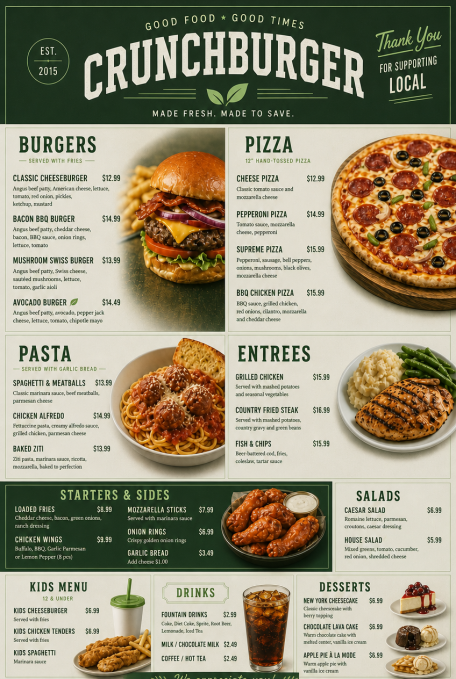
More and more restaurants are starting to use generative AI to create menu illustrations, but such images are causing dissatisfaction among consumers. TechCrunch reports that these images are often too smooth and symmetrical, with details that seem complete but lack the texture that real food should have, making it easy for people to feel something is "not right" at a glance.

In some cases, the distortion is quite obvious, such as abnormal cheese textures or shrimp shapes that are not reasonable; more often than not, the issue is not so extreme, but rather reflected in an overall sense of uniformity. Those interviewed believe that this discomfort is not an illusion, but rather the result of the generated models producing similar outputs.

Training methods promote aesthetic convergence

According to a report citing the statements of Reality Defender, the Chief Technology Officer, and Alex Lisle, the image model identifies patterns based on massive training data and then generates results that match the prompts. For example, if a user requests to create a hamburger restaurant menu, the model will invoke the visual features it deems "most similar to a menu image."

However, model training is not just about pursuing accuracy; it also tends to favor content that is “more pleasing” or “safer.” As a result, ice cream balls become overly round, and pizzas, wraps, or seafood all end up with an unnaturally standardized appearance. Over time, the outputs begin to increasingly resemble a single aesthetic template.
It's not a crash, but a degradation in quality.

Lisle indicates that if a model continuously absorbs content generated by itself (AI), in extreme cases, it may experience a 'model crash', which means its output capability becomes completely ineffective. However, phenomena like restaurant menus are more akin to 'convergence'; that is, the model does not lose its functionality, but the quality of the content it produces continues to decline.

This kind of degradation usually doesn't immediately make the images seem absurd; instead, they appear ordinary, neat, and harmless. However, the more one looks at them, the less real they seem. It is precisely for this reason that many people may not be able to spot the problem at first glance, but they still instinctively feel uncomfortable.

It's becoming increasingly difficult to judge authenticity.

The director of Digital Future Center, Imagining, the, and AI believes that the common tendency in AI regarding images and language is to "smooth out" the edge features. This optimization reduces offensiveness and a sense of dissonance, but it also leads to a noticeable homogenization.

Reports indicate that the public is developing an increasingly strong intuitive ability to recognize the content generated by AI. Even if they cannot accurately explain why, people can still perceive the difference between it and real photos or artificially designed images. As this type of content further enters commercial scenarios, it will become even more difficult to determine whether the images are credible or genuine.

Tip
$0
Like
0
Save
0
Views 9
HQYC reminds readers to view blockchain rationally, stay aware of risks, and beware of virtual token issuance and speculation. All content on this site represents market information or related viewpoints only and does not constitute any form of investment advice. If you find sensitive content, please click“Report”,and we will handle it promptly。
Submit
Comment 0
Hot
Latest
No comments yet. Be the first!
Related
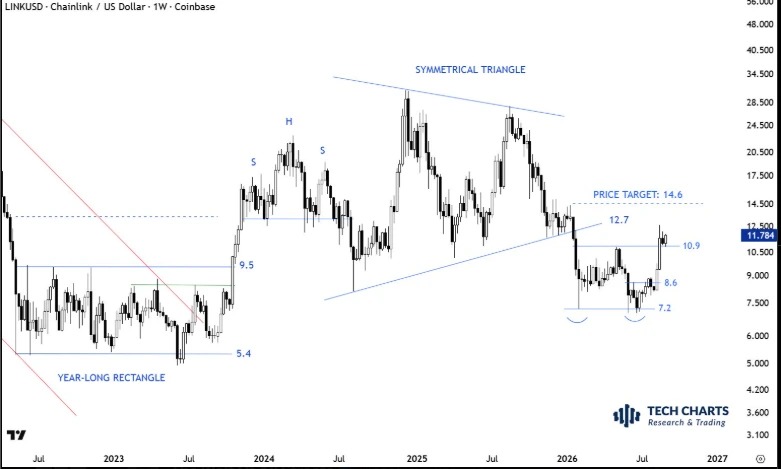
web3: Foreign media: LINK needs to reach $12.7 to continue its upward trend
Foreign media reports that LINK has seen a rise of over 45% in recent months, with $12.7 being regarded as a key resistance level for future trends.
CoinPedia
·2026-09-04 10:33:43
31
Aave V4 Risk Manager Enters Snapshot: Parameters Can Be Adjusted More Quickly, But Authorization Boundaries Must Be Clearly Defined
The Aave community's proposal regarding the activation of V4 Risk Steward was advanced to Snapshot on September 2nd, and voting began within less than 24 hours after the announcement. The proposal aims to enable risk administrators on the Aave V4 Ethereum and Avalanche instances, allowing restricted roles to adjust certain risk parameters within the preset governance boundaries. It addresses a common issue in the on-chain lending market: prices, liquidity, and utilization rates can change within hours, yet the complete governance process often takes much longer. However, the current status is still in the off-chain Snapshot confirmation phase, which does not mean that the relevant permissions have been fully implemented in both markets.
币界网
·2026-09-04 10:01:25
59
U.S. second-quarter productivity revised to grow by 1.4%; unit labor costs still rising, labor income share drops to a new low
The U.S. Bureau of Labor Statistics released revised figures for productivity and costs for the second quarter on September 3: Labor productivity in the non-agricultural business sector increased by 1.4% on a quarterly annualized basis, driven by a 1.7% increase in actual output and a 0.3% increase in working hours. Compared to the same period last year, productivity grew by 2.2%. Meanwhile, unit labor costs rose by 1.2% on a quarterly annualized basis, as hourly wages increased by 2.6%, which was higher than the rate of productivity growth; unit labor costs have accumulated an increase of 1.4% over the past four quarters. These data do not tell a simple story of "increased corporate efficiency necessarily leading to decreased costs," but rather show that output, working hours, and wages are changing at different rates.
币百科
·2026-09-04 09:59:16
24
Gemini 3.8 Flash Upgrade in three weeks: Prices remain unchanged for now, but complex tasks may require additional Token
On September 2nd, Google released Gemini version 3.8, as well as a 3.8 version tailored for network defense. Just three weeks after the release of 3.7 Flash, this marks the third update in six weeks for the Flash series. Google positions 3.8 as the current strongest reasoning and coding Flash model. The standard version has been deployed in Gemini API, Google AI Studio, Android Studio, Gemini Enterprise, and some consumer products; the Cyber version is only available through the new Fairwind.
CoinMeta
·2026-09-04 09:57:58
23
View More