

Lululemon The latest financial report shows that this sports apparel company's performance in the second fiscal quarter fell short of market expectations, followed by a significant drop in its stock price. Investors' concerns are not only focused on the decline in revenue for that quarter but also on the company's obvious reduction in its full-year performance forecast.
Weaker revenue in the second fiscal quarter
The company's revenue in the second fiscal quarter was $2.42 billion, a year-on-year decrease of 4%, lower than analysts' forecast of $2.46 billion. Comparable sales fell by 9%, indicating that both in-store and online demand have slowed down.
Reuters cites data stating that sales of leggings, one of the core categories of Lululemon, have declined by about 20%. This category has long been one of the company's most important sources of revenue, and the decline in sales has raised concerns about the brand's attractiveness and product competitiveness in the market.
Full-year revenue forecast lowered
Rather than single-quarter performance, what the market is more concerned about is the company's judgment of its future performance. Lululemon currently expects annual revenue to be between $10.35 billion and $10.5 billion, which is a significant reduction from the previous forecast of $11 billion to $11.15 billion.
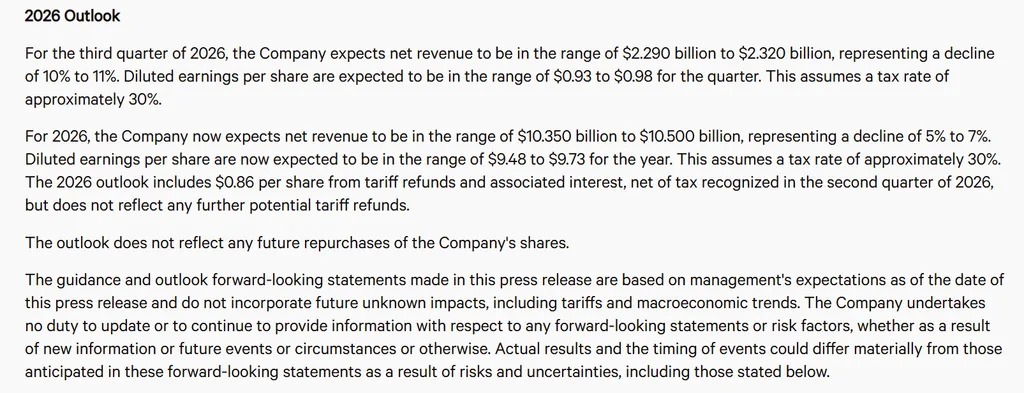
Based on the latest figures, the company's annual revenue is expected to decline by about 5% to 7% compared to the same period last year. This indicates that management is not optimistic about the recovery of demand in the coming quarters.
Continued pressure in the third quarter
The company expects revenue in the third quarter to be between $2.29 billion and $2.32 billion, a year-over-year decrease of about 10% to 11%; earnings per share are expected to be between $0.93 and $0.98.
In the high-end sports apparel market, brands such as Alo Yoga and Vuori are continuously competing for consumers. As competition intensifies, Lululemon needs to recover the sales of its core products more quickly in order to alleviate market concerns about slowing growth.