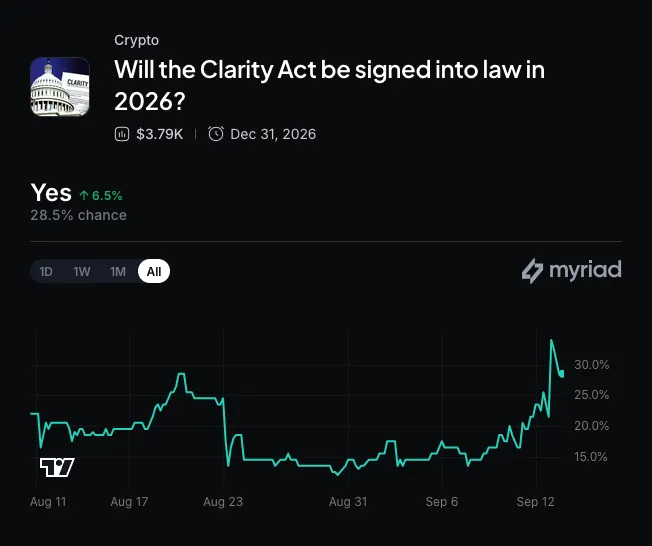






The U.S. Senate is about to conduct a procedural vote on the digital assets bill Clarity Act. Bernstein believes that the market has not yet fully reflected the potential progress of this bill, and if the voting result is better than expected, there could be a re-pricing in the crypto market.
Bernstein says the positive factors have not yet been reflected.
Bernstein analysts stated in their latest client report that after the recent concessions made by the Republicans, the resistance to advancing the bill has decreased, and any "positive surprises" have not yet been factored into market prices.
Clarity Act aims to establish a federal regulatory framework for digital assets and further clarify the division of responsibilities between the U.S. Securities and Exchange Commission (SEC) and the Commodity Futures Trading Commission (CFTC). Since the advancement of the bill requires support from Democrats, disputes over issues such as officials holding crypto assets and stablecoin incentive mechanisms have become major obstacles in previous negotiations.
Republicans amend ethics and banking regulations
The report mentioned that the Republican Party has adjusted the enforcement arrangements for the ethics provisions this time, and also added protections for community bank deposits. Bernstein believes that these modifications may win over the support of some Democratic members of Congress.
The chairman of the Digital Assets Subcommittee of the Senate Banking Committee, Republican Senator Cynthia Lummis, stated that after lengthy bipartisan negotiations, the revised bill has addressed the demands of the Democratic Party and called on them to support its advancement.
In previous versions, the enforcement of ethical provisions was mainly the responsibility of the U.S. Department of Justice, and related discussions also involved President Trump's cryptocurrency business. Bernstein pointed out that if the new version of the bill includes requirements such as asset divestiture or blind trusts, it may further increase the likelihood of some Democrats supporting the bill to move on to the next stage.
Institutions have different expectations for passing within the year.
However, market research institutions still have significant disagreements regarding whether the bill will pass smoothly. Analyst Jaret Seiberg believes that this is not a truly negotiated bipartisan agreement; rather, it seems to be a finalized text for the Democrats to work with. Therefore, he maintains his assessment that the likelihood of the bill being passed within the year is only 25%.
Another institution, Beacon Policy Advisors, has raised its expectations, increasing the probability of the bill passing within the year from less than 10% to 30% to 40%.
In the draft on September 10th, there were not many overall changes to the ethical provisions, but new requirements for registration were added for encrypted transaction protocols controlled by individuals or groups. This also indicates that the text of the bill is still being continuously adjusted regarding regulatory boundaries and responsible entities.
If legislation is hindered, CFTC will still push forward with the rules.
Even if Congress ultimately fails to pass the Clarity Act, the Commodity Futures Trading Commission (CFTC) is still prepared to use its existing authority to advance crypto regulatory rules. The chairman of CFTC has instructed staff to study feasible options. Selig
However, he also stated that if a clearer framework can be established through legislation, the relevant protective measures will be more difficult for future governments to easily overturn. This is also one of the reasons why the current market is paying close attention to this procedural vote in the Senate.