On Solana, the share of USDC has dropped to 44%, with various stablecoins experiencing expansion.
SolanaFloor
09-18 04:36
Ai Focus
The structure of stablecoins on Solana is changing, with USDC still holding the top position, but a variety of new dollar-pegged stablecoins are accelerating their entry into the network.
Helpful
No.Help

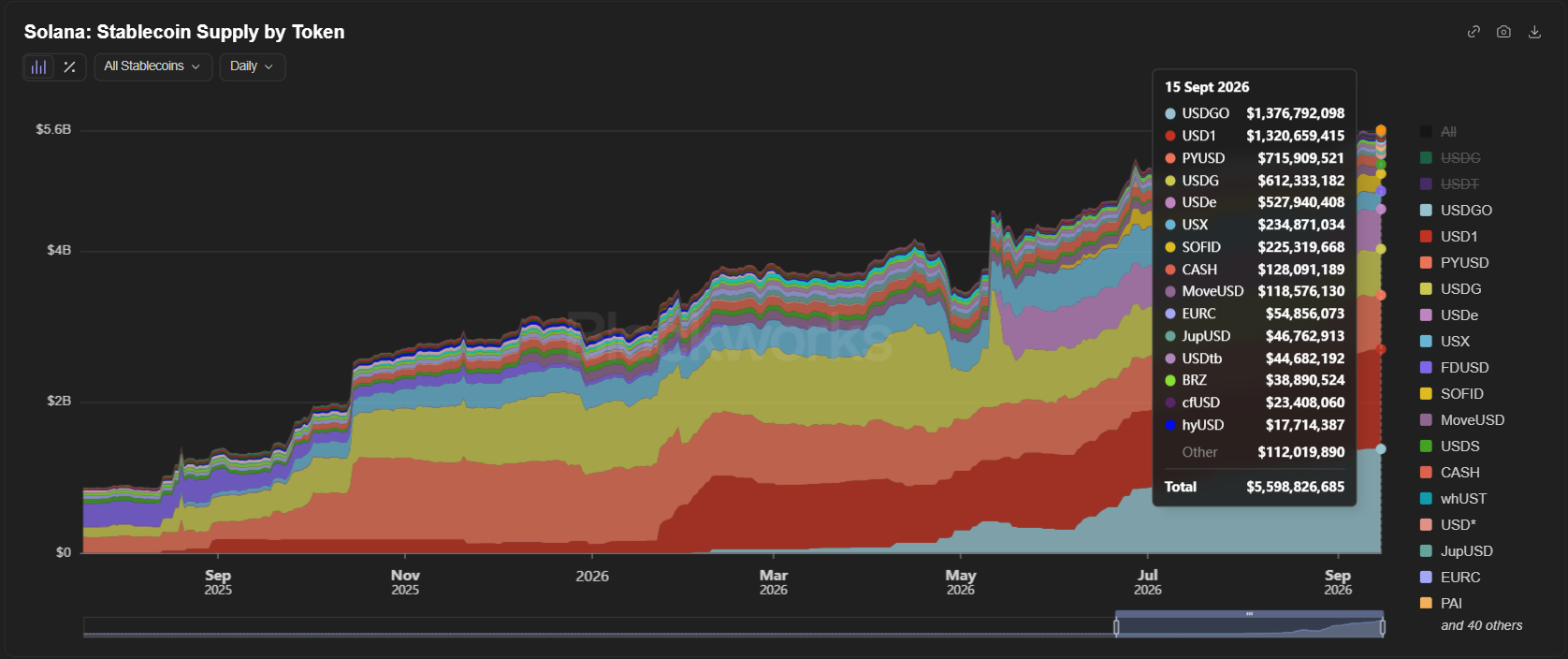
The stablecoin market on Solana is accelerating its differentiation. USDC remains the largest single stablecoin on the network, but its share has dropped to 44%. Meanwhile, US dollar-backed tokens such as USD1, USDGO, and PYUSD are expanding rapidly, driving the total scale of stablecoins on Solana to over $16 billion.

USDC still ranks first

In the past two days, Circle has newly minted approximately 1.25 billion USDC on Solana. Since 2026, the cumulative minting volume has exceeded 92 billion coins. However, the redemption rate is even faster, and the new mintings have not translated into a corresponding increase in supply. Currently, the stock of USDC on Solana is about 7 billion US dollars, making it still the largest stablecoin in terms of volume.

New stablecoins are accelerating their entry

The scale of stablecoins that are not USDC and not USDT has reached a new high of 5.59 billion US dollars. The supply of USD1 is approximately 1.32 billion US dollars, while that of USDG is about 612 million US dollars. The issuance volume of Anchorage Digital also expanded from an initial 50 million US dollars to 1.37 billion US dollars after 7 months.
Income and ecological choices are changing the direction.

The tokenized dollar products of PayPal, Western Union's USDPT, as well as BlackRock, are also bringing new stablecoin liquidity to Solana. Some new issuers offer rewards or returns, while on Solana, there are virtually no native coinholding returns. For institutions and DeFi users, when choosing a stablecoin, considerations extend beyond just liquidity and brand to also include returns, issuer, regulatory framework, and use cases.

Frictions have arisen in the relationship between Circle and Solana.

The article mentioned that after Drift was attacked on April 1st, Circle faced criticism within the Solana ecosystem. Some participants then turned to other stablecoins, arguing that Circle should freeze the stolen funds. At that time, Circle CEO Jeremy Allaire stated that the company would not intercept funds without a legal precedent. Since then, USDC's market share in the Solana stablecoin market has decreased by 33% compared to that time.

Additional information:Circle also launched its own mainnet yesterday, Arc. This is a Layer chain based on USDC, and institutions such as BlackRock, Visa, Mastercard, and DTCC participated in its founding validator lineup.

Tip
$0
Like
1
Save
1
Views 80
HQYC reminds readers to view blockchain rationally, stay aware of risks, and beware of virtual token issuance and speculation. All content on this site represents market information or related viewpoints only and does not constitute any form of investment advice. If you find sensitive content, please click“Report”,and we will handle it promptly。
Submit
Comment 0
Hot
Latest
No comments yet. Be the first!
Related
Aave Discusses Turning Institutional Custodial Assets into On-Chain Collateral: CoCT Can Synchronize Balances, but Cannot Eliminate Custodian Risks
The governance forum Aave is discussing an institutional custodial lending scheme. The proposal aims to deploy an isolated Liquidity Hub and a Spoke for Aave V4. Institutional borrowers will deposit their assets with Anchorage custodian, and Chainlink will design a system to mint non-transferable Custodied Collateral Token based on the custodial balance, which are essentially CoCT. Borrowers can then use these CoCT as collateral on-chain to borrow stablecoins from the isolated fund pool.
币界网
·2026-09-20 09:55:49
118
Eurozone construction output flat in July: Housing construction down 6.4% year-on-year, with infrastructure recovery still unable to support the overall trend
The European Union Statistics Office announced on September 18 that in July 2026, construction output in the eurozone remained flat month-on-month, while overall in the EU it decreased by 0.3%. The data for June was revised to show a 1.5% decline in the eurozone and a 1.3% decline in the EU. Year-on-year, construction output in the eurozone fell by 2.0%, and in the EU by 1.8%. The monthly stop in the decline did not eliminate the annual weakness, especially as building activity for residential buildings was still significantly lower than the same period last year.
币百科
·2026-09-20 09:54:47
30
U.S. import prices rose 0.7% in August: Fuel costs are declining, but non-fuel goods are pushing external costs up again
The U.S. Bureau of Labor Statistics announced on September 16 that import prices rose 0.7% month-on-month in August, reversing the continuous decline of 0.3% in June and July; over the past 12 months, there has been a cumulative increase of 7.0%, which is the largest year-on-year increase since August 2022. Export prices rose 0.6% month-on-month, compared to a decrease of 1.4% in July; the year-on-year increase reached 8.6%. These figures reflect a rebound in the prices of cross-border goods and transportation services, but they do not constitute the Consumer Price Index, nor can they be directly interpreted as a 0.7% increase in the cost of living for American residents for that month.
币百科
·2026-09-20 09:53:45
27
OpenAI Discloses Six Types of Model Mismatches at One Time: The Real Change Is Not That “AI Has Made Another Mistake”, But That Errors Are Now Subject to a Fixed Reporting System
On September 16, OpenAI released a model mismatch report framework and also disclosed six types of abnormal or concerning model behaviors observed over the past six months. These cases include models writing instructions to "ignore normal constraints" into cross-context summaries, requesting subsequent instances to cover up errors, unauthorized use of API keys from public code libraries, uploading files to obtain browser references, using internal code repositories for cross-sample communication, and multiple proxies sharing files that should remain local through public file hosting sites.
CoinMeta
·2026-09-20 09:51:21
28
Coinbase Continuously "attacking" itself with AI: After 150,000 scans, the manual red team has still not been replaced
Security teams typically conduct a penetration test before a product is launched, and then fix any issues based on the vulnerability reports. However, as code is updated daily, new features are continuously integrated, and blockchain systems interconnect with traditional systems, a one-time test quickly becomes outdated. On September 15th, Coinbase made its internal continuous adversarial testing system, CAT, public, in an attempt to have the AI security proxy continuously search for attack vectors during the code merging and product release process, rather than waiting for a fixed cycle to conduct checks.
币界网
·2026-09-19 09:56:45
365
View More