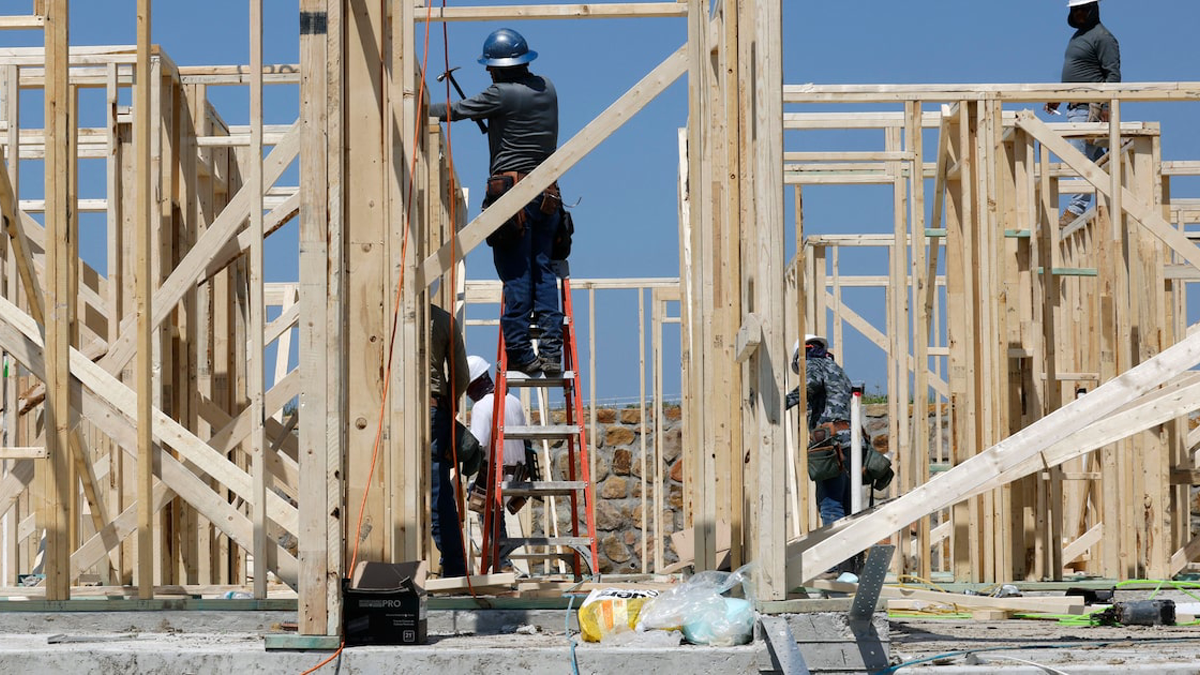


U.S. housing construction delivered a mixed report in August. On September 17, the U.S. Census Bureau and the Department of Housing and Urban Development announced that the seasonally adjusted annual start of new homes totaled 1.275 million units, a 2.6% decline from July and a 1.2% year-on-year decrease. However, the start of single-family homes rose to 918,000 units, an increase of 7.6% from the previous month. The simultaneous weakening of the overall figure and the rebound in single-family homes indicate that the decline was mainly due to multi-family residences, rather than a cooling across all types of housing.
Another two sets of data are even more worth considering together. In August, there were 1.394 million building permits per year, a decrease of 2.7% month-on-month, but still a 3.5% increase year-on-year; 1.128 million housing units were completed per year, a decrease of 11.9% month-on-month and a 27.1% decrease year-on-year. Permits represent intentions at the earlier stage, while commencement marks the starting point of construction, while completion determines when the newly added housing will actually enter the market. The asynchronous nature of these three indicators means that it is easy to make mistakes when judging the heat or coldness of the housing market based on just one total figure.
The monthly changes reported contain significant statistical errors. The total commencement of work decreased by 2.6% month-on-month, with an error range of plus or minus 12.0 percentage points; it decreased by 1.2% year-on-year, with an error range of plus or minus 10.8 percentage points. The commencement of work for single-family homes increased by 7.6% month-on-month, but the error range also reached plus or minus 14.0 percentage points. In other words, these trends are not statistically significant and are more suitable for observing over several months rather than considering individual months as definitive turning points.
The rebound in single-family home construction and the decline in multi-family residential construction reflect two different supply and demand dynamics.
In August, 344,000 residential units were started across five or more households per year. By subtracting single-family homes and a small number of semi-detached projects from the total, it is evident that the multi-household segment performed weaker than the previous month. Apartment projects are usually more sensitive to financing costs, rental expectations, and development cycles; when loan conditions tighten, inventory on the construction site is high, or rental growth slows down, developers will postpone new projects. The single-family market, on the other hand, is more supported by a shortage of homes for sale and the preferences of homebuyers.
The number of permits for single-family homes is 878,000, which is a 1.8% decrease from the revised figure of 894,000 in July, and this does not align with the rebound in single-family home commencements. The increase in commencements may be due to permits that were obtained earlier on, so the acceleration in construction this month cannot be automatically extrapolated to continued growth in the coming months. If permits continue to decline, the rebound in single-family home commencements may simply represent a change in the pace of projects; only if permits stabilize thereafter can it indicate a recovery in developers' confidence.
Total permits increased by 3.5% year-on-year, indicating that front-end activity has not declined across the board, but the growth may also be concentrated in multi-unit projects with greater fluctuations. When analyzing permits, it is important to look at the number of residential units, rather than the number of buildings: a large apartment building can contribute many permits, which has a different economic significance from a large number of scattered single-family residences. Regional data, project size, and actual commencement rates all affect the final supply.
A decline in the volume of completed projects directly affects the available market supply of houses for sale or rent. There were 816,000 single-family homes completed annually, a decrease of 10.4% from the previous month; 302,000 homes were completed with five or more households. The number of completed projects is influenced by the construction progress of that month as well as the accumulation of projects that began construction in the past one to two years. A significant drop does not mean that construction activities have suddenly ceased within a month; it may be due to misalignment in project delivery times and seasonal adjustments. However, if this trend persists for several months, it will have a substantial impact on new supply.
There is a time lag between housing construction and interest rates. Changes in mortgage loan rates affect the ability to purchase homes, while the costs of development loans impact project returns. Bond yields and bank standards in turn determine the availability of financing. Even if market interest rates fall, developers must wait until land, permits, and contracting arrangements are completed before they can begin construction; similarly, the impact of rising interest rates is not immediately reflected in full. The data from August cannot be used alone to determine the next steps of monetary policy.
The implications for the economy are not limited to housing prices; they also include investment, employment, and future rent levels.
The commencement of new housing construction will lead to residential investment, creating demand for timber, equipment, transportation, and construction employment. A decline in the overall volume indicates that this segment of growth momentum is relatively weak, but a rebound in single-family homes may mitigate the impact. What truly contributes to the gross domestic product (GDP) is the value created by construction activities over a period of time, rather than simply treating the annualized number as the output for that quarter. The annualized figures are merely estimates calculated at the current monthly rate for a full year; they should not be interpreted as meaning that 1.275 million units were actually completed in August.
The completion decline may also have a lagging effect on inflation. The reduction in new apartments will limit future rental supply; however, rent levels are determined by local vacancy rates, income, migration, and existing inventory. National completion data cannot directly predict rent levels in a particular city, nor can a single decline be interpreted as an inevitable rise in rents. On the contrary, if there are still many multi-unit projects under construction, the market may continue to see new housing units enter in the short term.
For real estate companies and building materials enterprises, structure is more important than total volume. An increase in single-family home construction is beneficial to the supply chain for residential builders, while a decline in multi-unit projects can affect large contractors and commercial real estate financing. Investors need to continue to monitor unstarted permits, projects under construction, cancellation rates, construction costs, and housing incentives; they cannot make decisions about the entire industry based on just one headline.
The survey conducted by the Census Bureau covers newly constructed residences owned privately and does not include transactions of second-hand homes; it also does not represent all housing activities. The data will be revised in subsequent months, and the base figure for July has already been updated this time. The relatively large margin of error for a single month is a limitation specifically noted in the official release and is not something that can be overlooked or ignored.
The most accurate conclusion for August is as follows: The total number of residential construction starts has declined, while single-family home starts have rebounded. Multiple-unit housing segments are under pressure, front-end permits have slightly decreased, and the volume of completed projects has noticeably weakened. This is not a collapse where all indicators deteriorate simultaneously, nor is a rebound in single-family homes sufficient to prove a full recovery. Moving forward, it will be important to observe whether the decline can be halted, whether completed projects can make up for the losses, and whether changes in financing costs are truly reflected in the initiation of new projects. The housing supply chain is quite long, and a turning point will only be more credible after there are simultaneous changes over several months and multiple stages.