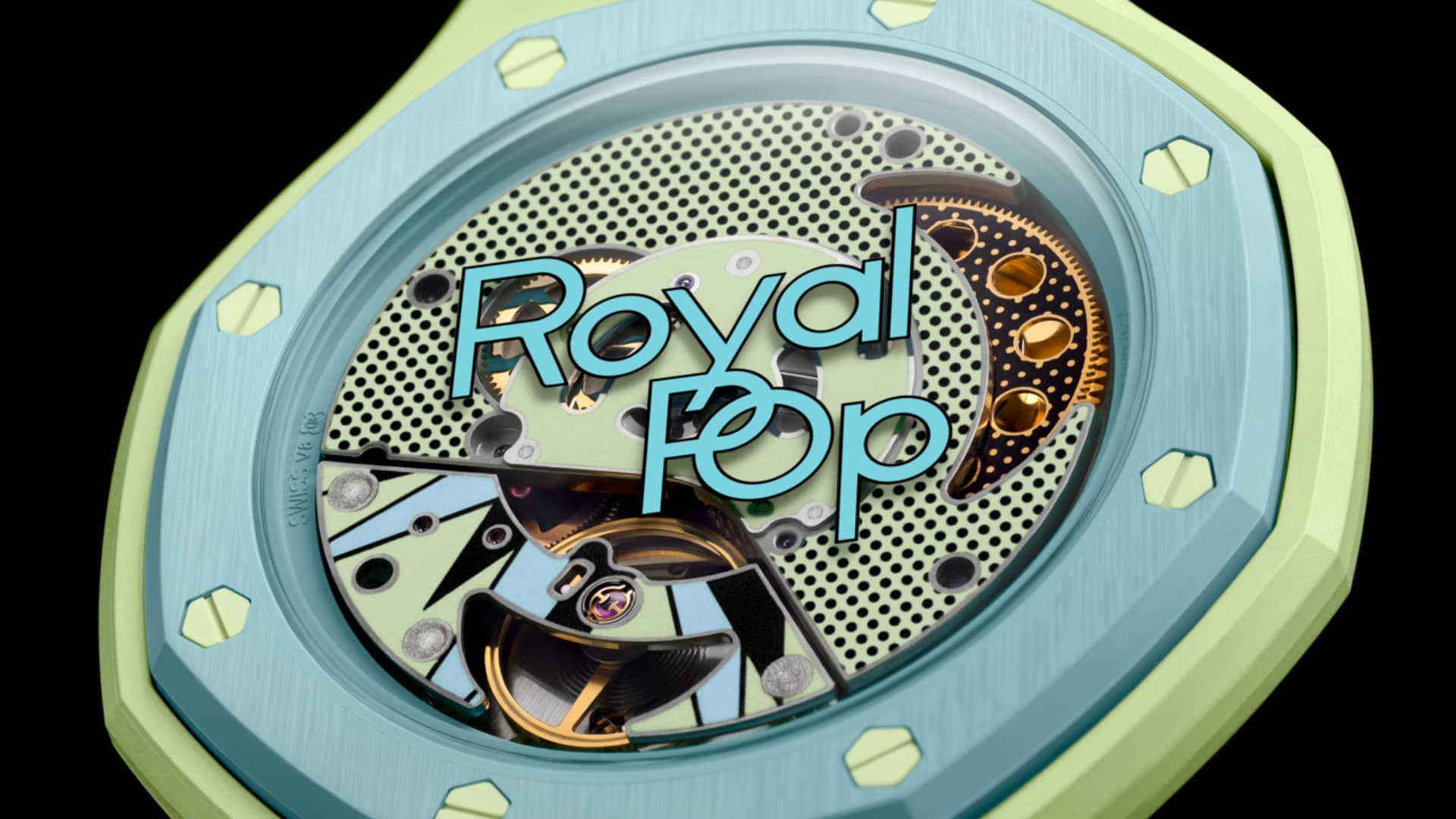


The CEO of luxury watch manufacturer Hublot ( Audemars Piguet ) stated that the bold and eye-catching Royal Pop collaboration series launched earlier this year with Swatch ( Swatch ) has set new records for both sales and user engagement.
In May, Hublot collaborated with Swatch to launch a series of brightly colored watches, which were sold together with their straps for a unit price of $400. This collaboration sparked intense interest on social media, with Swatch even posting on social media asking consumers not to rush to their stores. This trend has also sparked debate in the luxury goods industry: whether Hublot’s extremely rare watches, which sell for over $30,000 each, have seen their brand image tarnished by this collaboration, and whether it has diminished the status of Swiss watchmaking, which includes other prestigious brands such as Patek Phillipe (Patek Philippe) and Jaeger-LeCoultre (Vacheron Constantin).
However, Hublot's CEO Ilaria Resta stated that both brand sales and awareness have soared. She mentioned that this launch on social media has generated over 20 billion mentions and discussions. Millions of young consumers have suddenly begun to delve deeper into mechanical watches and horology. Even Hublot's most discerning collectors have called to inquire about purchasing their own Royal Pop.
Resta means: "Since the release of Royal Pop, we have set records every month. Our website once crashed due to the high traffic. Visitors to our boutique kept coming one after another. Just by focusing the spotlight on a single piece and a mechanical movement, you suddenly discover the world of Hublot."
The success of this company has become a case study for the troubled $50 billion Swiss watch industry, as well as the broader luxury goods economy. Although the ultra-high-end market of the Swiss watch industry remains prosperous, the business and profits of the broader industry are declining.
According to a report by Morgan Stanley ( Morgan Stanley ) and LuxeConsult, since 2011, the global exports of Swiss watches have decreased by more than half, and last year's total sales fell by 1.7%. The report states that although there are about 450 watch brands in Switzerland, the top four brands – Rolex ( Rolex ), Patek Phillipe, IWC, and Richard Mille – now account for approximately half of the industry's sales and around 76% of the profits.
The market at the top has become too scarce, even out of reach for wealthy watch enthusiasts. According to Morgan Stanley data, Audemars Piguet produces only 53,000 watches per year, while Rolex produces over 1 million watches annually. Audemars Piguet’s highly sought-after Royal Oak series typically starts at $30,000, with the most complex models costing over $200,000. Even those who are qualified to purchase them often have to face long waiting lists. Due to the extreme scarcity of supply, second-hand Audemars Piguet watches usually sell for 30% or more above the retail price.
Resta indicates that those Swiss watch brands that still rely on old tactics—such as relying on their history, an older customer base, and elitist marketing strategies—will face extinction.
She said, "Either dare to take risks, or face death."
She refers to her new strategy as "radical openness" ( radical openness ). The goal is to open up the elite world of Swiss haute horlogerie to a broader and younger audience. In addition to the Royal Pop series, Hublot is also launching the AP Labs – a pop-up experience space that allows visitors to immerse themselves in the world of mechanical watchmaking. Visitors can play games related to watches, learn about movements and complex functions, watch watchmakers at work, and even try to fix tiny watch parts themselves.
Resta indicates that AP Labs does not sell wristwatches. Its purpose is purely educational, and at the same time, it aims to recruit new watchmakers for this industry that has long lacked skilled craftsmen.
Resta said, "This is a category that was born and driven by passion, enthusiasm, and understanding. If you don't understand tabulation, you will never appreciate mechanical watches. You will always default to the simplest and cheapest way to tell time. Telling time is the least important reason for you to buy a mechanical watch. You buy it because you understand the mechanical inventions behind it, appreciate its movement, admire its aesthetics, and the meaning that something destined to be passed down forever carries."
As one of the few luxury watch manufacturers that remain privately owned by families, Hublot does not disclose its revenue or profits. Resta indicates that the company achieved 10% organic sales growth in 2025, driven mainly by more complex and more expensive watches. She said that in 2026, "this record will be further broken."
Apex is donating all the proceeds from its collaboration with Royal Pop to fund a program dedicated to training and educating tabulators.
However, in addition to success, Hublot also faces new industry pressures. Over the past year, the United States has imposed a series of tariffs on Swiss goods, with the current highest tariff rate reaching 12.5%. High-priced Swiss watches have been particularly hit by these measures. According to data from the Swiss Watch Industry Federation ( Federation of the Swiss Watch Industry ), Swiss watch exports to the United States declined by 19% in August, while globally they increased by 9%.
Industry analysts say that although wealthy watch buyers can easily afford the additional taxes and fees, some prefer to postpone their purchases or delay picking up their goods, waiting for the tariffs to be canceled or reduced. The prices of raw materials for luxury watches, especially gold, have also risen significantly, further increasing production costs. Over the past year, the Swiss franc has strengthened against many currencies, particularly against the US dollar, which has weakened the revenue from overseas sales for Swiss companies.
The combination of tariffs, material prices, and exchange rates has compressed the profit margins of Swiss watchmakers. Some companies are passing on the increased costs to consumers through price hikes of two digits. Resta indicates that Hublot has chosen not to pass on the tariff costs and has only made small price increases to partially offset the rise in raw material prices.
Resta said, "In the face of all these headwinds, my approach is not to let customers suffer the consequences. What I pursue is not the annual profit figure. I am fortunate to be at the helm of a private company that has a very long-term perspective. You need to maintain both your relationship with customers and the value that your products should provide."
Resta indicates that during difficult times, it is precisely when companies need innovation the most. Even as other watch manufacturers are reducing their facilities, Hublot is still building a brand-new, advanced service center in Raleigh, North Carolina ( Raleigh ), dedicated to the repair and maintenance of watches.
Resta said, "I always say that if you change your strategy because of a crisis, it means you were lazy when formulating it in the first place. A strategy should be able to withstand any test."
One highlight in terms of demand is technological wealth. Many new AI millionaires and billionaires have begun collecting luxury watches. Executives and founders from Silicon Valley are seeking hobbies and experiences that are clearly "anti-technology," whether it's wilderness hiking, fly fishing in remote areas, or purchasing classic cars and mechanical watches.
Resta said, "These were originally two worlds that should have been opposed in theory: the world of simulation and digital technology, on one hand, and the world of hyperconnection and disconnection, on the other. Now, they are beginning to merge together."