S&P 500 Enters Fourth Quarter: Earnings Growth of 30%, U.S. Treasury Yields Rise to 5%
Coinpaper
1h ago
Ai Focus
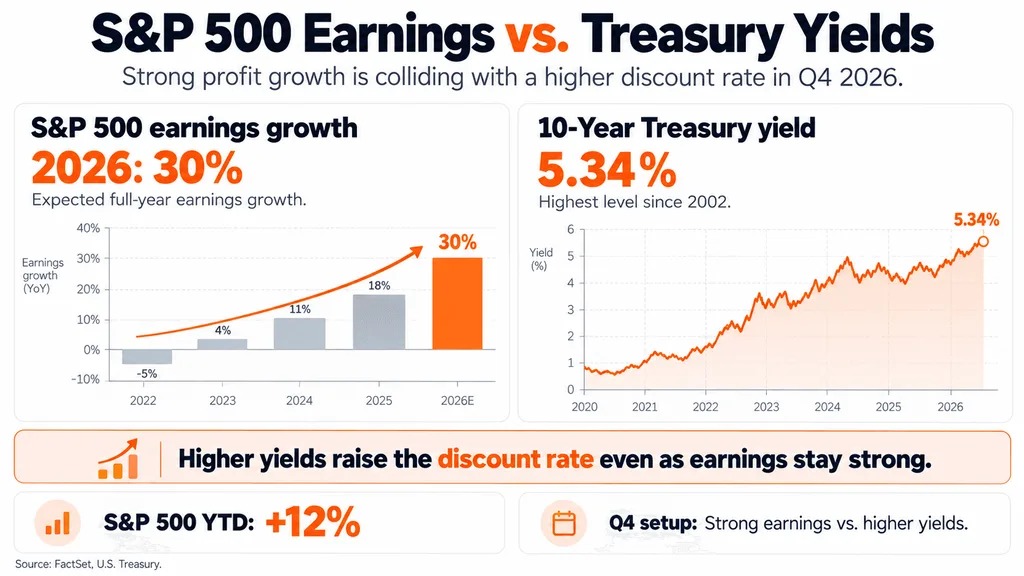
FactSet Currently, it is expected that the earnings of S&P 500 constituents will grow by 30% in calendar year 2026, with analysts also forecasting growth of 27.4% and 25.2% for the third and fourth quarters, respectively. However, the yield on 10-year U.S. Treasury bonds has risen above 5%, which is changing the valuation logic.
Helpful
No.Help

FactSet Currently, it is estimated that the earnings of S&P 500 components will grow by 30% in calendar year 2026. Analysts also predict that earnings will increase by another 27.4% in the third quarter and 25.2% in the fourth quarter. This strong performance continues from the exceptionally outstanding second-quarter financial reporting season; even excluding the exceptionally large investment returns from Alphabet and Amazon, earnings still grew by about 32%.

According to FactSet, since the beginning of the second half of the year, analysts have also been raising their forecasts rather than lowering them.

Normally, such profit figures would be directly regarded as positive.

The problem lies in the bond market.

5% Treasury yield changes valuation calculations

The yield on 10-year U.S. Treasury bonds has risen above 5%, reaching 5.34% at one point recently, the highest level since 2002. This upward trend continues a significant sell-off in bonds, which has become one of the biggest risks facing the U.S. stock market in the fourth quarter.

Official data from the U.S. Treasury Department shows just how significant the increase in long-term borrowing costs has been this year.

This is very important because investors can now obtain returns of over 5% on government debt, and the risks they bear are much lower than those associated with holding stocks. Higher yields also reduce the present value of future corporate profits, which is why expensive artificial intelligence and technology stocks are particularly sensitive to long-term interest rate changes.
Profits are playing a more significant role in driving growth.

So far, it seems that profits have been on the winning side.

Despite the soaring yields on U.S. Treasuries, the S&P 500 still rose by about 12% this year. When the 10-year yield climbed to 5.34%, the S&P 500 and the Nasdaq index remained strong, demonstrating their resilience.

Valuations have also become slightly less stretched. The forward price-earnings ratio of the S&P 500 has fallen back to near 20 times, whereas it was above 22 times earlier this year. This indicates that what drove this round of gains was more so profit growth than mere valuation expansion.

Emir Abyazov

Editor-in-Chief Coinpaper, responsible for data-driven editorial operations; SEO focuses on content discovery, as well as creating narratives that prioritize the audience interests in cryptocurrency, artificial intelligence, and fintech.

Tip
$0
Like
0
Save
0
Views 21
HQYC reminds readers to view blockchain rationally, stay aware of risks, and beware of virtual token issuance and speculation. All content on this site represents market information or related viewpoints only and does not constitute any form of investment advice. If you find sensitive content, please click“Report”,and we will handle it promptly。
Submit
Comment 0
Hot
Latest
No comments yet. Be the first!
Related
IMF Praises Economic Improvement in El Salvador, but Calls for Further Reduction in Bitcoin Use
The International Monetary Fund stated that it has approved the disbursement of $139 million to El Salvador, while also promoting the country to "reduce its involvement in Bitcoin-related activities." IMF noted that El Salvador's economic performance is better than expected, but also pointed out that some performance indicators, including Bitcoin accumulation, have not met the standards; meanwhile, El Salvador has previously indicated on multiple occasions that it continues to purchase Bitcoin.
Bitcoin Magazine
·2026-10-03 06:14:16
10
Non-farm payroll data came as a cold shock, dampening expectations for interest rate hikes; U.S. stocks continued to rise, NVIDIA hit a new high during trading; U.S. Treasury yields formed a V-shape. G7's reserve release dealt a heavy blow to crude oil prices, and gold and silver tumbled throughout the week.
U.S. non-farm employment cooled unexpectedly in September, leading to a decline in market expectations for the Federal Reserve's short-term interest rate hikes. This drove U.S. stocks higher and the dollar weaker, but U.S. Treasury yields quickly rebounded after a short-term drop. Meanwhile, G7 announced the release of 100 million barrels of oil and petroleum product reserves, causing international oil prices to plummet during trading hours, and gold and silver also continued to fall sharply this week.
Wallstreetcn
·2026-10-03 06:14:12
11
Apple plans to provide stricter privacy protection for Mac users to counter more powerful AI proxies
Apple stated that it plans to add more privacy controls to the "full disk access" permission for macOS. This permission allows apps to read emails, private messages, browsing history, and other personal files; Apple claims that as AI proxies become more powerful and autonomous, the risks associated with such permissions will increase significantly.
Businessinsider
·2026-10-03 06:04:23
12
Sean Parker is rebuilding around music Stability AI
Co-founder Sean Parker stated that his return to the music industry this time will be "played by the rules." Two years ago, he participated in a $80 million bailout for Stability AI; now, together with his long-term partner and current CEO Prem Akkaraju, they are working to transform this company into a AI tool provider for music professionals. At the end of August, Stability AI announced that it had received $76 million in financing from institutions such as Sony, Warner, and Universal. These companies also authorized their respective music libraries for training purposes during the transaction. Since then, the company has launched three new audio models and the AI music editing software.
TechCrunch
·2026-10-03 05:23:35
29
72% of enterprises in the eurozone planning to invest in AI intend to finance with their own funds
A survey by the European Central Bank of 5,087 enterprises in the eurozone shows that among those planning to invest in AI, 72% expect to use internal funds, including cash flow and retained earnings; bank loans and subsidies each account for 16%, leasing for 15%, private equity or venture capital for 6%, and debt securities for only 1%.
Coinpaper
·2026-10-03 05:14:48
22
View More