

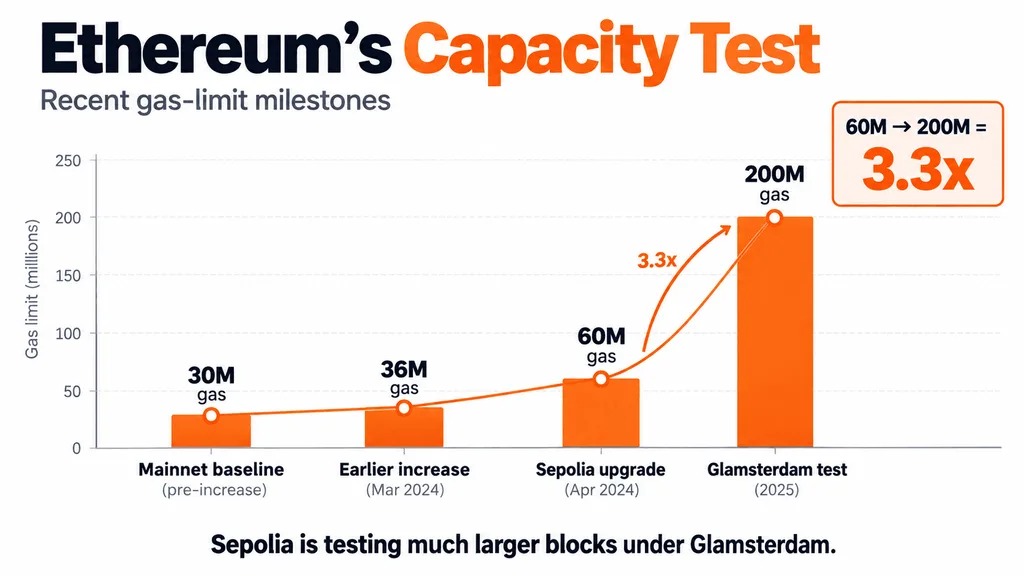
Ethereum is testing one of the most significant attempts to increase its capacity. During the Glamsterdam upgrade, which is being progressed on the Sepolia test network, the target for the number of blocks has been set at a limit of 200 million gas.
This test more than tripled the previous upper limit of approximately 60 million gas for Sepolia. Developers use this to measure whether Ethereum validators can safely process significantly larger blocks.
This change does not mean that the Ethereum mainnet will immediately increase to 200 million gas. On the contrary, developers are using Sepolia to determine to what extent the capacity of Layer can be expanded further, while also avoiding placing an excessive burden on hardware or verification requirements.
Ethereum tests an over-three-fold increase in capacity
Gas represents the computational workload required to execute transactions and smart contracts on Ethereum.
A higher limit on blocks gas means that each block can accommodate more exchanges, stable coin transfers, and smart contract interactions before users start competing fiercely for available space.
Ethereum has previously been gradually increasing the upper limit of gas, but on Sepolia, it has been raised from 60 million to 200 million, representing a more radical test.
This experiment emerged as developers attempted to expand Ethereum itself while maintaining a broader Layer 2 scaling strategy for the network.
Glamsterdam Changing the Way Ethereum Processes Blocks
Glamsterdam introduced a number of architectural changes aimed at supporting higher throughput.
One of these is the block-level access list, which allows nodes to know in advance which accounts and storage locations will be used by a block before it is executed. This may make it easier to process independent transactions in parallel, rather than executing them all in sequence.
Another important feature is the separation of proposers from builders within the protocol, which is ePBS. This feature incorporates more aspects of the Ethereum block construction process directly into the protocol.
Previously, the tests of Nethermind included 2,302 performance tests, during which it processed 570.7 billion gas in just over three minutes. Developers used this to evaluate the design's performance under heavier loads.
These improvements are at the core of Ethereum's broader roadmap for scaling, especially as blockchain activities are growing in the fields of payments, DeFi, and tokenized assets.