The storage boom driven by AI pushed Samsung's profits to nearly 9 times growth, but the stock price fell.
Coinpaper
1h ago
Ai Focus
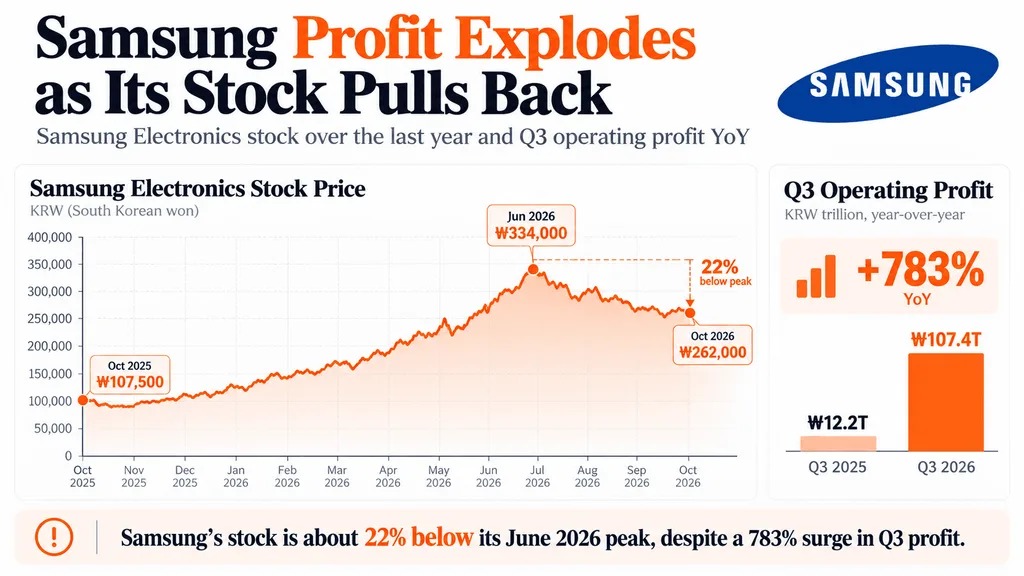
South Korean chip giant Samsung Electronics expects its operating profit in the third quarter to reach 107.4 trillion won (about $80.2 billion), a year-on-year increase of about 783%, with revenue expected to be around 195 trillion won. The main factor driving this growth is the surge in demand for memory chips required for artificial intelligence infrastructure. However, even after the release of the earnings forecast, Samsung's stock price still fell. Investors are concerned whether the current memory chip profit margins can be sustained and whether the positive news has already been fully factored into market prices.
Helpful
No.Help

Based on preliminary performance, South Korean chip giant Samsung Electronics expects its operating profit for the third quarter to be 107.4 trillion Korean won (approximately $80.2 billion), a year-on-year increase of about 783%. Revenues are expected to be around 195 trillion Korean won.

This growth is mainly driven by the exceptionally strong demand for storage chips used in artificial intelligence infrastructure. Despite the strong data, Samsung's stock price still fell after the announcement, continuing its previous downward trend, and is now significantly below its June high.

AI storage shortage drives Samsung's profits to record levels

Artificial intelligence servers require a large amount of DRAM, as well as increasingly complex high-bandwidth memory ( HBM ).

Strong demand, coupled with tight supply, has driven a significant increase in the prices of storage chips, altering the profit structure of Samsung's semiconductor business. The company currently expects to record a fourth consecutive quarter of record profits, and its latest operating profit is also set to exceed 100 trillion Korean won for the first time.

This improvement also aligns with the broader recovery trend of memory chip stocks. Micron has similarly benefited significantly from the demand for storage driven by AI, while Samsung and SK Hynix have helped drive the Korean Composite Stock Index (KOSPI) to rebound significantly after the semiconductor sell-off in July.
Why has Samsung's stock price fallen?

The question is no longer whether Samsung has benefited from AI. Investors are questioning how much of this positive news has already been reflected in the stock price, and how long the current storage profit margin can continue.

Traditional DRAM prices are expected to rise by 10% to 15% month-on-month, which is significantly lower than the approximately 60% increase in the second quarter. As the Korean won strengthens and concerns about future chip pricing rise in the market, analysts have also lowered their forecasts for Samsung's profits.

Competition also brings another risk. Chinese storage chip manufacturers are expanding their production capacity, while Samsung continues to make substantial investments in HBM and advanced semiconductor manufacturing to maintain its competitiveness.

In addition, the company's performance in areas other than its storage business is weaker. Reuters reported that Samsung's mobile business division incurred losses of over $1 billion, and its wafer foundry business has yet to achieve profitability.

Author: Emir Abyazov

Coinpaper is the chief editor, responsible for driving data-driven editorial operations, content discovery oriented towards SEO, as well as narrative strategies that prioritize the audience in the fields of encryption, AI, and fintech.

Tip
$0
Like
0
Save
0
Views 26
HQYC reminds readers to view blockchain rationally, stay aware of risks, and beware of virtual token issuance and speculation. All content on this site represents market information or related viewpoints only and does not constitute any form of investment advice. If you find sensitive content, please click“Report”,and we will handle it promptly。
Submit
Comment 0
Hot
Latest
No comments yet. Be the first!
Related
Pomerantz Law Firm Reminds Investors: Simply Good Foods Class Actions and Related Deadlines
Pomerantz LLP indicates that a class action has been filed against The Simply Good Foods Company, and investors who purchased or held the company's securities during that period are reminded of the deadline to apply to become lead plaintiffs. The press release recalls that the company previously disclosed a slowdown in sales growth for its OWYN business, issues with product quality, and subsequently announced in its financial reports that sales for the OWYN quarter fell by nearly 17% year-on-year, with a provision for impairment of $187 million and a downward revision of the full-year sales forecast. As a result, the stock price declined after these announcements.
PR Newswire
·2026-10-08 22:21:41
8
NextBlock invests $3 million in Soda Labs to expand blockchain privacy
NextBlock invests $3 million in the seed round of Soda Labs, providing all the funds for that round. Soda Labs is expanding from its current gcEVM privacy layer to chain-agnostic Soda Bubble, with plans to promote privacy computing capabilities to networks such as Ethereum, Polygon, Arbitrum, Base, and Solana, as well as advancing commercial integrations with banks, payment companies, and tokenization platforms.
CoinJournal
·2026-10-08 22:21:39
8
Investors Reminder: Pomerantz Law Firm Reminds Holders of Papa John's International, Inc. Investors with Investment Losses Should Pay Attention to Class Actions and the Approaching Deadline - PZZA
Pomerantz LLP represents that it has already filed a class action on behalf of Papa John's International, Inc. It also reminds investors who were appointed as lead plaintiffs to apply before November 2, 2026. According to the original text, Papa John disclosed on August 6, 2026, that same-store sales in North America had declined by 8.3%, suspended dividend payments, and significantly lowered its performance forecast for 2026, followed by a 17.18% drop in the stock price.
PR Newswire
·2026-10-08 22:12:17
14
Encrypted lending has rebounded, but the attacks on AI and the associated chain risks remain.
Since July, encrypted lending has rebounded by over 55%, with a total locked-up value of approximately $56 billion. However, cross-dependencies between protocols, AI assisted attacks, and human errors continue to increase risks. Institutions such as Aave, Spark, Ledn, and Maple have stated that security audits, asset isolation, and risk mitigation mechanisms are more important than ever.
Cointelegraph
·2026-10-08 22:12:15
15
Over 6 million Bitcoins at Risk After Public Keys Were Exposed: AI Risk Warning Intensifies
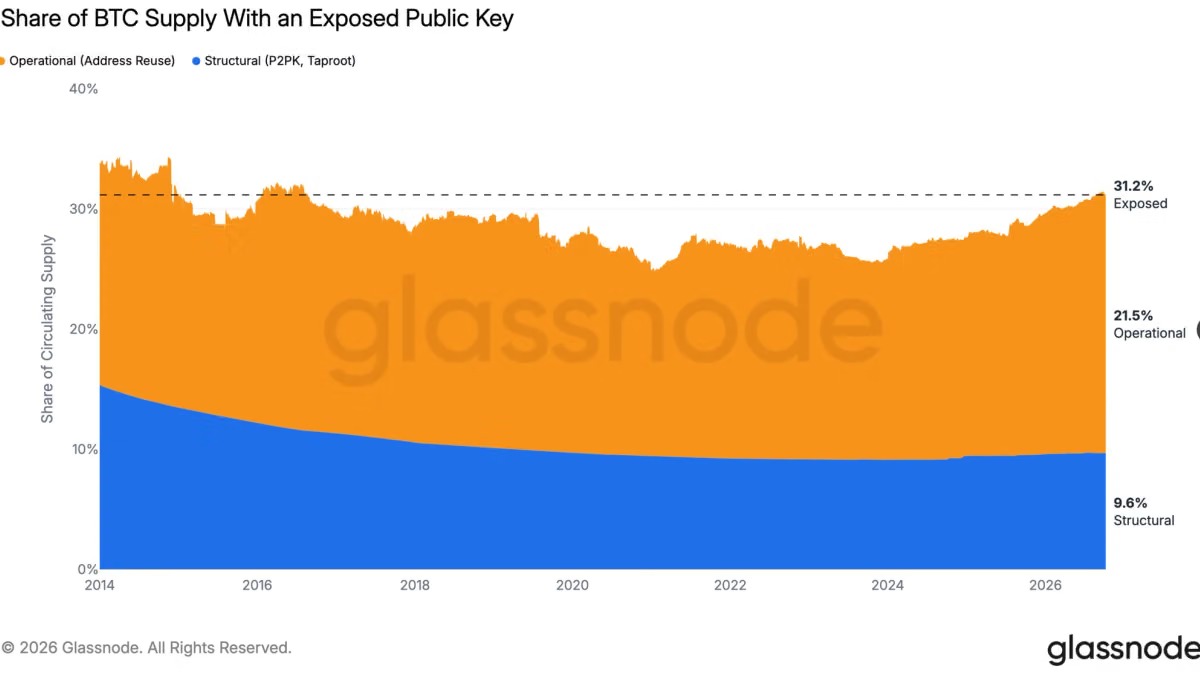
Glassnode Data shows that over 6 million Bitcoins are located behind visible public keys on the blockchain, accounting for 31.2% of the circulating supply, which is about 5 to 6 percentage points higher than the low point in 2023. Glassnode Co-founders Rafael Schultze - Kraft stated that since the report in May, the exposed supply has increased by 222,000 BTC. The number of Bitcoins held by exchanges behind visible public keys has risen to 1.79 million BTC. The report also mentions that the current measurement is of address usage and does not imply an immediate security risk.
CoinDesk
·2026-10-08 22:12:13
15
View More