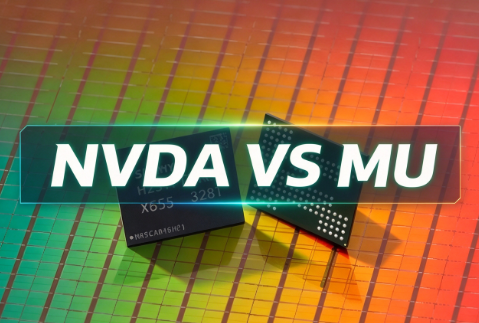


As of press time, Nvidia's forward P/E is approximately 25x, while Micron's is only about 6x. The former reported quarterly revenue of $68.1 billion, while the latter reported $54.2 billion, a year-over-year surge of 379%. One is the definer of AI computing power; the other is the memory leader amid a supply-demand gap. Their business models, profit cycles, and valuation logic are completely different.
What Sectors Are in the US Semiconductor Market?
When mentioning US semiconductor stocks, many investors' first reaction is Nvidia. But the US semiconductor sector covers far more than the GPU niche, including computing chips, memory chips, semiconductor equipment, analog chips, and more. The Philadelphia Semiconductor Index (SOX) alone includes 30 core companies. Since the start of 2026, the index has risen 84%, with notable performances from Micron, Marvell, Intel, AMD, and others.
Below is our compilation of sub-sectors, related companies, and key data:
| Sub-sector | Key Companies | Key Data Support |
|---|---|---|
| Computing Chips | Nvidia | FY2026 full-year revenue of $215.9 Billion |
| Computing Chips | AMD | Q1 2026 revenue of $10.3 Billion |
| Computing Chips | Broadcom | Q3 FY2026 revenue of $29.6 Billion |
| Computing Chips | Intel | Q2 2026 revenue of $16.1 Billion |
| Memory Chips | Micron | Q4 FY2026 revenue of $54.2 Billion |
| Semiconductor Equipment | TSMC | September revenue up 54.6% YoY |
| Semiconductor Equipment | KLA | FY2026 revenue of $13.579 Billion |
| Analog and Communication Chips | Qualcomm | Q2 FY2026 revenue of $10.599 Billion |
| Analog and Communication Chips | Texas Instruments | Q2 2026 revenue of $5.5 Billion |
Note: The above content is compiled and summarized by CoinMeta based on public market data. Please refer to actual data if there are any fluctuations.
Among these targets, the comparison between Nvidia and Micron is the most representative. Both are core beneficiaries of AI infrastructure. Below we detail their differences and holding logic.
Nvidia vs Micron: Core Differences
Table: Core Differences Between Nvidia and Micron
| Comparison Dimension | Nvidia | Micron |
|---|---|---|
| Core Advantage | Dual barrier of hardware performance and software ecosystem | High-performance memory chips and scarce manufacturing barrier |
| Hardware Performance | Blackwell delivers ~4x AI training improvement over H100 | HBM3E speed exceeds 9.2Gb/s |
| Technical Barrier | CUDA has 6 million developers, etc. | The only US manufacturer mass-producing DRAM and other memory types simultaneously |
| Market Position | ~80% to 90% data center GPU share | 18% HBM share, ranking third globally |
| Key Financials | FY2026 data center revenue of $193.5 Billion | FY2026 revenue of $133.188 Billion |
| Main Difference | Computing chips and ecosystem lock-in | Memory chips, manufacturing scarcity |
Nvidia
Key Data
Nvidia's positioning has evolved from a GPU chip supplier to an AI computing platform. In Q4 FY2026, the company reported revenue of $68.1 billion, of which data center revenue was $62.3 billion, up 75% year-over-year. Full-year revenue reached $215.9 billion, up 65% year-over-year. Q4 GAAP gross margin was 75%, with operating profit of $44.3 billion.
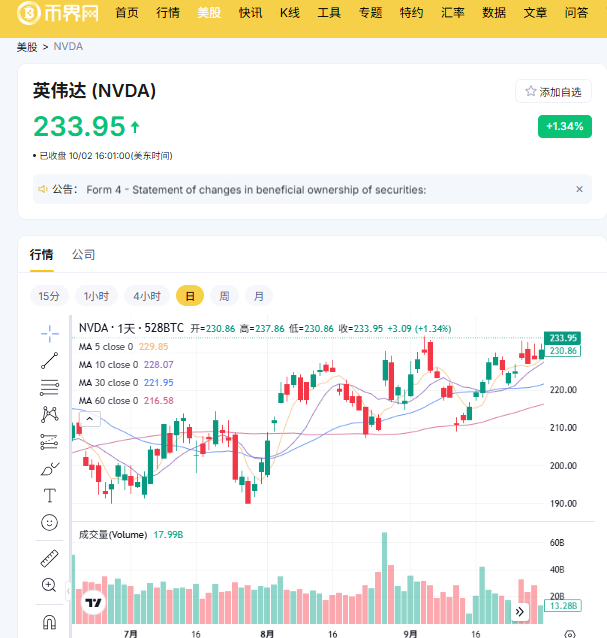
Image: Nvidia Latest Stock Price
Advantages
Our analysis suggests Nvidia's core advantage lies in the dual barrier of "hardware performance + software ecosystem."
On the hardware side, its Blackwell architecture GPU delivers approximately 4x the AI training performance of the previous H100 generation, and inference throughput at FP4 precision can reach 4x that of H200. The GB200 superchip can achieve 30x performance improvement for large model inference. On the software side, the CUDA platform, accumulated over nearly 20 years, has gathered 6 million developers, covering over 400 libraries, 600 AI models, and 3,700 GPU-accelerated applications, with cumulative downloads exceeding 53 million.Micron
Key Data
Micron's Q4 FY2026 revenue was $54.2 billion, up 379% year-over-year, with full-year revenue reaching $133.2 billion, up 256% year-over-year. More striking is profitability: Q4 Non-GAAP gross margin was as high as 87%, and full-year gross margin reached 80.7%, with margins consistently higher than Nvidia's 75% for multiple quarters.
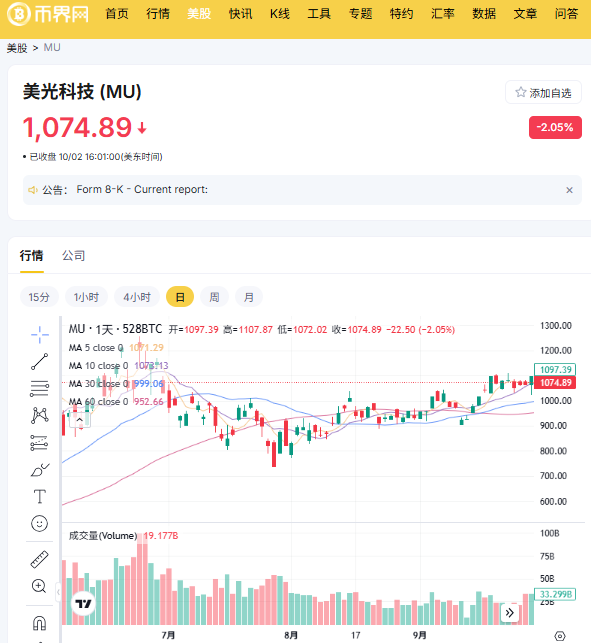
Image: Micron Latest Stock Price
Advantages
In our view, Micron's core advantage is high-performance memory chips and scarce manufacturing.
On hardware performance, HBM3E pin speeds exceed 9.2Gb/s, bandwidth reaches over 1.2TB/s, and power consumption is about 30% lower than competitors. HBM4 bandwidth exceeds 2TB/s, a 60%+ improvement over the previous generation, with energy efficiency further optimized by 20%. A 288GB HBM4 system can boost GPU computing power by 1.5x. Its HBM market share is 18%, ranking third globally.On technical barriers, Micron is the only US-based manufacturer with mass production capabilities in all three major memory types: DRAM, NAND, and NOR. It has continuously invested in HBM packaging patents since 2008, with deep accumulation in TSV stacking and hybrid bonding technologies.Valuation Comparison
From a valuation perspective, the two present completely different pictures. Micron's forward P/E is only about 6x, with a PEG of 0.14; Nvidia's forward P/E is about 25x, with a PEG of 0.58. Micron's stock has risen 673% over the past 12 months, while Nvidia has risen only 37% in the same period.
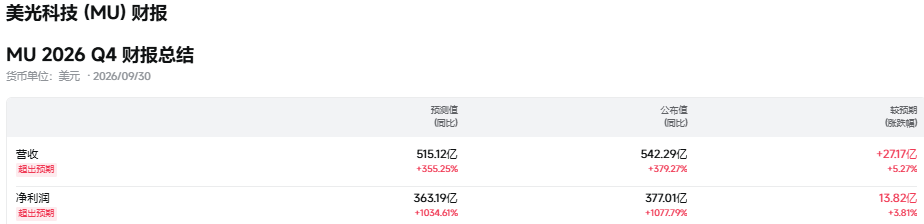
Image: Micron Latest Financial Report
Nvidia's 25x P/E reflects the market's belief that its growth has platform-level stickiness; Micron's 6x P/E implies market concerns about "profit decline after the cycle peaks." In our view, both are core allocations.
Which Is More Worth Holding?
Nvidia vs Micron: which is more worth holding? In our view, this depends on the investor's holding period and risk tolerance.
If holding for 3-5 years, Nvidia offers higher certainty, for the following reasons:
Its inference cost advantage, CUDA ecosystem barrier, and full-scenario coverage from training to inference make its growth more predictable. The current 25x forward P/E corresponds to guidance of approximately 70% revenue growth for the next fiscal year, with a PEG below 0.4, so the valuation is not expensive.
Image: Nvidia Institutional Views
If holding for 1-2 years, Micron may offer greater elasticity, for the following reasons:
The supply-demand gap is unlikely to ease before 2027-2028. Micron has locked up most of its 2027 HBM capacity, with prices significantly higher than in 2026. JPMorgan maintained a buy rating on Micron in its report, believing that continued price increases and margin expansion will still drive the stock price.Our advice is that for allocation-oriented investors, holding both Nvidia and Micron is essentially betting on two independent logics: the "computing cost decline curve" and the "memory supply shortage curve," which can hedge single-track risk to a certain extent. For short-term traders, Micron's high-beta attribute may provide greater swing trading opportunities, but requires bearing higher volatility risk.
Nvidia and Micron FAQ
Q1: Can Nvidia and Micron be held simultaneously?
Yes, they are not mutually exclusive choices. Nvidia represents the computing chip logic, while Micron represents the memory chip supply-demand gap logic. The two drivers are independent.
Q2: Does Micron's low P/E mean it is more worth buying than Nvidia?
Not necessarily. A low P/E may reflect market concerns about a cyclical peak. Micron's forward P/E is only about 6x, but the memory industry has historically been highly cyclical, and the market worries that new capacity releases around 2028 could lead to profit declines. In our view, low valuation does not equal low risk; it should be judged in conjunction with the industry cycle position.
Q3: Should ordinary investors choose Nvidia or Micron?
It depends on the holding period: 3-5 years, choose Nvidia; 1-2 years, choose Micron. Nvidia's CUDA ecosystem and inference cost advantages make its growth more predictable; Micron's current supply-demand gap is clear, its 2027 HBM capacity is locked, and short-term elasticity is greater.
Q4: What is the overall valuation level of the US semiconductor sector?
Overall valuations are clearly divergent, and leading stocks are not expensive. A recent Goldman Sachs report noted that after a roughly 11% pullback over two months in the Philadelphia Semiconductor Index, semiconductor sector valuations have returned to a reasonable range. Goldman maintains buy ratings on four major groups including equipment and AI CPUs. Nvidia's forward P/E is below the S&P 500 average, and Micron's is even in the single digits, but it is necessary to distinguish between "undervalued" and "undervalued at a cyclical high."
Disclaimer: Readers are strictly advised to comply with local laws and regulations. This article is compiled based on public market data for reference and educational purposes only, and does not constitute investment advice. Follow CoinMeta for the latest updates.