

Over the past week, the situation in Yemen has escalated sharply, with the United States and Iran continuing to be in a stalemate. Both sides are preparing for a resumption of hostilities, but Trump has clearly ruled out the possibility of taking action before the mid-term elections. Meanwhile, minutes from the Federal Reserve meetings and statements from several officials signal a consensus: although inflation remains high, there may be another interest rate hike within the year, but an action in October is not necessarily imminent.
The upward momentum of the US dollar continues to strengthen, with the daily chart recording four consecutive gains, marking the longest weekly increase in 21 months. This is due to soaring oil prices putting pressure on the currencies of energy-importing countries, as well as ongoing concerns about global inflation. Strong auctions of long-term US Treasury bonds have somewhat alleviated the selling pressure on these bonds. The yield on 10-year Treasuries ended a five-week upward trend, climbing to 5.368% at one point during the week, setting a new high since 2002.
Geopolitical risk premiums dominate the trend of international crude oil prices. Iran has increased attacks on oil tankers in the Strait of Hormuz, and Yemen's Houthi rebels are reportedly laying mines in the Bab el-Mandeb Strait. Additionally, hurricanes have disrupted crude oil production in the Gulf of Mexico, all of which constitute positive factors for oil prices. On Friday, after Trump announced that Russia would immediately supply diesel to the United States and global markets, oil prices tumbled, but they still maintained an upward trend throughout the week.
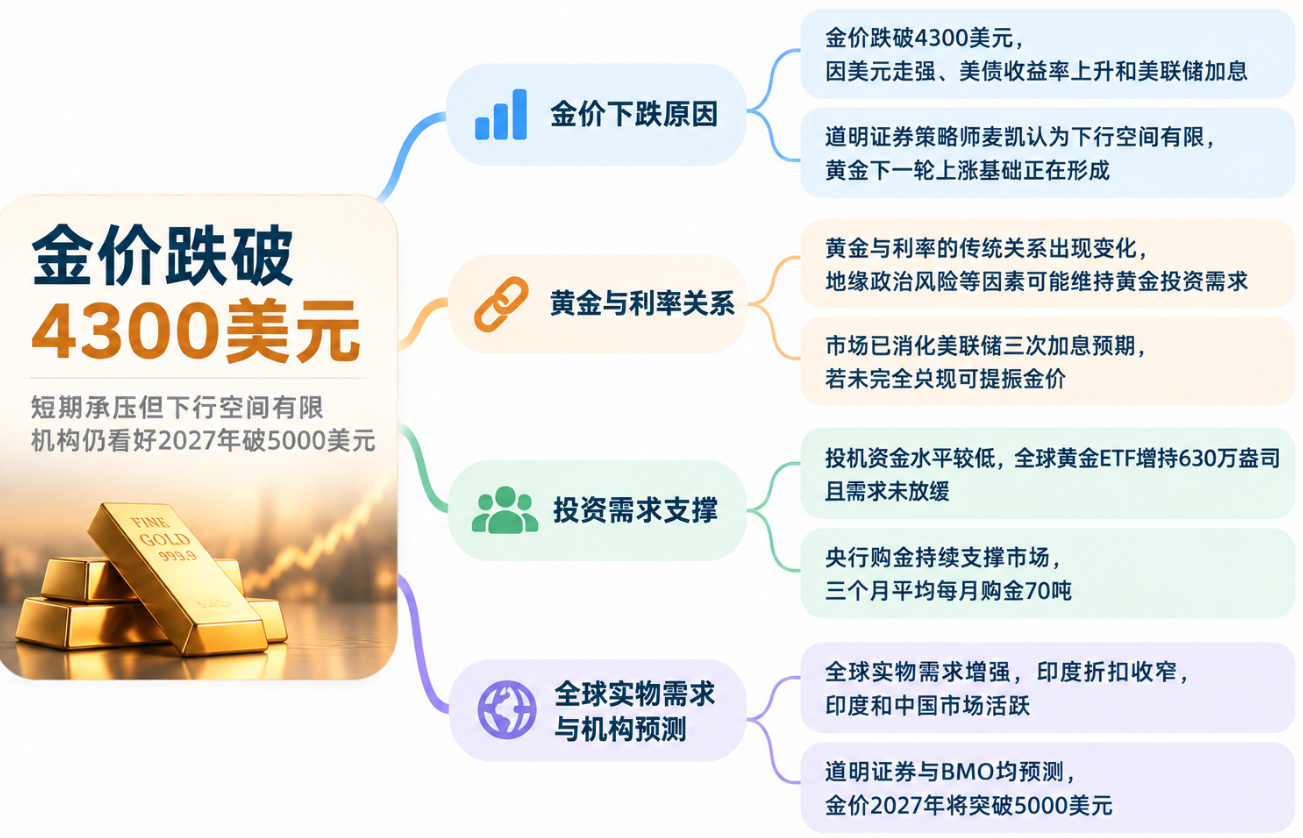
The dual pressure of high U.S. dollar levels and high yields on U.S. Treasury bonds once pushed international spot gold to a two-month low this week. However, subsequent declines in oil prices and buying at lower levels supported gold to touch the $4,200 mark again, with a weekly increase of 1.33%. International spot silver also wiped out all of its losses during the week.
As investors re-evaluated reports regarding the revenue growth of OpenAI, concerns in the market about whether the demand for AI could support massive infrastructure investments eased. Large tech stocks in the U.S. market quickly rebounded after a sell-off on Thursday, with the Nasdaq index rising for the fourth consecutive week, and the S&P 500 approaching its historical highs once again, closing the week with a gain of over 1%.
The following are the key points that the market will focus on in the new week (all times are Beijing time):
Central Bank Dynamics: The Fed Is Not Eager to Raise Rates Continuously, So Why Is Wall Street Still Bullish on the Dollar?
Federal Reserve:
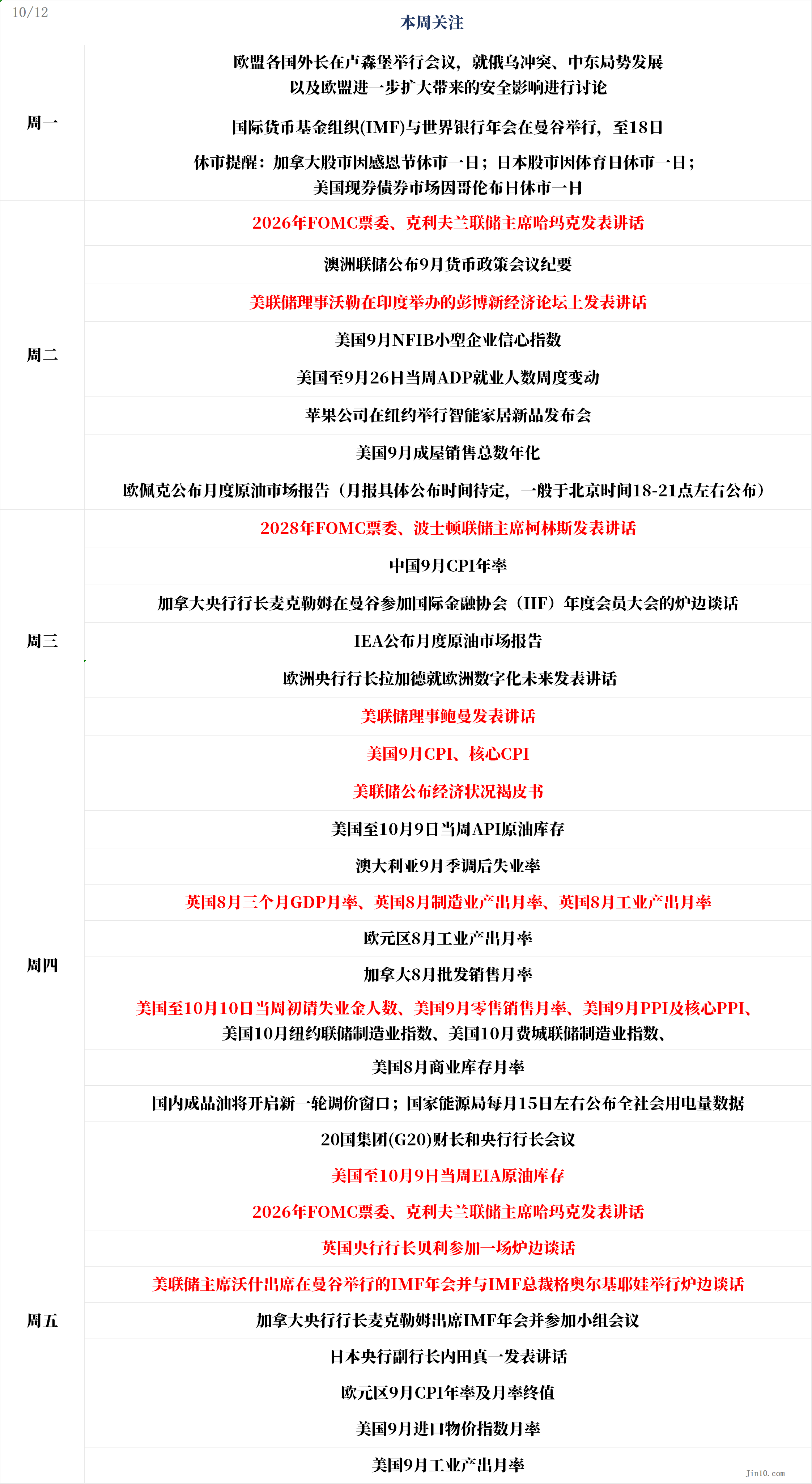
- On Tuesday, FOMC voting member of the Federal Reserve Board and Chairman of the Cleveland Federal Reserve, Loretta Harker, delivered a speech; at 3:45 p.m. on Tuesday, Federal Reserve Governor Jerome Powell spoke at the Bloomberg New Economy Forum held in India; at 4:00 p.m. on Wednesday, FOMC voting member of the Federal Reserve Board and Chairman of the Boston Federal Reserve, Eric Collins, gave a speech; at 5:40 p.m. on Wednesday, Federal Reserve Governor Christopher Bovman addressed the audience; on Thursday at 2:00 p.m., the Federal Reserve released its Economic Brief; on Friday at 4:30 p.m., FOMC voting member of the Federal Reserve Board and Chairman of the Cleveland Federal Reserve, Loretta Harker, delivered another speech; and on Friday at 11:30 a.m., Federal Reserve Chairman Jerome Powell attended the IMF annual meeting held in Bangkok and had a "fireside chat" with IMF President Elvira Nabiullina.
Other central banks:
- At 8:30 on Tuesday, the Reserve Bank of Australia released the minutes of its September monetary policy meeting; at 2:05 on Wednesday, Bank of Canada Governor Mark Carleham participated in a fireside chat at the annual general meeting of the International Financial Association ( IIF ) in Bangkok; at 4:30 on Wednesday, European Central Bank President Christine Lagarde delivered a speech on the future of digitalization in Europe; at 10:00 on Friday, Bank of England Governor Andrew Bailey attended a fireside chat; at 12:15 on Friday, Bank of Canada Governor Mark Carleham attended the IMF annual meeting and participated in panel discussions; at 2:30 on Friday, Vice Governor of the Bank of Japan, Makoto Ueda, gave a speech.
Fed officials are set to see a surge in public statements before the quiet period next week. Signals released by officials recently indicate that although further interest rate hikes may still be needed this year, they are not in a hurry to tighten policy at consecutive meetings. As a result, market bets on another rate hike in October have weakened, with attention shifting to the potential next move in December.
The minutes of the Federal Reserve's meeting on September 15-16 show that most officials believe it may be appropriate to raise the federal funds rate further before the end of this year. However, there is disagreement among officials regarding the reasons for raising rates: some are more concerned about the risk of supply shocks such as energy prices continuing to drive up inflation, while others worry that strong demand and economic growth are creating broader inflationary pressures.
The summary also emphasizes that in the future, each meeting will maintain an open attitude, and policy decisions will depend on new data and their impact on economic prospects and risk-benefit balances.
On October 8, Waller stated in a speech in Istanbul that if economic data meets expectations, further interest rate hikes could help bring inflation back to the 2% target more promptly. However, he noted that the interest rate hikes do not have to occur at two consecutive meetings; they just need to be completed within an appropriate time frame.
This statement is in line with recent remarks by other Federal Reserve officials. Federal Reserve Vice Chairman Jefferson and New York Fed Chair Williams have previously stated that there is no need to rush to raise interest rates again after the actions taken in September, and it is possible to wait for more information.
St. Louis Fed Chairman Mussalem stated that in order to bring inflation back to the target level in a timely manner, further tightening of monetary policy will be necessary in the future. He believes that interest rates may need to continue to rise over the next 6 to 9 months.
Meanwhile, Trump has reinvigorated his actions against Federal Reserve Governor Lael Brainard Cook, establishing a committee to investigate allegations of false statements in housing loan documents and requiring her to appear before a hearing at the White House on November 5th. This development once again brings into focus the policy independence of the Federal Reserve versus the president's authority to appoint and remove governors. If Trump decides to remove her after the hearing, such a decision could potentially lead to another judicial process.
The controversy over Cook's removal from office occurs against the backdrop of the White House's ongoing focus on central bank policies. Although this move will not immediately change the committee's interest rate decisions, the investigation process may continue to test the market's confidence in the Fed's independence.
Compared to other major economies, the United States has more room to withstand further interest rate hikes, which provides an additional boost for the dollar. Francesco Pessole, a foreign exchange strategist at ING Group, wrote in a report that the global bond market and risk sentiment remain fragile. The Fed's stance has convinced the market that there may be an interest rate hike in December, and the strong dollar trend is not expected to change in the short term.
As of October 6th, data from CFTC shows that asset management institutions and non-commercial speculators continue to increase their long positions in the US dollar, with the scale of bets on a rising dollar exceeding 35 billion US dollars.
President Brent Donnelly ( Brent Donnelly ) remains bullish on the US dollar in the short term, expecting that the wave of capital expenditure ( AI ) will continue to attract funds into the United States, driving up inflation and nominal economic growth.
LPL Financial Adam Turnquist, the head of cross-asset strategies at Adam Turnquist, stated that the US Dollar Index has broken through a double-bottom pattern and reached the June high of 101.75, with the bullish trend continuing. If the US Dollar Index breaks through 102.86, the upside potential could extend to 107.
Important data: CPI If there is no major upset or surge, gold may continue to "stand still"
- At 14:00 on Monday, foreign ministers from EU countries met in Luxembourg to discuss the Russia-Ukraine conflict, developments in the Middle East situation, and the security implications of further EU expansion; on Monday, the International Monetary Fund (_IMF) and the World Bank Annual Meetings will be held in Bangkok until the 18th; at 18:00 on Tuesday, the U.S. September NFIB Small Business Confidence Index will be released; at 20:15 on Tuesday, the U.S. weekly change in employment numbers for the period ending September 26th will be announced; at 21:00 on Tuesday, Apple will hold a new smart home product launch event in New York; at 22:00 on Tuesday, the annualized total number of newly sold homes in the U.S. for September will be released; on Tuesday, there are no scheduled events; on Wednesday at 9:30, China's September CPI annual rate will be announced; at 16:00 on Wednesday, IEA will release its monthly crude oil market report; at 20:30 on Wednesday, the U.S. September CPI, core CPI will be released; at 4:30 on Thursday, the U.S. crude oil inventories for the week ending October 9th will be released; at 8:30 on Thursday, Australia's September seasonally adjusted unemployment rate will be released; at 14:00 on Thursday, the UK's August three-month GDP monthly rate, UK August manufacturing output monthly rate, and UK August industrial output monthly rate will be released; at 17:00 on Thursday, the Eurozone's August industrial output monthly rate will be released; at 20:30 on Thursday, Canada's August wholesale sales monthly rate will be released; at 20:30 on Thursday, the initial number of people receiving unemployment benefits in the U.S. for the week ending October 10th, U.S. September retail sales monthly rate, U.S. September PPI and core PPI, U.S. October Federal Reserve Manufacturing Index, and U.S. October Philadelphia Federal Reserve Manufacturing Index will be released; at 22:00 on Thursday, the U.S. August commercial inventory monthly rate will be released; on Thursday, there are no scheduled events; a new round of price adjustments for refined oil products will begin in China; the National Energy Administration releases national electricity consumption data around the 15th of each month; on Thursday, there are no scheduled events; the G20 (G20) Finance Ministers and Central Bank Governors Meeting will take place; at 00:00 on Friday, the U.S. crude oil inventories for the week ending October 9th will be released; at 17:00 on Friday,Eurozone September CPI annual and monthly rates; Friday at 20:30, US September import price index monthly rate; Friday at 21:15, US September industrial output monthly rate.
The U.S. inflation data for September CPI will be released on Wednesday, and investors will use this to determine the possible timing of the Federal Reserve's next interest rate hike.
Following recent weak U.S. employment data and statements from several Federal Reserve policymakers indicating there is still time to wait before raising interest rates again, according to LSEG data, the current market pricing for a rate hike on October 28th is only 19%, whereas previously this probability was as high as 70%. However, the market has fully anticipated that the Federal Reserve will raise interest rates by 25 basis points in December.
James Knightly, the chief international economist at ING Group, stated in a report: "Only 'particularly strong' economic reports could change the market's expectation that interest rates will remain unchanged in October. Given the significant increase in gasoline prices and airfare, such a scenario is not impossible. Nevertheless, we still expect the Federal Reserve to wait until December before raising interest rates."
The Banque de France ( Natixis ) believes that the CPI data is likely to meet market expectations. The inflation in August, which exceeded expectations, was a one-time abnormal fluctuation, mainly driven by a short-term increase in some sub-items. These related factors are not expected to recur, and this round of core inflation data will reflect a trend of inflation gradually returning to normal.
Economists Christopher Hodge ( Christopher Hodge ) and Céline Ak ( Selin Aker ) from the bank stated that the inflation data for August did not weaken their optimistic outlook on a decline in inflation, and they expect inflation to continue to fall in the coming quarters. They predict that the Federal Reserve will maintain interest rates unchanged at its meeting at the end of October. On one hand, this allows time to further assess economic indicators at the December meeting; on the other hand, it also avoids the political controversy that could arise from raising interest rates around the mid-term elections in November.
The Banque de France believes that the Federal Reserve may only carry out one interest rate hike during this tightening cycle, but it also acknowledges that monthly inflation data fluctuates significantly, making it difficult for there to be consecutive positive readings. Therefore, the bank still retains the scenario assumption of another interest rate hike in December or January next year.
Despite gold holding its own against multiple negative factors, downside risks still exist, and the inflation data to be released next week is particularly crucial.
FXTM Senior market analyst Lukman Otunuga ( Lukman Otunuga ) stated that only if inflation data significantly exceeds expectations will it force the Federal Reserve to take action on interest rates this month. Technically, if gold prices continue to fall below $4,200, the next targets would be $4,100 and $4,000; if they manage to hold above that resistance level, they could challenge the 100-day moving average around $4,260 and $4,300.
Bannockburn Global Forex Managing Director Mark Chandler ( Marc Chandler ) warned that multiple attempts to break through the $4,200 level for gold were met with selling pressure, and a firm hold above $4,230 is necessary to confirm a bottom has been reached.
Ole Hansen, the head of commodity strategy at Shengbao Bank ( Ole Hansen ), predicts that gold prices are likely to remain within a range of fluctuations next week, while the rebound from below $4,100 this week is encouraging. On one hand, high macroeconomic risks are negative for gold prices; on the other hand, these same risks have prompted investors to increase their allocation to gold, resulting in continuous weeks of capital inflows into gold ( ETF ).
In the medium to long term, he is bullish on gold for two main reasons: high borrowing costs will ultimately drag down the economy, and sectors with high leverage will expose risks. A slowdown or recession in the economy will boost demand for U.S. Treasury bonds and lower real yields, leading to loose monetary policies, which is favorable for gold prices. Another scenario is that although the economy has strong resilience, high yields will increase fiscal pressures on various countries. The debt levels of many governments have already exceeded the annual GDP, and the pressure to pay interest on debt may force policy intervention in the bond market. If this undermines monetary credibility, the demand for gold as a hedge against inflation will increase.
SIA Wealth Management Chief Market Strategist Colin Czeszynski ( Colin Cieszynski ) holds a neutral view, believing that the next major turning point for gold is likely to be influenced by changes in geopolitical situations. 'Unless we see some significant changes, I think we are just circling around in the same place at the moment.'
Important event: The US and Russia reach a diesel supply agreement, but analysts say it will be difficult to fill the global gap.
Trump announced on Friday local time that he had reached an agreement with Russian President Putin for Russia to immediately supply diesel to the U.S. market, a move that essentially relaxes U.S. energy sanctions against Russia. The Kremlin issued a statement saying that during talks with Trump, Putin expressed his willingness to increase the supply of oil and other fuels to the world.
After Trump announced the news, the U.S. Treasury Department immediately stated that it would lift the sanctions on Russian diesel exports, allowing Russian diesel to enter the global market, and issued general licenses to Russian energy companies, with the licenses valid until April of the following year.
Russia is a key global supplier of diesel fuel. Previously, Ukraine had continuously targeted Russian refining and fuel infrastructure, prompting Russia to extend the ban on diesel exports until the end of October. The tight supply has pushed up fuel prices, coinciding with the eve of the U.S. mid-term elections. Trump has previously criticized Ukraine's actions for driving up oil prices.
According to the supply scale announced by Trump on social media: Russia immediately supplied 300,000 tons of diesel to the US and global markets; an additional 500,000 tons were supplied in November; followed by another 1 million tons; and subsequently, depending on the situation of refineries, 3 million tons of diesel will be delivered in the short term. Trump expressed his gratitude to Putin at a White House press conference, stating that he was willing to accept this batch of diesel.
Edward Fishman, a senior researcher at the Council on Foreign Relations in the United States ( Edward Fishman ), doubts whether Russia will be able to fulfill its promises. He pointed out that when Russia initially imposed a ban on diesel exports, it was because Ukraine's attacks had damaged refining capacity, leading to a need for rationing of domestic fuel. He believes this is a typical strategy of Putin, aimed at dividing the transatlantic alliance through empty promises.
Ukrainian President Zelensky harshly criticized this diesel agreement on Friday. At that time, Ukrainian negotiators were meeting with the U.S. side in Florida to discuss a ceasefire between Russia and Ukraine. Zelensky stated that this agreement would provide funds for Putin, allowing him to fight more aggressively. Trump ignored Zelensky's criticism.
Kevin Burke ( Kevin Book ), the Managing Director of the energy agency ClearView Energy Partners, analyzed that even if Russia delivers the full amount, this volume is still relatively small compared to the global demand for diesel. Diesel is widely used in trucks, ships, agricultural machinery, and generators, with the global consumption of diesel and related fuels amounting to about 30 million barrels per day. According to estimates, there will be an additional supply of about 72,000 barrels per day in October, about 124,000 barrels per day in November, and subsequently between 240,000 and 720,000 barrels per day; in the last three months of 2025, Russia's diesel exports are expected to be 800,000 barrels per day. Burke commented that the increase is limited and will only have a minor impact on prices, and will not be sufficient to make up for the global supply gap.
Company Financial Reports: The third-quarter reports of U.S. stocks will be released next week. Does the increased attractiveness of U.S. bonds necessarily lead to portfolio rebalancing?
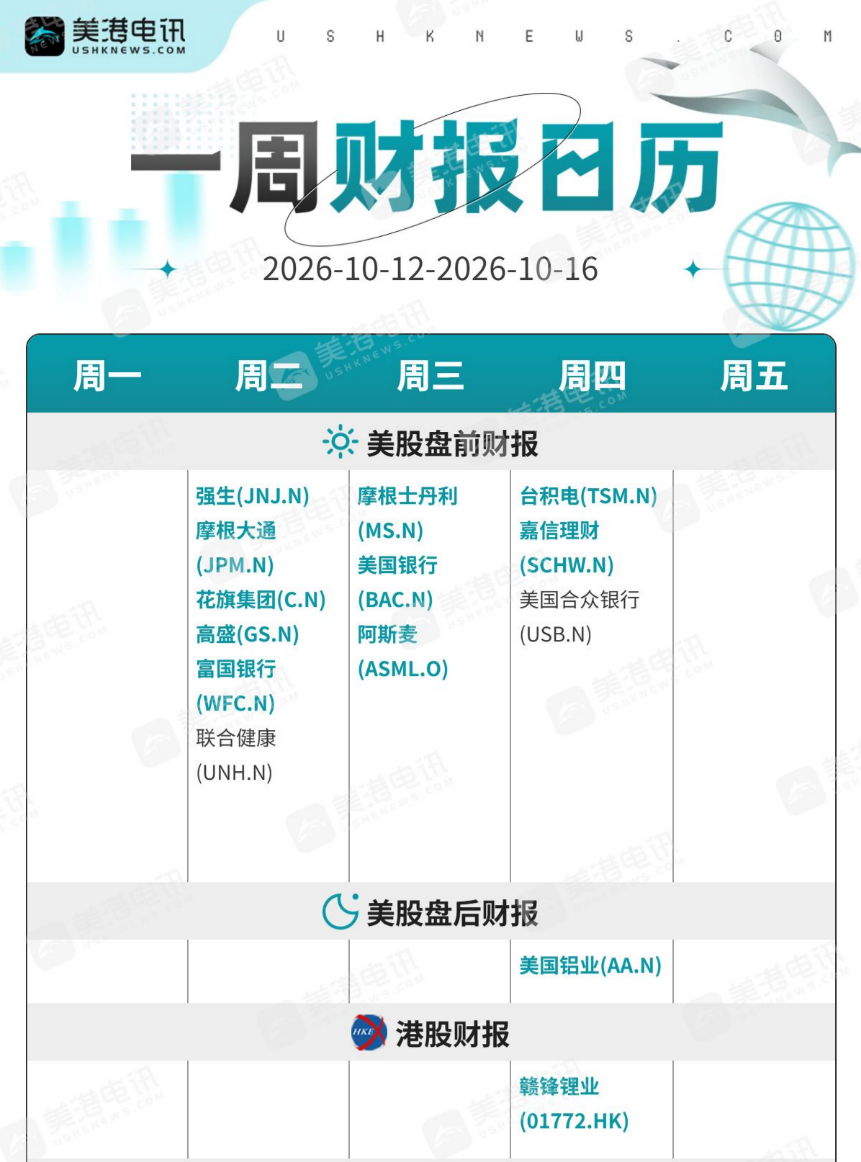
The financial reporting season will kick off next week, with large banks taking the lead. JPMorgan Chase ( JPM.N ), Goldman Sachs ( GS.N ), Citigroup ( C.N ), and Wells Fargo ( WFC.N ) are scheduled to release their results on Tuesday, while institutions such as Bank of America ( BAC.N ), Morgan Stanley ( MS.N ), and BlackRock ( BLK.N ) will disclose their results on Wednesday.
Corporate profitability will become a key factor in supporting the stock market. FactSet expects that the profits of companies comprising the S&P 500 index will increase by about 29.5% year-on-year in the third quarter, with revenue growth of around 12.3%. If these expectations are met, it will be the third consecutive quarter with profit growth exceeding 25%. The S&P 500 index has already achieved double-digit profit growth for seven consecutive quarters.
Investors are not only concerned about bank profits but also about the impact of higher interest rates and energy costs on consumers and capital market activities. Matt Stucky, the chief portfolio manager at Northwest Mutual Wealth Management, stated that the market needs to observe how rising interest rates will be transmitted to the capital market and consumer spending, especially whether consumers can withstand the pressure brought about by the increase in energy prices.
Recently, bank stocks have underperformed the broader market. Over the past month, the S&P 500 Bank Index has fallen by 7.5%, and rising yields on U.S. Treasury bonds have been one of the factors suppressing related stocks. Matthew Miskin, Co-Chief Investment Strategist at Matthew Miskin, stated that if financial institutions deliver good performance, the market might breathe a sigh of relief as a result.
Important financial reports are also released in the semiconductor industry. ASML ( ASML ) is scheduled to release its financial report on Wednesday, while TSMC ( TSM ) will announce its results on Thursday. The orders, demand, and guidance from these two companies will provide new insights into the prosperity of the chip industry and investments related to AI.
The host of the established financial program "Mad Money" and former hedge fund manager "Jim Cramer" stated that if ASML raises its performance guidance and confirms stable demand, investors can pay attention to semiconductor equipment stocks such as Fanuc Group (LRCX) and Applied Materials (AMAT). Regarding TSMC, he believes that if its performance is strong, it could significantly boost chip stocks.
However, even if the financial reports as a whole are strong, if inflation data once again drives up expectations for interest rate hikes, or if long-term U.S. Treasury yields continue to rise, U.S. stocks may still face valuation pressure. Previously, the market was concerned that yields of 5% might suppress market performance, but this expectation did not materialize. Currently, investors' focus has shifted to the potential risks associated with 10-year Treasury yields potentially reaching 6%.
Dan Ivashin of Pacific Investment Management Company ( Pimco ) said in an interview with The Financial Times this week that if high-leverage investors are forced to close their losing positions under a continuous selling market, the yield on 10-year U.S. Treasury bonds could reach 6%.
Dustin Reid, the Chief Fixed Income Strategist at Mackenzie Investments ( Mackenzie Investments ), stated that there is a possibility for yields to naturally rise to 6%, but this is not his baseline scenario. This week, strong buying in the market and the robust performance of U.S. Treasury auctions have limited further increases in yields.
On Friday, the yield on 10-year U.S. Treasury bonds remained stable around 5.25%, while the yield on 30-year U.S. Treasury bonds stayed at 5.6%. Reid pointed out that this yield level is sufficient to attract long-term funds such as sovereign wealth funds, central banks of various countries, and pension funds that are seeking asset-liability matching. He also mentioned that if oil prices continue to remain high, the AI capital expenditure boom continues, and the U.S. economy maintains its resilience, it would be reasonable for the yield on 10-year U.S. Treasury bonds to rise to 6%.
Harley Bussman, a veteran of the bond market and the founder of the MOVE index that measures the volatility of U.S. Treasury bonds, stated in a teleconference that he did not predict a specific level for the 10-year yield. However, given the $2 trillion U.S. fiscal deficit and the substantial capital expenditures by major cloud providers continuing to invest in data center construction, he maintains the view that "interest rates will remain higher for a longer period."
Bassman also mentioned that a large amount of funds are passively allocated to stocks through target-date funds. This 'passive automatic allocation' mechanism means that even if bonds become more attractive, investors are not likely to adjust their holdings easily.
Market Close Notice:
- On Monday, the Canadian stock market was closed for one day due to Thanksgiving; the Japanese stock market was closed for one day due to a national holiday; and the U.S. cash bond market was closed for one day due to Columbus Day.
Recommended Reading More
- 9 minutes ago: Weekly Outlook: CPI Tests the Fed's Expectations of Pausing Interest Rate Hikes; Is Gold's Direction Still Unclear?
- 1 hour ago: The US plans to relax cross-trading of bonds; how to reduce costs and prevent conflicts of interest
- Just 2 hours ago, it was no longer enough to only buy crude oil for hedging; the widening premium on aviation fuel is reshaping the cost management of European airlines.
- 2 hours ago, 1.29 trillion Korean won flowed into cash-based ETF, while Korean individual investors are rushing to buy collateralized products.
- 1 day ago, LPG A giant ship was attacked and caught fire in the Strait! Iran warns: The scope of tracking for violators will be expanded.