Key Points
- By 2030, the electricity consumption of data centers in the United States may account for 15.3% of the country's total electricity consumption.
- Even if NVIDIA GPU can be obtained, grid connection may still slow down the project progress.
- Transformers, transmission lines, and cooling systems make the expansion of AI more complex.
An artificial intelligence company can purchase thousands of NVIDIA GPU, build a data center, but still cannot operate it at full capacity. The missing key element may be electricity – not because the United States no longer has electricity available in a physical sense, but because the local power grid is unable to supply enough power.
The scale of this challenge is expanding. A report from Berkeley Lab in June 2026 estimated that by 2030, data centers could consume between 9.5% and 15.3% of the total electricity used in the United States, with a median estimate of 11.8%. This prediction highlights a fundamental difference: manufacturing AI chips is one thing, and providing the infrastructure necessary to run these chips is another.
Why buying more NVIDIA GPU doesn't solve the problem
The AI data center needs to supply power to processors, memory, network devices, and cooling systems. As more powerful AI accelerators are installed in the facility, the demand for electricity may grow faster than the rate at which local utility companies can expand their available capacity.
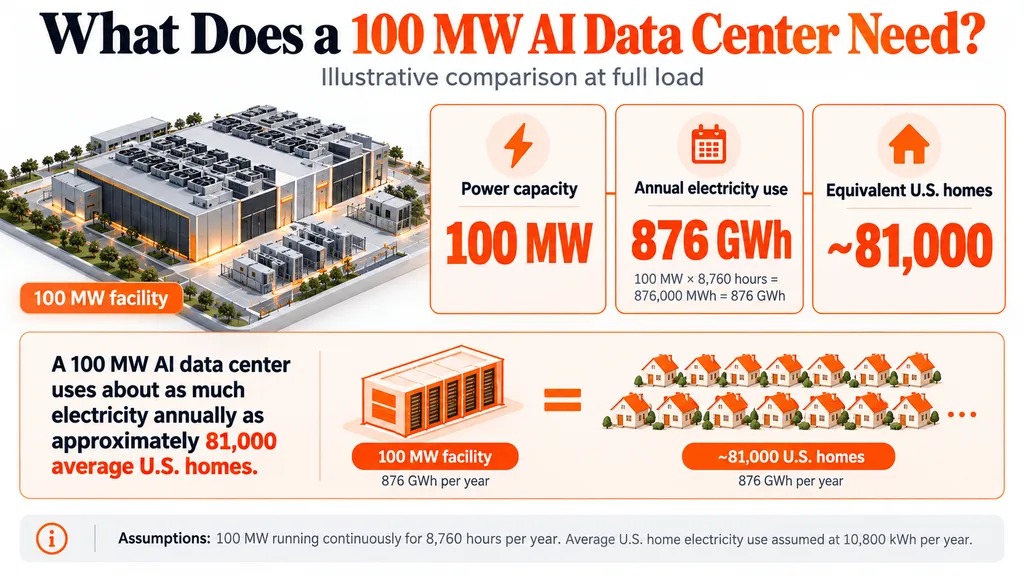
Taking a continuously operating 100-megawatt data center as an example, at full load, it consumes approximately 876 gigawatt-hours of electricity per year, which is equivalent to the annual electricity usage of about 81,000 American households, assuming each household uses 10,800 kilowatt-hours per year.
However, connecting such facilities to the power grid is not as simple as finding a power plant. Utility companies must assess the local transmission capacity, substations, transformers, and whether the grid can reliably accommodate another large customer.
New power transmission connections may require expensive infrastructure upgrades, regulatory approvals, and several years of construction time. As a result, while the equipment may already be installed, the electricity necessary to operate it is not yet available.
Why is the power grid slower than the AI industry?
Data centers can sometimes be built within two to three years, while large-scale power infrastructure projects often take much longer.
The International Energy Agency predicts that global data center electricity consumption will roughly double from 485 terawatt-hours in 2025 to 950 terawatt-hours by 2030. The agency's analysis indicates that transformers, gas turbines, and grid access approvals are becoming increasingly important bottlenecks.
This issue is particularly evident in the continuously expanding AI infrastructure market in the United States. The demand for computing power capacity has also created opportunities for companies that supply cooling equipment, power systems, and power generation capabilities.
When the AI data center needs more electricity, who will foot the bill?
Tech companies are increasingly signing long-term power agreements, rather than relying solely on the existing grid capacity.
At the same time, the construction of new infrastructure has brought another issue: who should bear the cost of upgrading? Depending on the rates for public utilities and regulatory provisions, the cost may fall on data center developers, power suppliers, or other users.
This debate has reached Washington. Proposals to protect electricity bill payers have highlighted concerns from the outside world about household users subsidizing the infrastructure of large tech companies.
The financial impact is not limited to utility companies. If data centers cannot obtain sufficient power, expensive GPU may operate at low capacity, while financing, depreciation, and maintenance costs will continue to accumulate.
Therefore, for AI investors, the important question is not just how many NVIDIA chips a particular company has purchased, but rather how much of this computing power can actually be put to use and turned into cash.
Adrian Cole
Adrian Cole has been engaged in financial market reporting for over 6 years, with a focus on cryptocurrencies, stocks, and macroeconomic trends. He tracks Bitcoin, major altcoins, the U.S. stock market, interest rates, commodities, as well as data that drives market fluctuations. Over the years, he has written hundreds of market updates and analysis articles, with an emphasis on price trends, investor sentiment, and the connections between traditional finance and digital assets.