

On October 13th, Google brought a previously rather cumbersome process to the forefront in an update announcement on Play. Users who have created their own Android applications using Google AI Studio can now install these applications directly on their devices in eligible regions through Google Play, without having to register a developer account or go through the entire public release process first. The announcement emphasized that this is a personal application library and a private installation experience, which does not mean that anyone can distribute a program to the world just by creating it. The service is initially available to users over 18 years old in selected markets such as the United States; sharing with family and friends will be available in the coming months. For ordinary people, the change is not about "AI replacing programmers" in a grand sense, but rather about the reduction of steps required between describing a need and having a functional tool available on their phones.
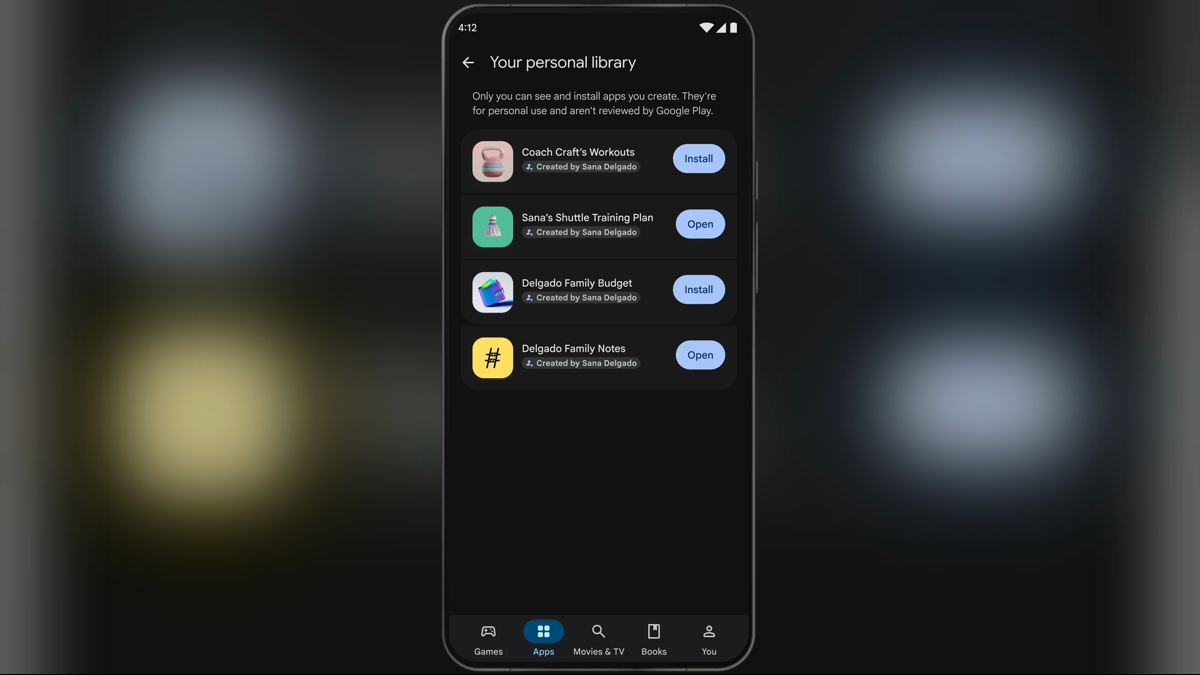
Let's take a more specific scenario as an example. A user wants to create a workout plan card that suits their own training pace, or a budgeting tool for household use. In the past, even if AI helped write the code, they still had to deal with packaging, installing package signatures, device security prompts, and application distribution. Now, Google connects the personal application libraries from AI Studio and Play, with the goal of making the steps of creation, installation, and re-opening more similar to the user experience of using regular applications. On the schematic diagram provided by Google, personal applications appear alongside the vast number of products in the public store, but it is also indicated on the interface that these personal applications are only visible to the creator and have not undergone the review process for public applications by Google Play. This is the key to understanding the situation: the entry point has become smoother, but the risks have not disappeared as a result.
Private installation and public listing are two completely different sets of requirements.
The announcement from Google is quite clear: personal applications are currently only available for installation and use by their creators, and they are not yet open to users in all countries. Sharing with family and friends is still part of a future plan and cannot be described as already available. If developers wish to make the applications available to the public, they still need to go through professional developer accounts, policy compliance, and review processes. Therefore, the so-called “zero-threshold release” of App confuses at least three things: generating a prototype with the model, installing that prototype on one’s own phone, and releasing it to unknown users after passing store reviews. What really changes this time is the second point mentioned. It does not reduce the costs of software engineering, nor does it lower the requirements for privacy, security, payment, or content responsibility; rather, it reduces the barriers for personal use at the final stage.
This distinction is particularly important for media coverage. The public tends to misunderstand "can be installed" as meaning "the platform has been certified as secure." However, the announcement provides clear indications regarding the private scope and review status of these personal applications. A small tool that runs only on one's own device may still handle schedules, images, or financial information; if it requests unnecessary permissions, the risk does not automatically decrease just because it is generated by AI. Users need to check the permissions, the flow of data entered, and whether it connects to external services in the same way they would with any regular software. Google includes it within the experience provided by Play, which can improve search and installation processes, but it cannot verify whether there are logical errors in the generated code on behalf of the users. As for future sharing features, once they involve multiple users, permission management, updates, revocations, and attribution of responsibility will become even more critical product issues.
For creators, such arrangements also have clear limitations. Personal applications are suitable for verifying whether a specific need is genuine: for example, organizing multiple tables into one's own reminder panel, or creating a workflow that is only tested locally for a small team. However, they are not suited to be packaged as mature commercial products. An application that can run on a prototype still needs to take into account different phone sizes, offline states, account loss, abnormal inputs, and changes in third-party interfaces. The policy compliance, content review, user support, and update maintenance required for public distribution cannot be automatically achieved with just a few prompts. Moreover, while AI can quickly produce results that make the "home screen look good," it may not be responsible for handling boundary conditions or ensuring long-term data consistency.
What's truly worth watching is whether the demand for personal software can be retained.
From a platform perspective, Google is not short of the number of applications. On Play, there are mature large-scale products. What has been scarce in the past is whether long-tail tools that “serve only one person or a very small group of people” can naturally become part of daily use. If generative tools can reduce production costs and stores can handle the private installation process, many small requirements that were not worth outsourcing for development could now be realized in software form. However, low costs also lead to a large number of similar prototypes that are used once and then forgotten. To measure the success of this update, we should not just look at the number of times they are generated; we need to see if users open them repeatedly, whether they are willing to make modifications, and whether problems can be fixed when they arise. It is more like a trial channel from an idea to actual use, rather than a production line that guarantees that every idea will turn into a good product.
For AI company, this is also a shift in the focus of product competition. In the past, what was showcased was how many lines of code a model could generate within a few minutes; now, the competition has turned to seeing who can enable non-professional users to safely use the results. Model capabilities are certainly important, but installation, permission prompts, version updates, error feedback, and platform rules also determine the user experience. If a user creates a household budget application and the data gets overwritten on the first input, it doesn't matter how good the model is at generating interfaces. On the contrary, a small tool with fewer features but that is sustainable to use may be more valuable than a dazzlingly complex application shown in promotional videos. This step by Google has pushed the evaluation scenario from demonstration platforms to mobile phone desktops.
Another issue that is easily overlooked is the method of discovery. Public applications attract users through search, rankings, and recommendations, while the core value of private applications lies in the creators' own understanding of the problems they aim to solve. Such applications may not need widespread dissemination at all; in fact, they should deliberately avoid being discovered. Therefore, the traditional metric of download volumes used in app stores cannot be directly applied to measure these types of applications. In the future, if sharing with friends and family is allowed, it will also be necessary to distinguish between "sending a tool to acquaintances" and "operating a service for the public." The former is more akin to collaboration, while the latter entails greater legal, quality, and after-sales responsibilities. What is currently announced by Google are features that will be rolled out gradually; it is not an open market that has already implemented all of the aforementioned governance measures.
The most prudent conclusion for today is that Google has added an important installation point for the personal AI application, which is still limited to eligible users and for private use only. This makes the behavior of “I need a tool, so I make one for my own use” more in line with everyday practices, while also clarifying issues related to application security and maintainability. What is worth observing next is the permission design after the rollout and sharing among friends and family, as well as whether users will actually continue to use these prototypes on their phones over the long term. The announcement did not provide these results, and the news should not claim success on its behalf.
Image caption: Google Play Schematic image of the personal application library product in the official announcement; The official notes that the screen image is simulated, and the operation sequence has been shortened, which does not indicate that the product has passed the public store review process.