

What is a Bitcoin ETF? Simply put, it is a fund product listed on a traditional stock exchange, with its net asset value directly pegged to the spot price of Bitcoin, and the underlying Bitcoin held by licensed custodians. According to CoinMeta data, as of October 15, the total net asset value of US spot Bitcoin ETFs has reached $104.828 billion, with the ETF net asset ratio its market cap share reaching 6.38%, and historical cumulative net inflows of $56.956 billion. So, what does $104.8 billion in total assets and a 6.38% market cap share mean?
What Is a Bitcoin ETF?
Keyword: One share is one "Bitcoin in custody."
What is a Bitcoin ETF? In plain terms: it takes the highly cumbersome "self-custody" steps—mining, wallets, private keys—and hands them to licensed institutions. Take BlackRock's IBIT as an example. The underlying Bitcoin is held by compliant custodians such as Coinbase Custody. Each share corresponds to a certain amount of real BTC, and the price is pegged in real time to the spot price through CF Benchmarks' Bitcoin reference rate. Investors can buy and sell Bitcoin in a stock account just like buying and selling stocks, without registering on an exchange, without managing private keys, and can also allocate compliantly in retirement accounts such as 401(k)s.

Image: Bitcoin ETF Overview as of Press Time
How Is a Spot Bitcoin ETF Different from Buying Coins or a Futures ETF?
How is a spot Bitcoin ETF different from buying coins or a futures ETF? The key points are compared below:
Table: Bitcoin ETF Key Data
| Comparison Dimension | Bitcoin Spot ETF | Direct Bitcoin Purchase and Holding | Bitcoin Futures ETF |
|---|---|---|---|
| Underlying Asset | Physical Bitcoin | Stored in self-custody wallet | CME-listed Bitcoin futures contracts |
| Trading Method | Traded like stocks | 24/7 trading | Traded through a brokerage account |
| Fee Structure | Annual management fee 0.15%–0.50% | Subject to exchange fees, etc. | Higher management fee, approx. 0.50%–0.95% |
| Rollover/Holding Cost | Not applicable. | Not applicable | Core hidden cost |
| Account Compatibility | Can be held in 401(k) and similar accounts | Not applicable | Held through a brokerage account |
| Suitable Investors | Investors who prefer traditional brokerages | On-chain investors | Only suitable for investors with specific strategies |
From the table above, we can see that unlike futures ETFs, which hold contracts and carry rollover costs, spot ETFs directly hold the underlying physical asset, with lower fees and closer tracking to spot. Compared with buying coins directly on an exchange, spot ETFs add the certainty of regulation and custody, at the cost of sacrificing absolute control through self-held private keys.
Total Assets of $104.8 Billion, 6.38% of Market Cap — What Does It Mean?
What does this core data $104.8 billion in total assets and a 6.38% market cap share really mean? Let's look at three signals: holdings, lock-up, and pricing power.
| Data Dimension | Specific Data |
|---|---|
| Total Net Asset Value of Bitcoin Spot ETFs | $104.828 Billion |
| ETF Net Asset Ratio (of BTC Total Market Cap) | 6.38% |
| Historical Cumulative Net Inflows | $56.956 Billion |
| BlackRock IBIT Single-Product Net Inflows | $65.734 Billion |
| BlackRock IBIT Holdings | Over 800,000 BTC |
| Total BTC Held by Bitcoin Spot ETFs | Approx. 1.293 Million BTC |
| Top Product Management Fee Comparison | IBIT at 0.25% |
From Zero to One Hundred Billion: ETFs Have Reshaped Bitcoin's Holding Structure
As of press time, according to CoinMeta data, US spot Bitcoin ETFs have total net assets of $104.828 billion, accounting for 6.38% of Bitcoin's total market cap, with historical cumulative net inflows of $56.956 billion. For reference, spot Ethereum ETFs have total net assets of $15.202 billion, accounting for 5.15%. If we look at a longer cycle, Nasdaq's monthly digital asset report shows that the proportion of Bitcoin held by ETFs relative to Bitcoin's market cap has fluctuated between 5.5% and 8.4% over the past year or so. This shows that 6.38% is not an accidental spike, but a repeatedly verified holding anchor.
BlackRock IBIT Dominates: The Ballast for a Hundred-Billion-Dollar Asset
How exactly is the $104.8 billion in total assets and 6.38% market cap share distributed?
Our statistics show that, as of October 13, 2026, BlackRock's IBIT held approximately 796,700 BTC, close to 3.7% of Bitcoin's future circulating supply, with cumulative net inflows of approximately $64 billion, accounting for more than half of total ETF assets. Fidelity's FBTC ranked second with cumulative net inflows of approximately $10.466 billion. A single product from one asset management giant holding nearly 4% of all Bitcoin in the market is itself a declaration: institutional pricing power has been established.
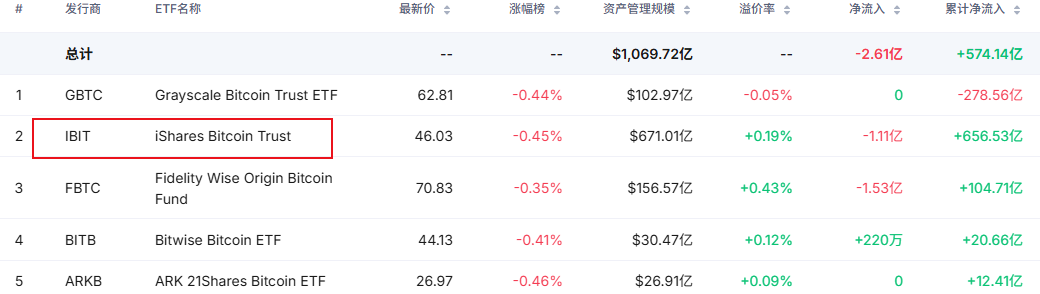
Image: BlackRock IBIT Latest Data
The Deeper Meaning of 6.38%: Incremental Capital, Lock-Up, and Pricing Power
In our view, the real weight of the 6.38% ratio lies in the fact that it simultaneously represents three things: continuous incremental capital on September 21, nearly $1 billion flowed in in a single day, marking the third consecutive month of net inflows; a lock-up effect Bitcoin in ETFs is locked by compliant custody, reducing circulating supply and supporting prices; and a transfer of pricing power when more than 6% of Bitcoin is held by professional institutions, their buying and selling behavior is becoming the marginal pricing force that dominates the market.
Our view is that 6.38% is more like a starting point. It means Bitcoin is transforming from a retail-dominated asset into a new type of major asset class continuously priced by institutions using compliant capital.
After a Hundred Billion, Is a Bitcoin ETF Still Worth Allocating?
Facing $104.8 billion in total Bitcoin ETF assets, we turn to the practical investment level to analyze capital fluctuations, potential risks, and future allocation logic.
Capital Flows Are Not All Smooth Sailing: Inflows and Outflows Coexist
Let's first look at where the volatility behind this $104.8 billion lies. Just one day before publication (US Eastern Time, October 14), spot Bitcoin ETFs saw a single-day net outflow of $261 million, with Fidelity FBTC leading outflows at $153 million. In late September, however, there were two days of massive inflows totaling $1.7 billion.
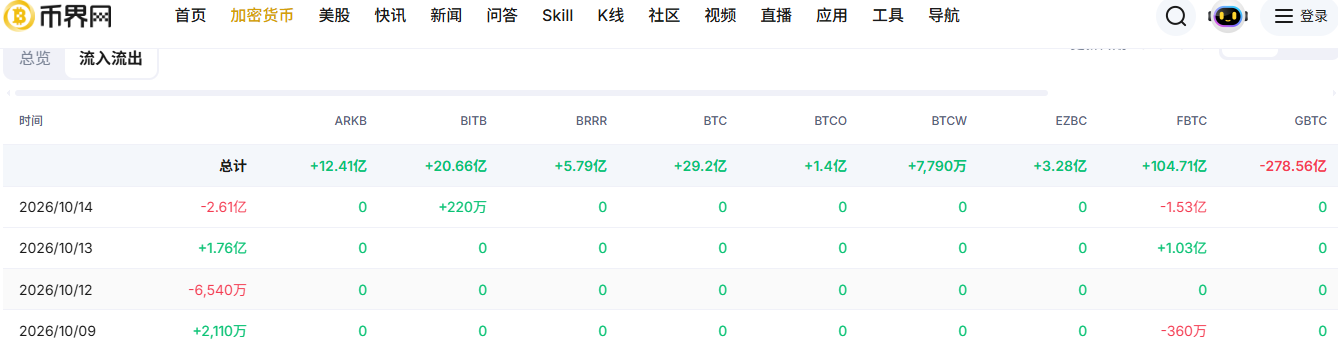
Image: October 14 Bitcoin Inflow and Outflow Data
This shows that ETF capital has obvious "pulse-like" characteristics: it surges on positive drivers and flows out during pullbacks. It amplifies market volatility rather than providing one-way support.
Three Major Risks to Understand Before Allocating
What are the risks of allocating to Bitcoin ETFs? In our view, there are three:
Price volatility: ETFs do not eliminate Bitcoin's wild swings; they may even amplify short-term procyclical stampedes.
Custody concentration: The underlying Bitcoin is concentrated among a few compliant custodians, creating single-point risk in extreme situations.Macro and regulatory risk: We note that IMF crypto asset monitoring shows that global crypto ETP total assets once fell from a peak of about $230 billion in September 2025 to $127 billion in February 2026, indicating that such assets are highly sensitive to liquidity and regulatory sentiment (IMF Connect).Bitcoin ETF Outlook
From a longer cycle perspective, the CoinMeta team estimates that if Bitcoin ETF AUM reaches $1.85 trillion in the future, the corresponding Bitcoin price range would be approximately $490,000 to $730,000. This is not a prediction, but a scenario based on linear extrapolation of demand. We speculate that as more traditional capital enters through ETFs, Bitcoin will become more tightly bound to macro liquidity and US dollar interest rates, and its dual attributes of "safe haven" and "risk asset" will be repriced.
Bitcoin ETF FAQ
What is a Bitcoin ETF?
A Bitcoin ETF is a fund listed on traditional exchanges such as those in the US, with its net asset value pegged to the spot price of Bitcoin and the underlying Bitcoin held by licensed custodians. Investors can allocate compliantly in ordinary accounts just like buying and selling stocks, without self-managing private keys. It packages crypto assets into traditional financial pipelines and is the most convenient and compliant entry point for institutions and retail investors to gain exposure to Bitcoin.
Does a larger Bitcoin ETF scale necessarily mean the price will rise?
Not necessarily. ETF scale growth does not necessarily equal directional buying; some inflows are driven by basis arbitrage, with hedge funds buying ETFs while shorting futures. Fund flows can amplify short-term volatility, but prices are still affected by multiple factors including macro conditions, halving, regulation, and liquidity.
Conclusion
What is a Bitcoin ETF? It is a compliant bridge linking traditional capital and crypto assets. Total assets of $104.8 billion and a 6.38% market cap share mean that Bitcoin's pricing power is migrating from the retail market to the institutional market. Our advice is: stay alert to multiple risks including custody, regulation, and severe price volatility, and rationally view the shift in Bitcoin's asset logic under institutional dominance.
Disclaimer: Readers are strictly advised to comply with local laws and regulations. This article is compiled based on public market data for reference and educational purposes only, and does not constitute investment advice.