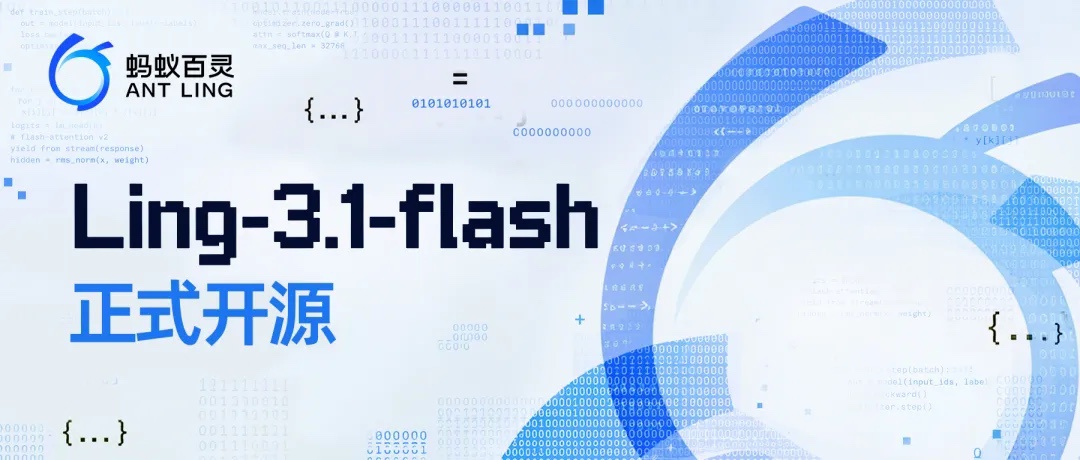
Ant Birdling announced yesterday the open-sourcing of the Ling-3.1-flash model. The total parameters of Ling-3.1-flash are approximately 560B, with each Token activation costing about 25B, and it supports up to 1M contexts.
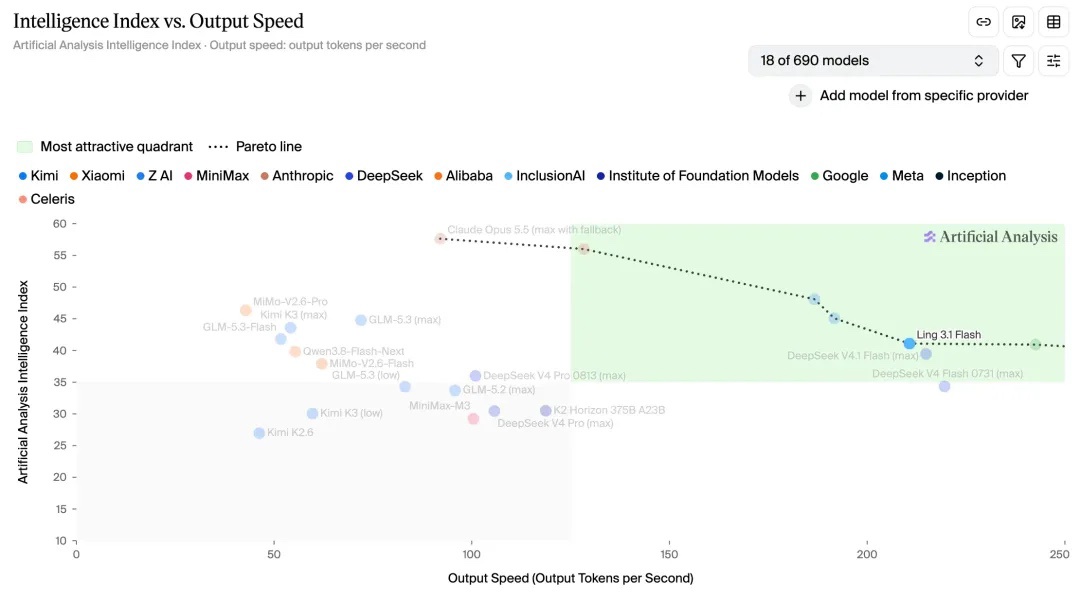
In the public evaluation of Artificial Analysis, the intelligence index of Ling-3.1-flash is 41, with an output speed of approximately 210 Token per second.
For local deployment, the team adopted MXFP4 quantization for routed and experts, and maintained block-FP8. The weight occupancy was reduced from approximately 534GB to 292GB. In the corresponding Hopper GPU test configuration, the service deployment was reduced from 8 cards to 4 cards, allowing teams with server-level GPU to run models with fewer cards; however, actual requirements may still vary depending on context, concurrency, and service configuration.
For processing long documents, the team provides a parallel reasoning solution for long contexts ( PCP / DCP ); the tool calls have also enhanced support for JSON Schema, facilitating integration with existing business interfaces.
Enterprise knowledge Q&A and office assistants often need to read longer materials first, but users still hope to see responses as quickly as possible. The team has reduced inference overhead through operator fusion and DSpark speculative decoding: in a simulated production request with an average input of about 25.47K Token, an average output of about 224 Token, and a cache hit rate of 76%, the average first Token time under an 8-core Hopper configuration was 604 milliseconds, and the average interval between consecutive outputs Token was 3.28 milliseconds. This provides a test reference for interactive responses after long material inputs.
For business systems that provide continuous services, it is also necessary to evaluate within a fixed GPU budget how many requests a single instance can handle. In a throughput test with an average input of about 8.5K Token and an average output of about 800 Token using 4 cards Hopper, the model achieved approximately 1.36 QPS. At the same time, it met the test constraints of an initial Token time of less than 3 seconds and an interval between consecutive outputs of less than 70 milliseconds Token. This provides a reference for capacity planning for self-deployed systems.
In terms of online experience, Ling-3.1-flash currently offers a limited-time 25% discount. The price after the discount is as follows:
- OpenRouter (denominated in US dollars): Input 0.075 USD; Output 0.225 USD; Cache read 0.015 USD.
- Ling Studio (denominated in RMB): Input 0.5 yuan; Output 1.5 yuan; Cache read 0.1 yuan.
IT Home with Open Source Links:
- Hugging Face : https :// huggingface.co / inclusionAI / Ling-3.1-flash
- ModelScope : https :// modelscope.cn / models / inclusionAI / Ling-3.1-flash
Related Reading: "Ant Birdling Releases Ling-3.1-flash Model: Approximately 560B Total Parameters, 25B Activation Parameters"