

In blockchain, block producers work in rotation within the network, with each one passing on information to the next. Both distance and network routes can affect the speed of this handover process. On October 14th, Solana officially released a technical study focused on SIMD-0675, exploring whether it is possible to rearrange the existing sequence without changing the number of block production windows for each validator, so that adjacent block producers are geographically closer to each other. The simulation results from the study indicated that certain parameter combinations could reduce the average handover delay. This is merely a scheme assessment; the new scheduling has not yet been implemented on the mainnet, nor has it been confirmed that all user transactions will definitely become 29 milliseconds faster as a result.
The current arrangement selects verifiers based on their stake weight, with each verifier being responsible for four time slots in a row within a single window. The random order has anti-manipulation value, but it doesn't matter whether two adjacent block producers are in the same city or separated by an ocean. The latter case will result in additional propagation time, even though computers are very fast. SIMD-0675 retains the original random selection results and only reorders the sequence of windows, attempting to find a balance between performance gains and the security benefits of randomness. It's crucial to understand that this approach does not reallocate the block-producing rights to larger nodes; what changes is the order in which blocks are produced, not the number of times a node gets to produce a block.
A faster handover might result in a more concentrated short period of time.
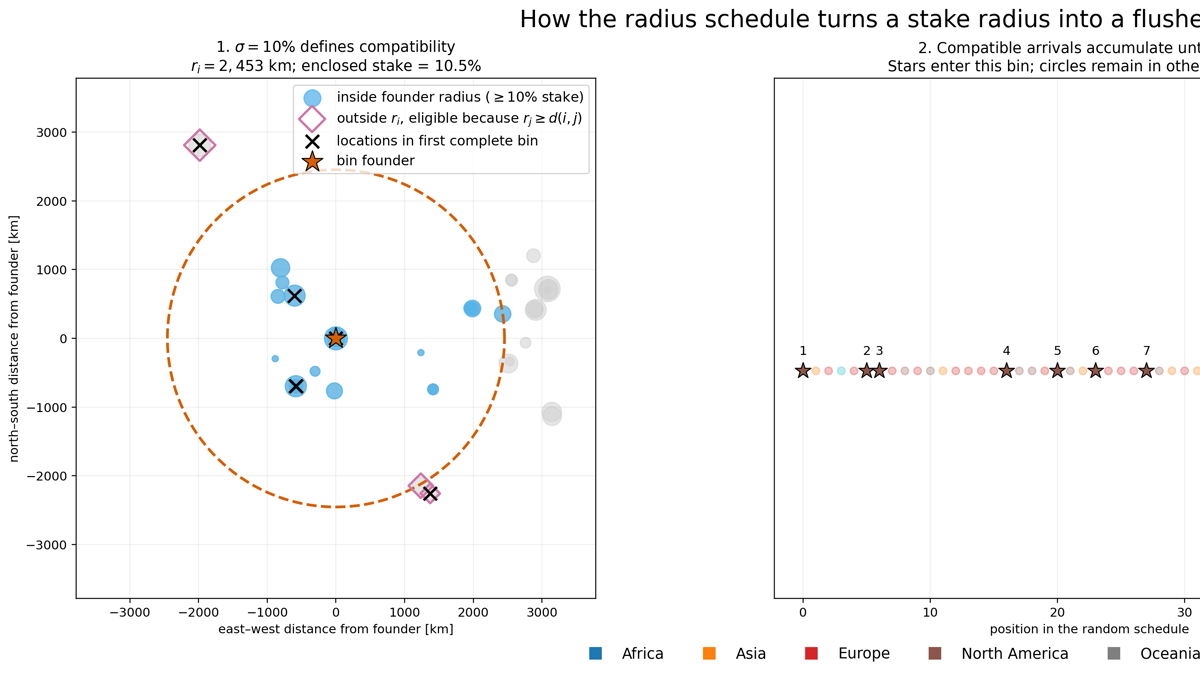
Based on the existing 124 locations of verifiers used in official research, 6,250 synthetic networks were generated to test the performance after redistributing the number of nodes and staking weights. The research recommends maintaining the STAKE_FLOOR parameter at around 10% and setting RUN_LENGTH between 3 and 7; under one of these settings, the average handover time was reduced by about 29 milliseconds compared to a random arrangement. This is the average value in a simulated scenario and should not be interpreted as a 29-millisecond improvement in the current mainnet performance, nor can it guarantee that every transaction will be confirmed more quickly as a result. Network routes, verifier locations, and actual loads are all subject to change, so simulations can only assist in selecting appropriate parameters.
The risk of rearrangement lies in the fact that adjacent miners staying in the same geographical area for an extended period or in a concentrated manner may lead to block generation opportunities favoring certain regions more frequently. When the network encounters regional failures, routing interruptions, or local censorship pressures, such concentration may not be advantageous. Therefore, research takes into account not only average latency but also geographic persistence and worst-case scenarios. It does not claim to have found a "single optimal solution" but rather seeks a compromise point between performance and risk curves. If only the fastest set of simulation results is cited, omitting the corresponding risks of concentration, readers will not be presented with a complete range of technical options.
Verifiers may also misreport their locations. If the system arranges the block order based on the reported geographical information, some nodes may have an incentive to claim they are closer to others in order to secure a more favorable handover path. The study discussed parameters that could increase the cost of such attacks and pointed out that the Asian region, which accounts for about 10.4% of staked nodes, would be affected by changes in these thresholds: if the parameters are set too high, the local scheduling advantages in Asia could disappear. The global network operates not only in the United States and Europe, and its design should not ignore other regions in favor of the average performance of one area.
From papers to the mainnet, what verifications are still missing?
Even if the simulation is significant, changes to the mainnet still require software implementation, verification by validators, compatibility testing, and deployment arrangements. What actual users experience is the total delay in transaction submission, packaging, confirmation, and front-end feedback, of which the handover between block producers is just one part. If the new order makes it easier for certain wallets or transaction senders to predict the next block producer, it may also change the transaction routing strategy and competitive behavior. The Solana research itself reminds developers that they can no longer assume that adjacent leaders are geographically independent; this means that the network assumptions at the application layer may also need to be re-examined.
For verifiers, the benefits and burdens are not evenly distributed. Verifiers in areas with sparsely distributed nodes may more easily find a nearby predecessor, reducing the cost of cross-ocean transactions; however, if the reported location does not match the actual network latency, the expected benefits will be reduced. The locations of cloud service providers' data centers, the actual routing of nodes, and the distribution of stakes are constantly changing, so parameters determined based on the current geographical distribution should not be fixed permanently. The governance process requires continuous measurement, rather than accepting a pretty performance curve as the final standard.
The most commendable aspect of this research is that it does not present “faster” as an unconditional advantage. It also highlights the costs associated with geographical concentration, false location reporting, and regional disparities. In the competition among public blockchains, performance is often measured in terms of transactions per second or in milliseconds, but security and openness are also part of performance: however, the network can become unstable under certain failures, resulting in an unreliable experience for users. The choice of parameters ultimately depends on the actual network operation, rather than a single simulated scenario.
If it enters testing in the future, acceptance should not only measure the average latency. At a minimum, it is necessary to compare verifiers from different continents and with different levels of staking, recording the median and tail of handover delays, as well as the distribution of block production within the same region over a period of time. If the average value improves but extreme handover times slow down, or if disadvantaged regions find it significantly harder to participate during certain periods, this could change the overall conclusion. Only by making these grouped results public can the community determine whether the performance improvements come at an invisible cost borne by a few regions.
As of October 16th, it is confirmed that Solana has officially released a geosensitive scheduling analysis and parameter recommendations for SIMD-0675; however, there is no evidence that this scheme has been fully implemented as a mainnet rule. Subsequent monitoring should include the review of proposals, client implementation, testnet operations, geospatial concentration indicators, and the actual handover data after its adoption on the mainnet. It is important to clearly distinguish between "research recommendations" and "changes to the protocol" to maintain the proper context of this technical news.