

SpaceX ( SPCX.O ) and Tesla ( TSLA.O ) will release their third-quarter financial reports this week, allowing investors to examine the operating conditions of two of Musk's most valuable companies at the same time, a rare occurrence.
As discussions about a potential merger between the two companies heat up, market attention has shifted from merely quarterly earnings to a more direct question: Whether the growth of Starlink and the cash generated by Tesla's automotive business will be sufficient to support Musk's ongoing investments in artificial intelligence.
SpaceX will announce its financial results after the US stock market closes on Tuesday this week, followed by Tesla, which will release its financial report after the US stock market closes on Wednesday. Camelthorn Investments Advisor Sean Campbell ( Shawn Campbell ) stated that for investors, the most important indicator is Starlink revenue growth, rather than the number of launches; Tesla, on the other hand, needs to prove that its automotive business's profit margin can improve.
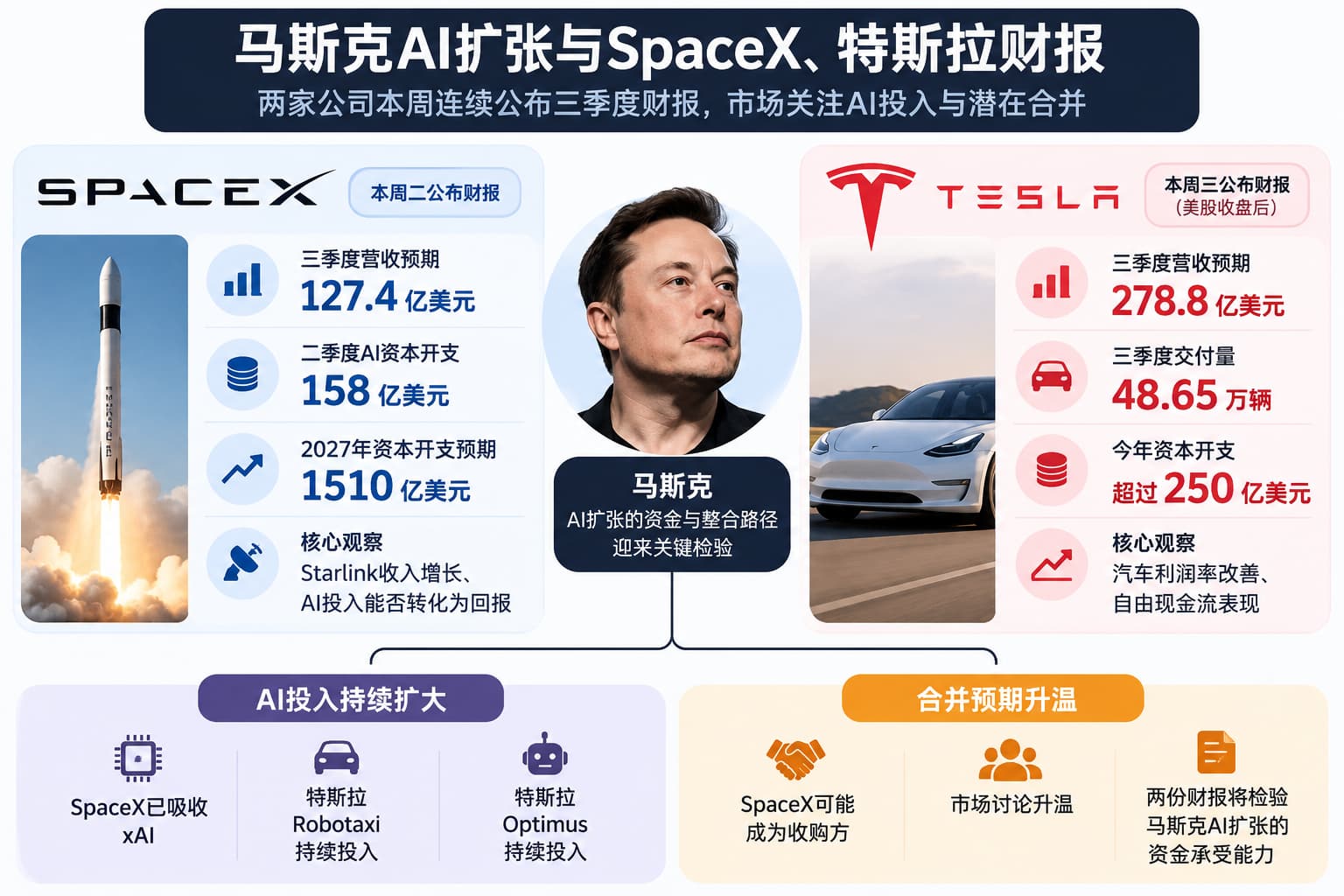
The expectation of a merger between the two companies also makes the connection between their financial reports even closer. Barclays suggested last week that the transaction between the two companies could be announced before Tesla's annual shareholders' meeting, with SpaceX being more likely to act as the acquirer. However, neither SpaceX, Tesla, nor Musk has officially committed to advancing the related transaction.
Tesla stated on Monday this week that its annual general meeting of shareholders will be held on December 3. Barclays estimates that if the transaction is conducted in the form of all-stock exchanges, Musk may hold approximately 37% of the equity in the merged company and control about 56% of the voting rights.
Campbell believes that the transaction structure for the acquisition of Tesla by SpaceX is relatively easy to handle, one of the factors being the ability to arrange Tesla's China business more independently. However, this judgment is still merely market analysis at present and is not a plan that has been finalized by both companies.
SpaceX Artificial Intelligence Capital Expenditure Expands Dramatically
SpaceX This is only the second time the financial report has been released since the company went public. According to data summarized by LSEG, analysts expect the company's revenue for the third quarter to be approximately $12.74 billion, with earnings per share at around 14 cents.
In the second quarter, SpaceX reported revenue of $7.8 billion and a net loss of $541 million, with capital expenditures related to artificial intelligence reaching $15.8 billion. As the company continues to invest more funds in the AI infrastructure, the market will closely monitor whether these investments begin to translate into revenue.
Evercore ISI predicts that by the end of 2026, the annualized revenue operating rate of SpaceX could reach approximately $104 billion, with the artificial intelligence business contributing the main increase. The institution also estimates that SpaceX capital expenditures in 2027 may further rise to about $151 billion.
Starlink remains an important source of cash flow and growth for SpaceX. In the second quarter, connect business revenue, including that from Starlink, increased by 66% year-over-year to reach $4.3 billion.
On October 8th, SpaceX still agreed to purchase 800 MHz spectra from Grain Management for approximately $8 billion. This transaction still requires approval from the US Federal Communications Commission, and the related spectra will support the business expansion of Starlink Mobile.
SpaceX went public in June this year, and its current stock price is still above the issuance price of $135 for IPO, but it has clearly fallen below its peak after going public. Previously, in February, the company acquired xAI under Musk, which further tilted SpaceX's capital expenditures and business structure towards artificial intelligence.
Tesla's car profits and free cash flow are under pressure.
Compared to SpaceX, Tesla faces more challenges that are focused on the profitability of its existing business. Analysts expect the company's revenue for the third quarter to be around $27.88 billion, with an adjusted earnings per share of about 43 cents, which is lower than the 50 cents from the same period last year.
Tesla's car deliveries this year are expected to see year-over-year growth for the first time since 2023. The company delivered 486,532 cars in the third quarter, exceeding analysts' previous forecasts. However, whether the improvement in car sales will lead to higher profit margins remains an important indicator to watch in this financial report.
In the second quarter, Tesla's profits fell significantly below expectations, with free cash flow at -$1.1 billion, marking the first time in over two years that it has turned negative. The company has stated that its capital expenditures this year will exceed $25 billion, while analysts predict that free cash flow in the third quarter may further decline to -$4.92 billion.
Tesla's stock price has fallen by approximately 17% this year. Compared to short-term car sales, Wall Street has in recent years placed more emphasis on Robotaxi and Optimus humanoid robots as important variables for assessing the company's long-term growth. These projects are seen as potential high-profit businesses, but their current scale is still limited, with the majority of Tesla's revenue still coming from its car business.
At present, Robotaxi has significantly fewer vehicles and a smaller scale of operations compared to Waymo. In contrast, Tesla plans to expand the deployment of autonomous taxis over the next few years.
REX Financial Research Director Bill Birmingham ( Bill Birmingham ) believes that this showcase has enhanced the imagination of the integration between automotive and rocket technologies, and also provides a narrative at the level of engineering efficiency for potential mergers. He thinks that holding this announcement before Tesla's annual shareholders' meeting has clear timing significance.
Currently, the revenue sources of SpaceX include rocket launches, Starlink, and artificial intelligence computing power. Tesla mainly relies on its automotive and energy storage businesses. There are still significant differences in the business models of the two companies. However, as SpaceX absorbs xAI and capital continues to flow towards artificial intelligence, the overlap in terms of funding needs and technological investment between the two companies is expanding.